
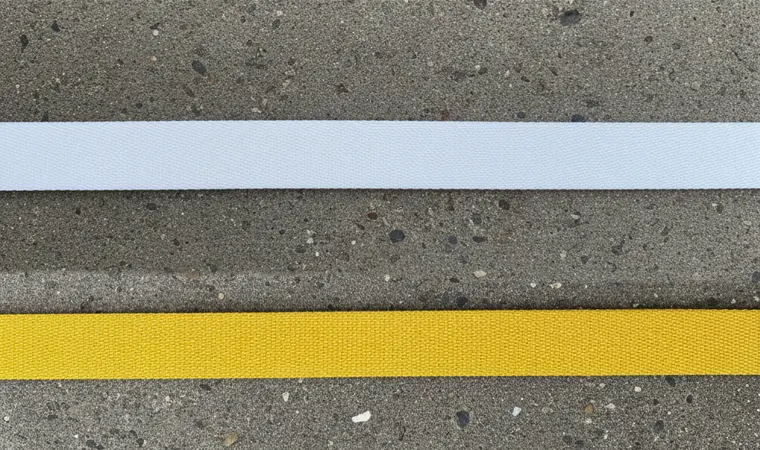
In the world of high-performance technical textiles, two giants dominate the field: Aramid (best known by the brand Kevlar®) and UHMWPE (best known by the brand Dyneema® or Spectra®). As a webbing manufacturer, we often see customers using these terms interchangeably, calling for "super strong webbing."
However, choosing the wrong one can be disastrous. Imagine using a low-melting-point strap for a firefighter's harness, or a heavy, water-absorbing strap for a competitive racing sail.
At TMG Webbing, we weave both materials daily. This guide will strip away the marketing hype and compare them purely on factory-level technical properties to help you make the right engineering decision.
At a Glance: The Quick Comparison Chart
| Feature | Aramid (Kevlar®, Technora®) | UHMWPE (Dyneema®, Spectra®) |
|---|---|---|
| Primary Strength | Heat Resistance | Strength-to-Weight Ratio |
| Melting Point | Does not melt (Decomposes >500°C) | Low (~145°C / 293°F) |
| Water Interaction | Absorbs water, Sinks | Hydrophobic, Floats |
| UV Resistance | Poor (Needs coating) | Excellent |
| Stretch (Creep) | Very Low (No Creep) | Low (Can creep under static load) |
| Cost | $$$ High | $$$$ Very High |
Round 1: Heat Resistance (The Dealbreaker)
This is the most critical difference. If your product involves fire, friction heat, or high temperatures, the choice is made for you.
Aramid (Kevlar®) 🔥
Aramid is inherently flame retardant. It does not melt or drip; it simply chars when temperatures exceed 500°C. This makes Aramid webbing the only choice for:
- Firefighter safety harnesses and breathing apparatus straps.
- Welding aprons and industrial protection.
- Aerospace components exposed to engine heat.
- Stunt and movie rigging where friction heat is high.
UHMWPE (Dyneema®) ❄️
UHMWPE is a thermoplastic polyethylene. While it is incredibly strong, its Achilles' heel is heat. It begins to lose strength at just 80°C and melts around 145°C. Do not use UHMWPE webbing for friction hitches, rappelling devices that generate heat, or firefighter gear.
Round 2: Strength, Weight, and Water
If heat isn't a concern, and your goal is purely "lightest and strongest," UHMWPE takes the crown.
UHMWPE (Dyneema®) 🌊
Pound for pound, UHMWPE webbing is 40% stronger than Aramid and 15 times stronger than steel. Crucially, it has a specific gravity of 0.97, meaning it floats on water. It is also hydrophobic, meaning it doesn't absorb water or get heavy when wet. This is why it dominates:
- Marine rigging and sailcloth.
- Ultralight climbing slings (Alpine runners).
- Tow straps for off-road recovery (easier to carry than steel chains).
Aramid (Kevlar®) ⚓
Aramid is still 5-7 times stronger than steel, but it is heavier than UHMWPE (Specific gravity ~1.44). It sinks in water and can absorb up to 4% of its weight in moisture, which can slightly affect its strength over time if constantly wet.
Round 3: Durability (UV and Flex Fatigue)
UV Resistance
Winner: UHMWPE. UHMWPE is highly resistant to UV degradation and can be left outdoors for years with minimal strength loss.
Loser: Aramid. Unprotected yellow Kevlar turns brown and degrades rapidly in sunlight. If you use Aramid outdoors, it must be protected by a black polyester jacket or a specialized coating.
Creep (Elongation over Time)
Winner: Aramid. Aramid has virtually no creep. If you hang a heavy static load on it for a year, it won't stretch.
Loser: UHMWPE. While it has low elastic stretch, UHMWPE suffers from "creep" (plastic deformation) under constant heavy load over long periods. (Note: Newer grades like Dyneema® SK99 have improved this significantly).
The Verdict: Which Should You Source?
✅ Choose Aramid (Kevlar®) if:
- You are making Fire & Safety equipment (harnesses, helmets).
- The application involves high friction or proximity to heat sources.
- You need absolute static stability (no creep) over long periods.
- You need cut resistance in an industrial setting (e.g., handling glass or steel).
✅ Choose UHMWPE (Dyneema®) if:
- Weight reduction is your #1 priority (Ultralight backpacking, aerospace).
- The product is used in a marine environment (needs to float/not absorb water).
- You need the absolute highest breaking strength possible in the thinnest width.
- The product will be exposed to UV sunlight constantly without a protective cover.
At TMG Webbing, we manufacture both. We can weave high-temp Aramid for your foundry workers and ultralight UHMWPE for your kite-surfing lines. We can even do hybrid weaves!
Still unsure? Let our engineers do the calculation for you. Contact us today with your project requirements.
Custom Webbing Orders
Custom webbing MOQ: 3,000 meters. Standard production lead time: 15 days after specification and sample approval. Confirm the delivery schedule for your exact order. Stock availability and finished-product quantities are quoted separately.
TMG Webbing holds GRS and OEKO-TEX STANDARD 100 certificates. Ask us to confirm the current certificate, holder and article scope for your material, color and finish. Recycled-content claims and transaction documentation depend on the order.