
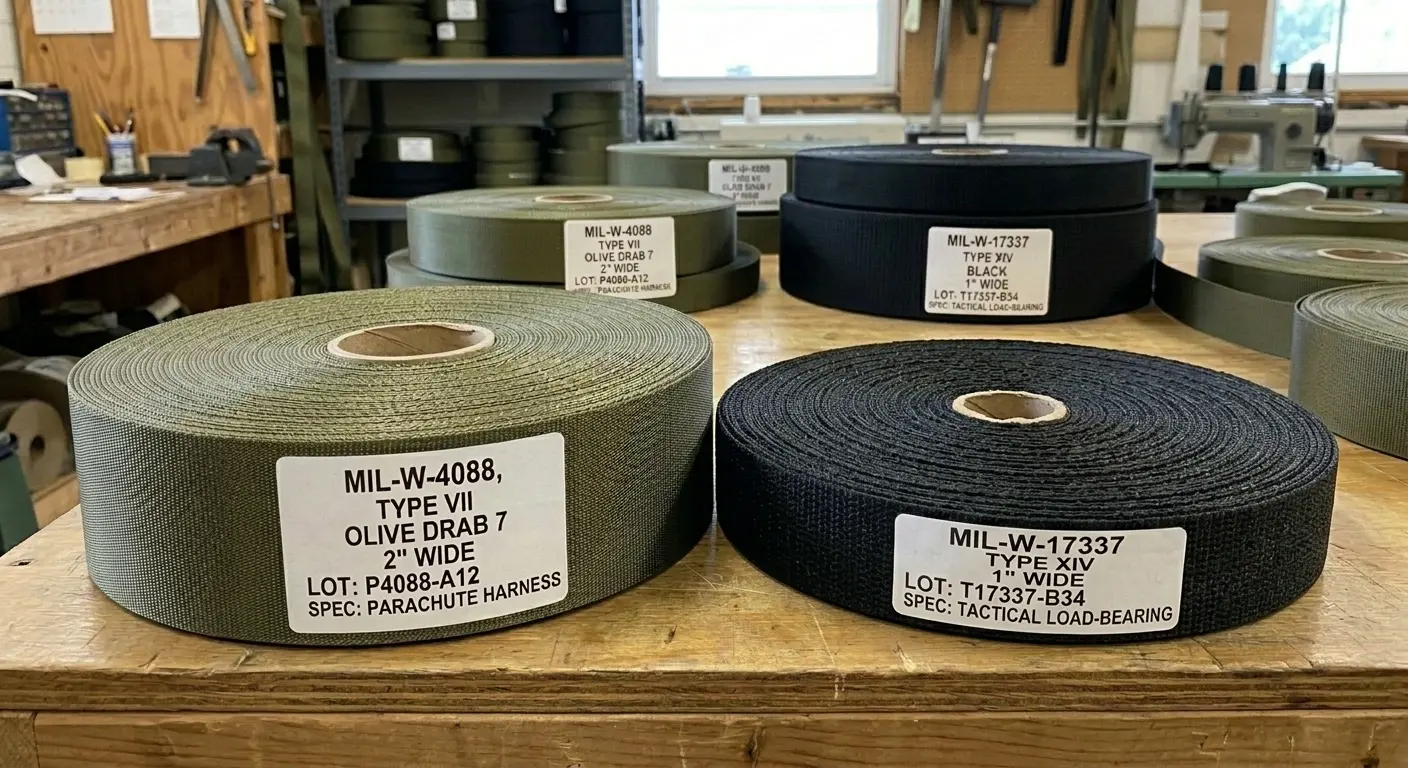
In defense procurement, confusing one military specification for another is not a trivial mistake. Specify MIL-W-4088 when you need parachute harness webbing, and you get a completely different product than if you specified MIL-W-17337. Both are mil-spec nylon webbing. Both carry the "MIL" prefix. But their tensile strength requirements, elongation limits, construction tolerances, and intended applications are substantially different—and procurement officers who get this wrong face rejected submittals, failed QA audits, and schedule delays that can cost millions in defense contracts.
This guide provides the definitive technical comparison between these two standards, updated to account for the fact that MIL-W-17337 has been officially superseded—and what that actually means for your supply chain.
First: What These Standards Actually Are
Both MIL-W-4088 and MIL-W-17337 are U.S. Department of Defense (DoD) military specifications (Mil-Specs) that define requirements for woven nylon webbing. They cover material composition, construction geometry, breaking strength, elongation, dimensional tolerances, finishing treatments, and quality verification procedures.
Think of them as two different "recipes" for webbing—each optimized for different operational requirements. A parachute harness webbing and a tactical PALS grid webbing face completely different load profiles, and the specs reflect that.
MIL-W-4088: The Parachute & Life-Safety Standard
Status: Active (current revision: MIL-W-4088K)
MIL-W-4088 governs webbing used in personnel safety and life-critical systems: parachute harnesses, restraint harnesses, safety belts, bomb hoist slings, cargo extraction harnesses, and mine-laying parachute gear. Because failure in these applications is literally life-threatening, MIL-W-4088 is the more demanding of the two specs.
Key Characteristics of MIL-W-4088
- Material: High-tenacity Nylon 6.6 yarn, Type 6.6 is mandatory for most types. The spec is strict about denier (yarn thickness) and tenacity (strength-to-weight ratio).
- Type Classification: MIL-W-4088 defines webbing by "Type" (Roman numerals: Type I, Type II, Type III, and so on up to Type XXVII+). Each type specifies a specific minimum breaking strength, width, and elongation range. Type 18 and Type 27 are among the most common for parachute harness use, with breaking strengths exceeding 6,000 lbs for wider widths.
- Breaking Strength: By far the most demanding spec. Strength tables are organized by Type and width, with minimum breaking strengths that can exceed 9,000 lbs for the heaviest types. This is not marketing copy—"minimum breaking strength" here means the webbing must not fail below this value under ASTM D805 testing conditions.
- Elongation: Controlled to a specific range (typically 15–30% at breaking load). This is a critical performance parameter: too much stretch makes a parachute harness unstable; too little means the webbing cannot absorb deployment shock. MIL-W-4088 types are designed for controlled energy absorption.
- Berry Amendment Compliance: For DoD procurement, MIL-W-4088 is inherently Berry Amendment compliant. The spec requires U.S.-origin nylon yarn, which satisfies the Buy American / Berry Amendment requirements for defense contracts.
- Width Range: Covers widths from 3/4 inch up to 3+ inches, with precise dimensional tolerances (typically ±0.031 inch).
- Finishing: Types may include para-aramid reinforcement in stitching areas, water-repellent treatments, and mildew-resistant finishes.
Typical Breaking Strength by Width (MIL-W-4088, common types)
The following table shows representative minimum breaking strengths for 1-inch and 2-inch widths across several MIL-W-4088 Type classifications. Actual values vary by Type designation—consult the full specification for your specific Type:
| MIL-W-4088 Type | Width | Min. Breaking Strength (lbs) | Typical Elongation | Primary Use |
|---|---|---|---|---|
| Type I | 3/4" | 1,000–1,200 | 15–25% | Pack trays, container reinforcement |
| Type VII | 1" | 2,500 | 15–25% | Light harness, safety belts |
| Type XVIII | 1-3/4" | 5,000 | 20–30% | Main harness, riser attachment |
| Type XXVII | 2" | 7,500–8,000 | 20–30% | Heavy-duty parachute harness |
| Type XXXIII | 2-1/2" | 9,000+ | 20–30% | Cargo extraction, heavy-load harnesses |
The critical insight here is that within MIL-W-4088, strength varies more by Type than by width alone. A 3/4-inch Type XVIII webbing will outperform a 2-inch Type I webbing. This is why specifying "MIL-W-4088" without the Type designation is incomplete procurement language.
MIL-W-17337: The General-Purpose Tactical Standard
Status: Superseded (replaced by A-A-55301, see section below)
MIL-W-17337 was a DoD specification for general-purpose woven nylon webbing used in tactical equipment, equipment straps, PALS (Pouch Attachment Ladder System) grid webbing, and non-life-safety military applications. It was less demanding than MIL-W-4088 in breaking strength and elongation control, reflecting its use in equipment where load-bearing is important but not life-critical.
Key Characteristics of MIL-W-17337
- Material: Nylon (Type 6.6 preferred, though the spec allowed some flexibility). Material requirements are less prescriptive than MIL-W-4088.
- Class System: MIL-W-17337 used a Class designation (not Type) to distinguish webbing categories:
- Class 1: Non-elastic flat woven webbing—the standard tactical webbing most buyers are familiar with.
- Class 2: Woven elastic webbing with built-in stretch, used in adjustable straps and securing applications where some give is desired.
- Breaking Strength: Lower than MIL-W-4088 across comparable widths. For a standard 1-inch Class 1 width, minimum breaking strength is approximately 1,200 lbs—comparable to a light MIL-W-4088 Type, but with less stringent elongation control.
- Elongation: Less tightly controlled than MIL-W-4088. Class 2 elastic webbing is designed for stretch, but even Class 1 allows wider variation than parachute-grade specs.
- Thickness: MIL-W-17337 webbing is typically thinner and more flexible than MIL-W-4088 equivalent widths. A 1-inch MIL-W-17337 webbing runs approximately 0.039–0.053 inch thick, compared to 0.055–0.080+ inch for MIL-W-4088 types of similar width.
- Berry Amendment: Originally a full DoD Mil-Spec, but compliance depends on the specific procurement contract. Not all MIL-W-17337 webbing in the market is Berry-compliant.
Head-to-Head: The Key Differences at a Glance
Now the comparison that actually matters for procurement decisions:
| Criterion | MIL-W-4088 | MIL-W-17337 / A-A-55301 |
|---|---|---|
| Status | Active (MIL-W-4088K) | Superseded by A-A-55301 |
| Classification System | Type (I through XXVII+) | Class (1 = flat, 2 = elastic) |
| Primary Application | Parachute harnesses, safety belts, life-safety gear | Tactical equipment, PALS grid, general military straps |
| 1" Breaking Strength | 1,000–2,500+ lbs (by Type) | ~1,200 lbs (Class 1) |
| Maximum Breaking Strength | 9,000+ lbs (Type XXXIII, 2-1/2") | ~2,500 lbs (widest available) |
| Elongation Control | Tight range (15–30% by Type) | Wider tolerance; Class 2 is stretch |
| Typical Thickness (1") | 0.055–0.080+ inch | 0.039–0.053 inch |
| Weave Density | High; tighter, heavier construction | Moderate; lighter, more flexible |
| Berry Amendment | Inherently compliant (U.S.-origin nylon) | Contract-dependent |
| Shock Absorption | Engineered for controlled energy absorption | Not a design priority |
| Cost | Higher (tighter specs, U.S.-origin, more yarn) | Lower (less demanding, more sourcing options) |
The A-A-55301 Update: What "Superseded" Actually Means
If MIL-W-17337 is superseded, what should you specify instead? The answer is A-A-55301.
A-A-55301 is a Commercial Item Description (CID) adopted from the original MIL-W-17337 specification. It was created to ease procurement for commercial and defense buyers by replacing the more rigid Mil-Spec process with a commercially-oriented document. A-A-55301 retains the core technical requirements of MIL-W-17337—same material grades, same Class 1/Class 2 structure, similar breaking strength tables—but updates the language to align with modern commercial procurement practices.
Key implications:
- For new procurement: Specify A-A-55301 instead of MIL-W-17337. This is the correct and current designation.
- For legacy contracts: MIL-W-17337 may still appear in older RFQs and contract documents. Ask the contracting officer whether a "tailored" or "converted" requirement allows substitution with A-A-55301 compliant webbing.
- For equivalency: A-A-55301 webbing is functionally equivalent to MIL-W-17337 webbing for most practical purposes. If your specification references MIL-W-17337 but you source A-A-55301 material, most quality inspectors will accept it—provided the breaking strength and construction meet the original intent.
- For safety-critical applications: If your equipment requires parachute-grade performance, neither MIL-W-17337 nor A-A-55301 is the right choice. You need MIL-W-4088.
When to Use Which Standard: A Decision Framework
This is the question that matters most in practice. Use this framework:
Choose MIL-W-4088 when:
- Your equipment is a life-safety system (personnel parachute, restraint harness, fall arrest belt, rescue hoist sling)
- The procurement contract is DoD-funded and Berry Amendment applies
- You need controlled elongation within a tight range to manage deployment shock or energy absorption
- Breaking strength requirements exceed 2,500 lbs at any load point
- The end-user is US Army, US Air Force, US Navy, or a Tier 1 defense prime with explicit parachute specifications
- You are manufacturing for a Type Certificate or Technical Order (TO) that explicitly names MIL-W-4088
Choose MIL-W-17337 / A-A-55301 when:
- Your equipment is tactical gear, load-bearing straps, PALS webbing, or general military hardware—not life-critical
- You need flexible, lightweight webbing for equipment that soldiers carry or wear (vests, packs, holsters)
- The specification in the contract explicitly names MIL-W-17337 or A-A-55301
- You need elastic/stretch webbing (Class 2 under A-A-55301)
- Your procurement is for allies or coalition partners where Berry Amendment does not apply
Common Mistake to Avoid
Many buyers order "MIL-W-17337 webbing" for a parachute application because they know it's a military spec and they need nylon. This is a serious error: MIL-W-17337 webbing is not designed for the dynamic loads and shock absorption required in parachute systems. The result can be a harness that passes static strength tests but fails in the field due to excessive elongation or poor energy management under deployment loads. Always verify the specification against the actual equipment drawing or Technical Order before ordering.
Sourcing Checklist: Questions to Ask Your Supplier
Whether you're sourcing MIL-W-4088, MIL-W-17337, or A-A-55301 webbing, ask these questions to separate a qualified manufacturer from a reseller:
- "What is the exact Type or Class designation, and can you provide a Certificate of Conformance (CoC)?" A CoC signed by QA personnel confirming the lot meets the specification is the minimum documentation you should receive.
- "What is the breaking strength per lot, and do you test every batch?" Quality manufacturers pull-test samples from every production lot. Be wary of suppliers who only provide "typical values" rather than actual test results.
- "What is the elongation at break for this material?" For MIL-W-4088, this must fall within the Type-designated range. For MIL-W-17337/A-A-55301, this confirms the Class designation (Class 2 elastic webbing will have significantly higher elongation).
- "Do you have Berry Amendment documentation for DoD contracts?" If you're supplying to a U.S. defense contractor, the supplier must be able to certify the nylon yarn origin. Ask for raw material certifications from the yarn supplier.
- "What width and thickness tolerances do you hold?" MIL-W-4088 requires tight dimensional tolerances (±0.031 inch). MIL-W-17337/A-A-55301 allows somewhat wider tolerances, but for PALS grid applications, consistency is still critical.
- "Can you provide lot traceability back to the yarn source?" For defense contracts, you need to trace every spool of yarn to its manufacturing lot. If the supplier cannot provide this, they are likely a trader, not a manufacturer.
- "Do you perform colorfastness testing?" Military colors (olive drab, coyote brown, ranger green) must not bleed or fade under UV exposure or saltwater. Ask for test reports on colorfastness to wash, light, and saltwater.
TMG Webbing: Mil-Spec Manufacturing Capability
We manufacture nylon webbing meeting MIL-W-4088 (Type VII through Type XVIII) and A-A-55301 Class 1 specifications in widths from 3/4 inch to 2-1/2 inch. Our production lots include mandatory breaking strength and elongation testing with full traceability to raw material certificates. We provide Berry Amendment compliant documentation for DoD contracts and can produce in IR-reflective (IRR) versions for tactical applications.
If you're sourcing for a parachute program, tactical vest, or any military application that requires a specific Mil-Spec designation, contact our technical team with your Type/Class requirement, width, color, and quantity. We will provide a Certificate of Conformance with every order.