
For tactical gear manufacturers, sourcing MultiCam® webbing is often a point of confusion. The market is flooded with cheap imitations that fade after a week of use or glow like a flare under night vision goggles. As a professional military webbing manufacturer, TMG Webbing understands that for Mil-Spec contracts, "looking close enough" isn't good enough.
This guide explains the critical differences in manufacturing processes—specifically Jacquard Weaving vs. Surface Printing—and why IRR (Infrared Reflective) compliance is non-negotiable for modern combat gear.
The Core Conflict: Jacquard Weaving vs. Surface Printing
Not all camouflage webbing is created equal. There are two main ways to apply the MultiCam® pattern to nylon webbing, and the difference in quality is massive.
1. Surface Printing (The "Cheap" Way)
This method involves taking standard white or tan webbing and printing the pattern onto one side using heat transfer or screen printing.
- The Flaw: The ink only sits on top. When the webbing is scratched or abraded (which happens constantly with tactical gear), the white nylon underneath is exposed, ruining the camouflage.
- The "White Edge" Problem: Because the ink doesn't penetrate deep, the edges of the webbing often show white lines, creating a visual contrast that breaks concealment.
2. Jacquard Weaving (The TMG Way)
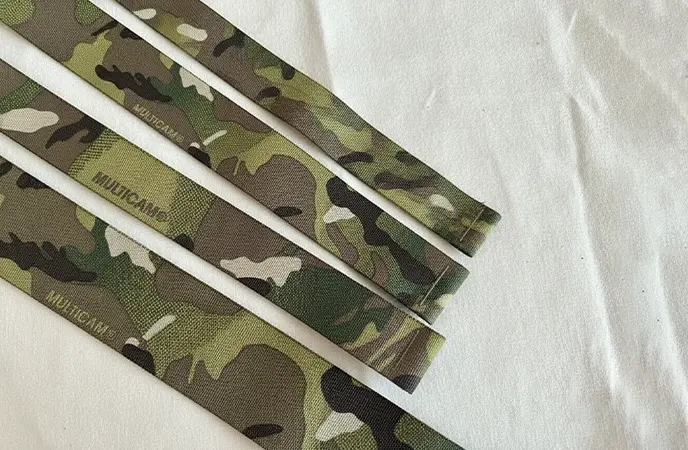
This is the professional standard. We use pre-dyed yarns in the specific MultiCam® color palette (Urban Grey, Desert Tan, etc.) and weave them together to create the pattern structurally.
- Double-Sided Camouflage: The pattern is visible on both sides (often with a reverse variant on the back), making it ideal for non-backed straps.
- Permanent Durability: The pattern is the fabric. It cannot scratch off, peel, or fade. Even if the webbing is cut or worn down, the color remains consistent all the way through.
Technical Specs: What is IRR Compliance?
IRR (Infrared Reflective) compliance refers to the webbing's ability to reflect infrared light at the same rate as the surrounding environment (like leaves or soil) when viewed through Night Vision Devices (NVDs).
If you use standard dyes, your MultiCam® webbing might look perfect in daylight, but under NVDs operating in the 650nm to 1200nm spectral range, it could appear pitch black or bright white. TMG uses specialized formulations to ensure our webbing maintains its camouflage properties across the Near-Infrared (NIR) spectrum.
| Feature | Printed MultiCam® Webbing | TMG Jacquard MultiCam® Webbing |
|---|---|---|
| Low (Scratches off) | Lifetime (Structural) | |
| Visual Edges | White edges often visible | Full edge-to-edge color |
| Texture | Smooth / Slippery | Textured / Matte Finish |
| IRR Reliability | Inconsistent | High (Yarn-level control) |
| Best For | Fashion / Airsoft | Military / Law Enforcement |
Standards We Meet
When sourcing for government contracts, refer to these standards. TMG webbing is designed to meet or exceed:
- A-A-55301: The standard for nylon webbing used in load-bearing equipment.
- MIL-W-17337: The classic thin nylon webbing standard for backpacks and PALS grids.
Don't Compromise on Camouflage
Building a plate carrier or tactical belt? Ensure your webbing meets the same standards as the rest of your gear. Request a sample of our Jacquard Woven, IRR-Compliant MultiCam® webbing.
Request Authentic SamplesConclusion
Sourcing authentic MultiCam® webbing is about more than buying a license; it's about buying a manufacturing capability. By choosing Jacquard weaving technology over cheap printing, you ensure your product survives the harsh reality of the field.
Ready to upgrade your supply chain? Contact TMG Webbing for factory-direct tactical textile solutions.