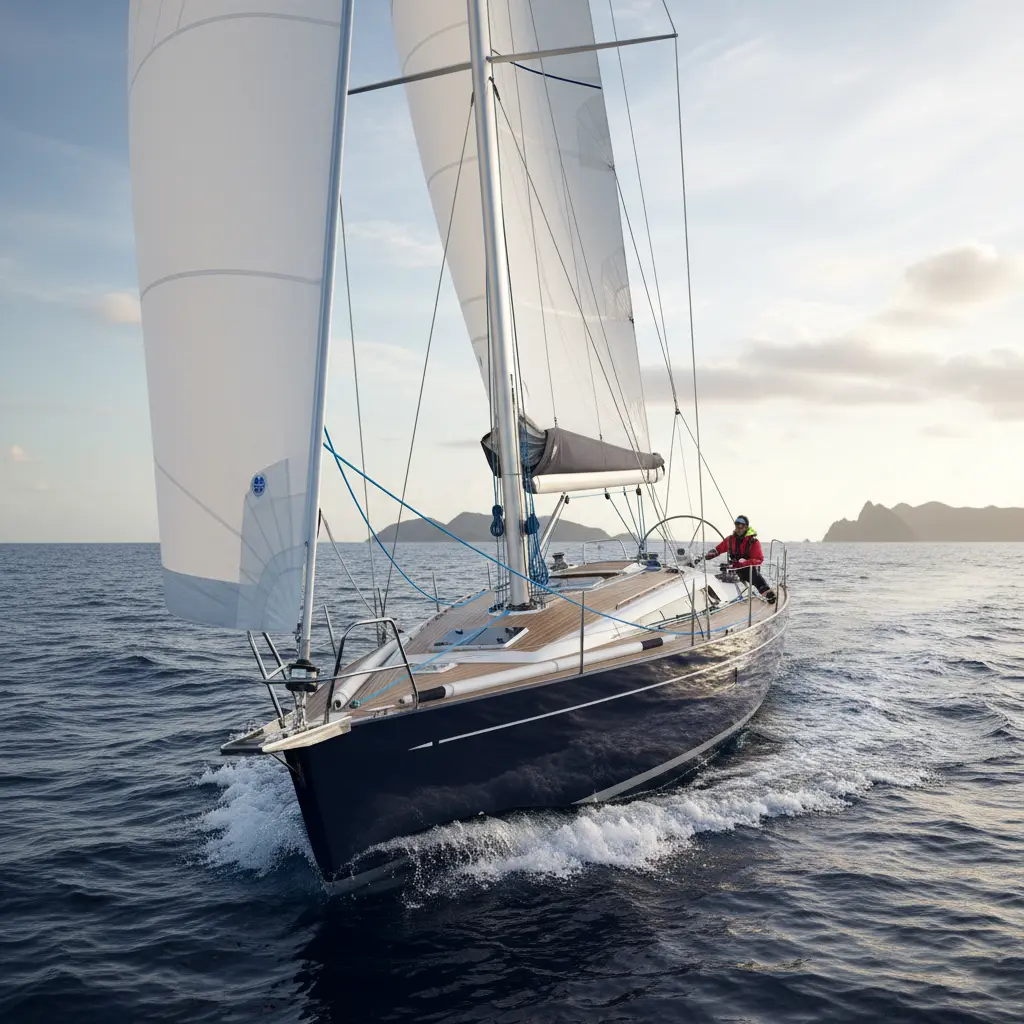
For decades, the marine industry relied on stainless steel for strength and polyester for handling. But a quiet revolution has taken place on the decks of racing yachts and supertankers alike. The shift to UHMWPE (Ultra-High Molecular Weight Polyethylene)—often known by the brand name Dyneema®—is no longer just a trend; it is the new standard for high-performance marine applications.
Why are boat builders and riggers switching from steel cables and polyester straps to UHMWPE webbing? The answer lies in physics: it offers the strength of steel at 1/7th of the weight, and unlike traditional fibers, it loves the ocean.
1. The Enemy is Water: Hydrophobicity Matters
In the marine environment, water is the constant challenge. Traditional materials like Nylon absorb water (up to 4% by weight). When wet, Nylon loses up to 15% of its breaking strength and becomes heavy. Even Polyester, while better, still holds some surface moisture.
The UHMWPE Advantage:
- 0% Water Absorption: UHMWPE is hydrophobic. It does not absorb water. A wet strap weighs the same as a dry strap.
- Floats on Water: With a specific gravity of 0.97, if you drop a UHMWPE gear overboard, it floats. This is crucial for recovery lines and dinghy tow straps.
- No Hydrolysis: It does not break down chemically when exposed to water for long periods.
2. Replacing Steel: Corrosion vs. Inertness
Stainless steel rigging suffers from crevice corrosion and fatigue—issues that are often invisible until catastrophic failure occurs. Saltwater accelerates this process.
UHMWPE is chemically inert. It is impervious to salt, fuel, oil, and most acids found on a boat. For applications like soft shackles, loop strops, and lashings, replacing metal hardware with textile solutions eliminates rust stains on the deck and reduces the danger of heavy metal swinging around during a storm.
3. Key Marine Applications for UHMWPE Webbing
The Safety Essential: Jacklines (Deck Safety Lines)
This is perhaps the most critical use of flat webbing on a boat. Jacklines run the length of the deck for sailors to clip their harnesses onto.
Why Flat UHMWPE Webbing?
While some use wire or rope, round profiles are dangerous—they roll underfoot, acting like ball bearings that can cause a sailor to slip overboard. Flat UHMWPE webbing lies flat on the deck, offers superior chafe resistance against non-skid surfaces, and has zero stretch, ensuring the sailor isn't thrown far if they fall.
Sail Ties & Lashings
Because UHMWPE is slippery (low friction), it slides easily over sailcloth without causing chafe or wear. It is ideal for high-load lashings where you need to attach blocks to the deck without heavy metal pad eyes.
Diving Weight Belts
Technical divers require gear that can withstand jagged wrecks and coral. UHMWPE webbing provides superior cut resistance compared to standard nylon belts, ensuring that weights stay secure even in abrasive environments.
4. Technical Comparison: Polyester vs. UHMWPE
For a sourcing manager, the numbers speak for themselves. Here is how marine-grade Polyester compares to our Marine-Spec UHMWPE:
| Property | Marine Polyester | Marine UHMWPE |
|---|---|---|
| Strength (25mm width) | ~2,500 kg (Standard) | ~6,000 kg (Ultra High) |
| UV Resistance | Excellent | Very Good |
| Stretch at 30% Load | ~5-8% | ~1% (Static Precision) |
| Specific Gravity | 1.38 (Sinks) | 0.97 (Floats) |
| Cost | $ Low | $$$ High |
Conclusion: Upgrading Your Fleet
While Polyester remains the economical choice for general-purpose tie-downs and bimini straps, UHMWPE webbing is the mandatory choice for high-load, safety-critical, and performance-driven marine applications.
At TMG Webbing, we understand the ocean. Our marine webbing is tested for UV degradation and salt spray resistance to ensure it survives the harshest conditions from the Southern Ocean to the tropics.
Ready to upgrade your marine product line? Contact us today for samples of our high-strength Jackline webbing and soft shackle materials.
Custom Webbing Orders
Custom webbing MOQ: 3,000 meters. Standard production lead time: 15 days after specification and sample approval. Confirm the delivery schedule for your exact order. Stock availability and finished-product quantities are quoted separately.
TMG Webbing holds GRS and OEKO-TEX STANDARD 100 certificates. Ask us to confirm the current certificate, holder and article scope for your material, color and finish. Recycled-content claims and transaction documentation depend on the order.