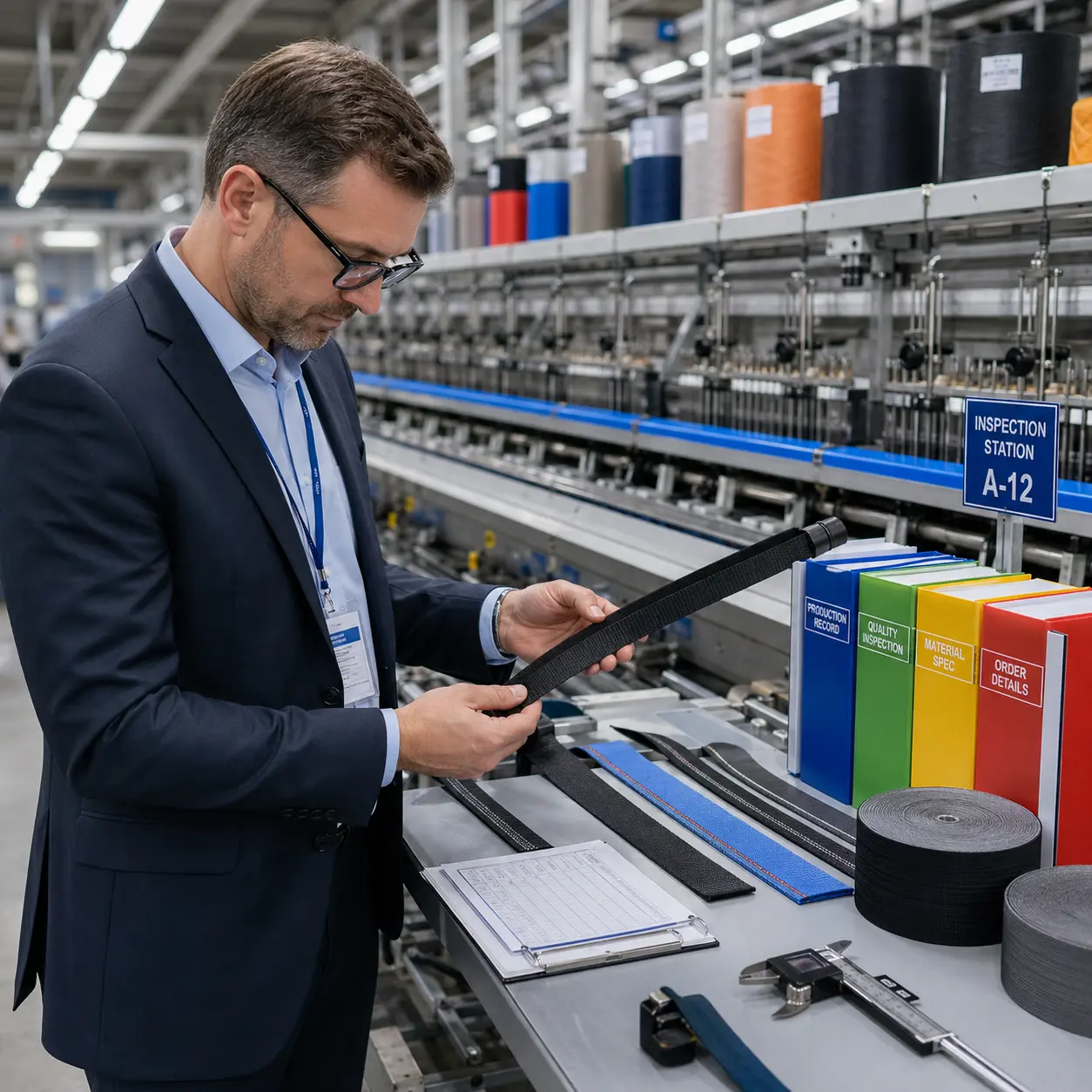
Visiting a webbing factory before placing a large order is one of the smartest decisions a B2B buyer can make. A spec sheet tells you what a supplier claims to produce. A factory inspection tells you what they actually deliver. Yet most buyers arrive at a factory without a clear checklist — and leave uncertain whether they made the right call.
This article gives you a complete, zone-by-zone inspection checklist based on what professional buyers and quality auditors verify when sourcing webbing from manufacturers in China and beyond. Use it as a walkthrough guide during your next factory visit, or share it with a third-party inspection agent if you're unable to attend in person.
Before You Arrive: Documentation to Request in Advance
Strong factories welcome scrutiny. Before scheduling your visit, ask for these documents to review in advance — this alone filters out suppliers who can't meet basic standards:
- Business license and export license — confirms the factory is legally registered and permitted to export
- ISO 9001 certificate — validates their quality management system exists on paper
- Sample test reports — tensile strength, colorfastness, and UV resistance for your target product. Not sure how to read them? See our webbing test report decoder guide.
- Production capacity documentation — loom count, monthly output, and lead time estimates
- Customer reference list — verifiable names of brands or distributors they currently supply
Zone 1: Company Scale and Production Capability
The first impression matters — but verify it counts. Walk the facility with these checkpoints:
- Registered floor space: Ask to see the actual property ownership or lease documents. Some suppliers show a showroom while sub-contracting production elsewhere.
- Loom count and type: Count the active looms on the production floor. Ask about their width capacity (e.g., 1-inch, 2-inch, 4-inch looms for different webbing widths). A factory claiming 50,000 m/month capacity should have the loom count to match.
- Staff headcount: Compare production staff to administrative staff. A healthy ratio is roughly 3–5 production workers per loom. An office-heavy operation may be a trading company, not a manufacturer.
- Workshop organization: Is the floor clean and organized? Yarn cones stored in a climate-controlled area? Production records posted at each workstation? Disorder signals broader quality control weaknesses.
Zone 2: Raw Material Storage and Incoming Inspection
Webbing quality begins at the yarn. Even the best loom cannot compensate for inferior yarn. This is one of the most overlooked inspection areas — and one of the most revealing.
- Yarn storage conditions: High-tenacity yarns (nylon, polyester, UHMWPE, aramid) absorb moisture and degrade under prolonged UV exposure. Check that yarn is stored in a dry, shaded warehouse — not outdoors or near windows.
- Yarn lot labeling: Each yarn batch should be clearly labeled with supplier name, lot number, material type, denier, and date received. Unlabeled cones indicate poor traceability.
- Incoming yarn test reports: Ask to see their yarn incoming inspection records. Reputable factories test denier variance, twist per inch (TPI), and breaking strength on each new yarn lot before approving it for production use.
- Yarn supplier diversity: A factory reliant on a single yarn supplier carries supply chain risk. Ask who their primary yarn suppliers are — well-known brands like INVISTA, Hyosung, or DSM indicate quality sourcing.
Zone 3: Weaving and Production Floor Inspection
Walk the production floor during active operation. This is where you see real-time quality behavior.
- Weave consistency: Inspect webbing in-process for uniform weave density, consistent width (check with calipers), and no visible defects: skipped threads, broken selvedge edges, or dye streaks.
- Quality Control Points (QCPs): Ask how many in-line inspection stations exist. At minimum, there should be checkpoints at: (a) yarn loading, (b) mid-weave visual inspection, (c) post-weave full inspection before packaging.
- Loom maintenance records: Request loom maintenance logs. Neglected looms produce inconsistent webbing — especially critical for Mil-Spec webbing.
- Speed vs. quality trade-off: Ask about loom speed settings. Some factories run looms at maximum speed to inflate output numbers, sacrificing tensile strength and weave uniformity. Request a test run at the speed they plan to use for your order.
- Defect logging: Check if the factory maintains a real-time defect log. If defects are discovered, are they recorded, classified by type, and fed back into process improvement? A factory that doesn't track defects will repeat them.
Zone 4: Dyeing and Finishing Process
If your webbing requires specific colors or functional finishes, the dyeing and finishing department deserves its own inspection zone.
- Color matching capability: Ask how they match Pantone or client-supplied color standards. Computerized color matching systems (X-Rite or Datacolor) with delta-E readings below 1.0 are industry standard for professional dye houses. For military and tactical orders, also review their Mil-Spec color standard compliance.
- Dye bath temperature and time controls: Dyeing is a chemical process. Uncontrolled temperature or dwell time causes batch-to-batch color variation. Ask about their process parameters for each fabric type.
- Functional finish application: For UV-resistant, flame-retardant, or waterproof webbing, verify the finish chemical is applied evenly and cured at the correct temperature. Ask for the technical data sheet (TDS) for any finish chemicals they use. See our webbing finishing treatments guide for what each finish does and how it's applied.
- Dye lot management: Can they guarantee that all webbing for your order comes from the same dye lot? Dye lot variation is a common cause of color mismatch complaints in large orders.
Zone 5: Laboratory and Testing Facilities
A factory that tests its own products has skin in the game. This zone separates true manufacturers from assemblers.
- Tensile testing machine: The most critical piece of equipment. Verify they own a calibrated tensile testing machine capable of ASTM D6770 or ISO 13934 testing standards. Ask for the last calibration certificate — it should be current (within 12 months). Our test report reading guide shows what a properly formatted result looks like.
- Colorfastness testing: Crockmeter (rubbing fastness), wash fastness tester, and light fastness tester (xenon arc or UV chamber) are standard for webbing intended for outdoor or apparel use.
- Width and thickness gauges: Digital calipers and thickness gauges should be readily available at QC stations. Verify they're calibrated and have current calibration stickers.
- Third-party lab access: Even the best in-house labs cannot test for every specification. Ask whether they work with accredited third-party labs (e.g., SGS, Bureau Veritas, Intertek) for formal certification testing on Mil-Spec or regulatory compliance orders.
- Test report format: Request a sample test report from a recent production run. A professional report should include: product description, test method standard, equipment used (with ID/calibration date), individual test results, average, and pass/fail verdict against the specified limit.
Zone 6: Quality Management Documentation
Ask to review the quality management files. Well-organized documentation is a reliable proxy for process discipline.
- ISO 9001 certificate: Verify it's current and issued by an accredited certification body (not self-declared). Check the certificate number on the issuing CB's public register.
- Inspection and Test Plan (ITP): Ask if they operate with a written ITP for each order. A proper ITP defines all inspection stages, acceptance criteria, sampling plans, and responsible parties before production begins.
- Non-conformance (NCR) records: Ask to see recent non-conformance reports. Factories with zero NCR records are either perfect — or not recording them. NCR volume and resolution speed are strong quality culture indicators.
- Traceability system: Can they trace any finished roll back to the specific yarn lot, loom number, shift, operator, and dye bath? Full traceability is essential for root cause analysis if a field failure occurs.
- First Article Inspection (FAI): For new products or new clients, does the factory produce a formal FAI report before bulk production begins? This is standard practice for military and aerospace webbing supply.
Zone 7: Packaging, Storage, and Logistics Readiness
The inspection doesn't end with the product. How a factory handles finished goods reveals their commitment to delivering quality that survives transit.
- Finished goods storage: Webbing should be stored flat, away from direct sunlight, in a clean, dry environment. UV-sensitive materials (UHMWPE, aramid) are particularly vulnerable to shelf degradation.
- Packaging specifications: Ask to see the standard packaging for your target market. Export packaging should include: moisture barrier (polybag + desiccant), outer carton with double-wall corrugated, product label with lot number and production date.
- Palletization and stacking: Check if cartons are palletized and stretch-wrapped for container loading. Over-stacking or improper palletization causes crushing damage in transit.
- Sample retention policy: Does the factory retain production samples for at least 6–12 months? Retained samples are the fastest way to resolve disputes about whether a reported defect existed at time of shipment.
Your Inspection Action Plan: Before, During, and After
Use this checklist as a structured workflow, not a one-time checklist:
- Pre-visit (1–2 weeks before): Request documents listed in Zone 0. Review their test reports. Cross-reference their claimed capacity with their loom count.
- During the visit: Photograph everything — the production floor, labeling systems, testing equipment, and storage conditions. Use the checklist above systematically. Don't rely on memory.
- Post-visit (within 48 hours): Compile findings. Flag any "no" responses. Request corrective action plans from the supplier for each failing item before placing an order.
- Consider third-party inspection: For orders above $10,000, engaging a third-party inspection company (QIMA, Asia Quality Focus, or similar) for pre-shipment inspection is cost-effective insurance against quality disputes. If you're still negotiating MOQ terms, factor inspection cost into your total landed cost calculation.
Not sure whether a factory you've visited can meet your webbing quality standards? Contact TMG Webbing — we're happy to walk you through our inspection protocol, share our test reports, and arrange a virtual or in-person facility tour before you commit to an order.