
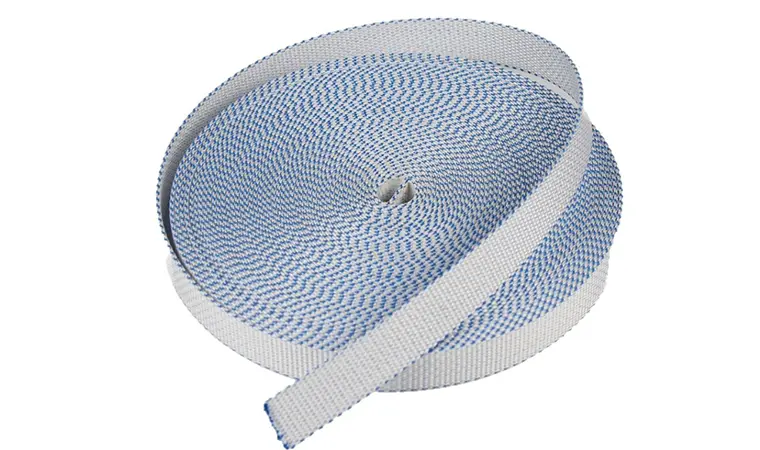
You’ve read the specs. You know that UHMWPE (Dyneema®) webbing is 15 times stronger than steel and floats on water. It seems like the perfect material for your new high-performance outdoor gear, safety harness, or marine rigging. But then, your prototype team comes back with bad news: "The stitches are slipping," "Our scissors are ruined," or "We can't get the logo to stay on."
Welcome to the paradox of Ultra-High Molecular Weight Polyethylene. The very properties that make it invincible – its extreme slickness, cut resistance, and chemical inertness – make it a nightmare to process.
As a manufacturer working with these advanced fibers daily, TMG Webbing understands these pain points. In this guide, we break down the three biggest challenges of working with UHMWPE webbing and how to overcome them.
Challenge 1: The Slippery Slope of Sewing
The most common complaint we hear from product designers is joint failure. The webbing didn't break, but the sewing did. Why?
UHMWPE has an extremely low coefficient of friction (similar to Teflon/PTFE). It is incredibly slippery. When you sew two pieces together, they don't "grip" each other like Nylon or Cotton would. Under load, the fibers slide, causing stitches to distort or pull out completely.
Expert Solutions for Sewing UHMWPE:
- Stitch Pattern Matters: A simple straight stitch is insufficient. You must use high-density Bar-tack stitching (often a "W" or box-x pattern with high thread count) to create enough mechanical friction to hold the joint.
- Thread Selection: Don't use standard cotton or weak poly threads. Use high-tenacity Bonded Nylon 6.6 or bonded Polyester thread. For ultimate performance, some applications require sewing UHMWPE webbing with UHMWPE thread, though this increases cost significantly.
- Needle Heat: UHMWPE has a relatively low melting point (around 140°C - 150°C). High-speed industrial sewing machines generate friction heat in the needle, which can melt the webbing fibers, weakening the strap before it's even used. Slowing down the sewing speed and using titanium-coated needles can help dissipate heat.
Challenge 2: Cutting the Uncuttable
You chose UHMWPE because it is cut-resistant. Naturally, this means it destroys standard cutting tools. Using regular scissors on Dyneema webbing will result in frayed ends and dull blades within minutes.
Cutting Methods Compared:
| Method | Pros | Cons |
|---|---|---|
| Standard Scissors | Cheap, accessible. | Dulls instantly, messy frayed edges. Not recommended. |
| Hot Cutting | Seals the edge to prevent fraying. | Risk of deformation. Since UHMWPE shrinks and melts quickly, hot cutting can leave a hard, beaded edge that may be uncomfortable or brittle. |
| Ultrasonic Cutting | Cleanest edge, seals fibers without excessive bulk. | Requires expensive machinery (We use this at TMG Webbing). |
For a deeper dive into cutting techniques for various materials, check out our Webbing Cutting Guide.
Challenge 3: The Color Conundrum (Dyeing & Printing)
Clients often ask: "Can I get this UHMWPE webbing in Neon Green with my logo printed on it?"
The short answer: It's difficult.
The technical answer: UHMWPE is chemically inert. It has no polar groups in its molecular chain for dye molecules to bond with. This means:
- Traditional Dyeing Fails: You cannot dip-dye white UHMWPE webbing like you can with Nylon. The color will simply wash off.
- Printing Rubs Off: Because the surface is so slick (frictionless), standard screen printing ink has trouble adhering. It often flakes off after minimal use.
The Solution: Solution Dyeing (Dope Dyeing)
To get colored UHMWPE, the pigment must be mixed into the polymer before it is extruded into fiber. This is called "Solution Dyeing."
Limitations to know:
- Limited Colors: Most suppliers (including us) stock Black and White. Other colors (Red, Blue, Yellow) require high MOQs because the fiber itself must be custom manufactured.
- Jacquard vs. Print: If you need branding, we strongly recommend Jacquard Weaving (weaving the logo into the fabric structure) rather than printing. A woven logo will never rub off, whereas a printed logo on UHMWPE is temporary at best.
Conclusion: Is UHMWPE Worth the Trouble?
Absolutely—if your application demands it. Despite the processing headaches, no other material offers the same strength-to-weight ratio and durability. The key is to partner with a manufacturer who knows how to handle it.
At TMG Webbing, we have fine-tuned our production lines to handle UHMWPE. From specialized looms for weaving to ultrasonic cutters and heavy-duty programmable sewing machines, we ensure the final product retains the super-fiber properties you paid for.
Ready to start your project? Check out our High-Performance Webbing Catalog or contact us below for technical advice.
FAQ: Processing UHMWPE Webbing
Does UHMWPE webbing shrink when heated?
Yes, high heat causes shrinkage and melting. It is critical to keep the material away from temperatures exceeding 140°C (284°F).
Can I use glue or adhesives on UHMWPE?
Generally, no. Most adhesives will not bond to the chemically inert, slick surface of UHMWPE. Mechanical fastening (sewing) is the standard method for assembly.
What thread should I use to sew Dyneema webbing?
We recommend High-Tenacity Bonded Nylon 6.6 thread (Size V69, V92, or V138 depending on webbing thickness) for a good balance of strength and cost. For maximum UV resistance, Bonded Polyester is also a good choice.
Need Technical Support?
Not sure if your design is manufacturable with UHMWPE? Send your drawings to TMG Webbing. Our engineers provide free feasibility assessments.
Contact Our Engineers