
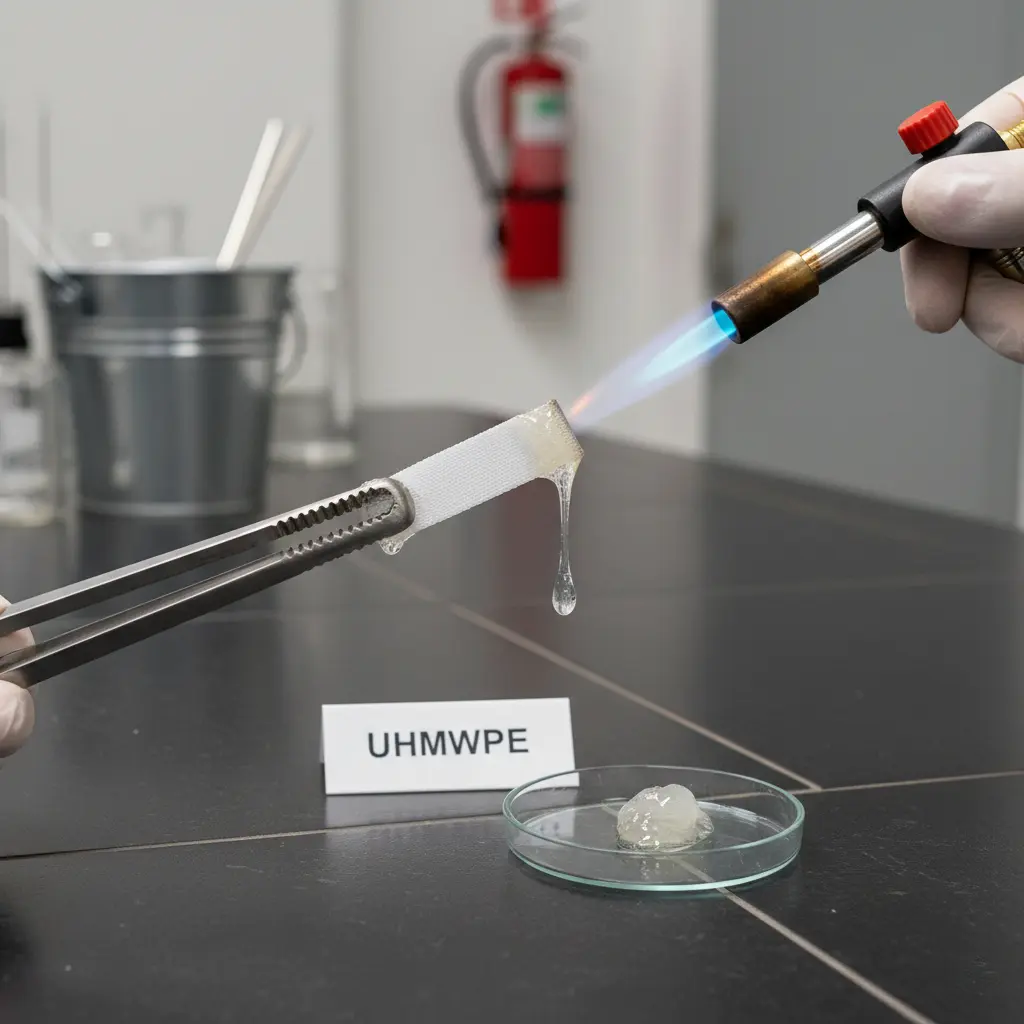
UHMWPE (often known by the brand name Dyneema®) is one of the most expensive and sought-after materials in the textile industry. Because of its high value, the market is unfortunately flooded with low-quality imitations. We have seen buyers pay top dollar for "High-Strength Webbing" only to receive standard Polypropylene (PP) or Polyester that breaks under a fraction of the expected load.
As a reputable manufacturer, TMG Webbing wants to empower you. You don't always need a high-tech lab to spot a fake. Here are 4 simple tests you can do in your office to verify if your sample is genuine high-quality UHMWPE.
Test 1: The Touch Test (Slippery & Cool)
The Method: Run your fingers firmly along the surface of the webbing.
What to look for:
- Real UHMWPE: It feels incredibly slick, "waxy," or "oily" (even though there is no oil). It has a very low coefficient of friction. It also tends to feel cool to the touch.
- Imitation (Polyester/Nylon): These feel "dry" and create friction heat if you rub them quickly.
- Cheap PE: Might feel plastic-like but lacks the dense, smooth textile structure of high-tenacity yarn.
Test 2: The Float Test (Specific Gravity)
The Method: Cut a small piece of the webbing and drop it into a glass of water. Push it down to remove air bubbles.
The Science: UHMWPE has a specific gravity of roughly 0.97, meaning it is lighter than water.
- ✅ Floats: It is likely UHMWPE or Polypropylene (PP).
- ❌ Sinks: It is Polyester (SG 1.38), Nylon (SG 1.14), or Kevlar (SG 1.44). If your "Dyneema" sinks, it's a fake.
Note: This test distinguishes it from Polyester/Nylon, but PP also floats. To separate UHMWPE from cheap PP, you need the next tests.
Test 3: The Burn Test (Smell & Appearance)
The Method: Carefully use a lighter to burn the edge of the webbing. Observe the flame, the smell, and the residue. (Do this in a ventilated area).
| Material | Smell | Flame/Residue |
|---|---|---|
| UHMWPE (Real) | Candle Wax (Paraffin) | Melts slowly, clear liquid bead, round hard bead when cool. |
| Nylon | Celery / Fishy | Melts, usually self-extinguishing. |
| Polyester | Sweet Chemical / Black Smoke | Melts and drips, black smoke. |
| Aramid (Kevlar) | Burnt Wood | Does not melt. Chars black. |
Test 4: The Cut Test (Abrasion Resistance)
The Method: Take a standard pair of office scissors and try to cut the webbing.
- Real UHMWPE: You will struggle. The fibers will slide between the blades, and you will likely have to "saw" at it to make a cut. It might even dull your scissors.
- Cheap PP or Polyester: Snip! It cuts easily with a crisp sound.
The Final Verification: Lab Tensile Testing
While the tests above verify the material, they don't verify the quality of the weave. Poorly woven UHMWPE can slip under load even if the fiber is real.
For critical safety applications, always ask your supplier for a Tensile Test Report. High-quality UHMWPE webbing should demonstrate:
- High Breaking Strength: E.g., a 25mm thin strap should easily exceed 1500kg-2000kg (depending on thickness).
- Low Elongation: It should stretch very little before breaking (unlike Nylon).
Learn more about how we test our products in our Quality Control Guide.
Conclusion
Sourcing high-performance materials requires trust and verification. By performing these simple checks—Touch, Float, Burn, and Cut—you can quickly filter out low-end imitations.
If you are looking for a transparent manufacturing partner who encourages testing, contact TMG Webbing today.
Custom Webbing Orders
Custom webbing MOQ: 3,000 meters. Standard production lead time: 15 days after specification and sample approval. Confirm the delivery schedule for your exact order. Stock availability and finished-product quantities are quoted separately.
TMG Webbing holds GRS and OEKO-TEX STANDARD 100 certificates. Ask us to confirm the current certificate, holder and article scope for your material, color and finish. Recycled-content claims and transaction documentation depend on the order.