
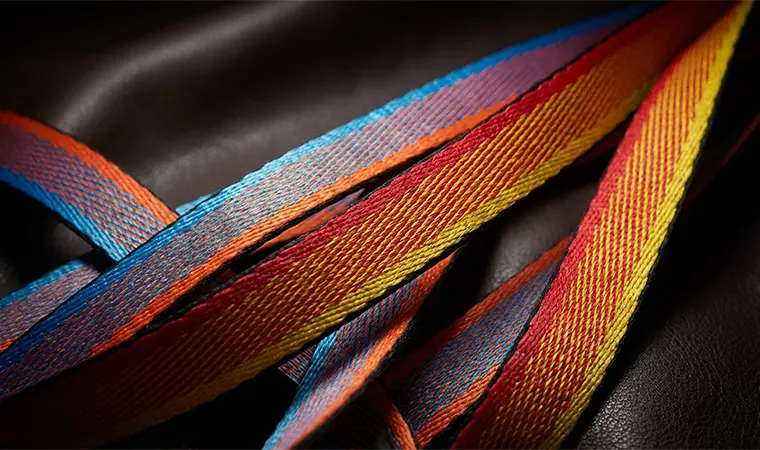
The global slackline market has evolved far beyond simple backyard fun. Today, it encompasses specialized disciplines like Tricklining (aerial maneuvers), Longlining (endurance), and Highlining (extreme altitude). For B2B buyers and outdoor gear brands, sourcing standard cargo straps is no longer enough. You need a slackline webbing manufacturer that understands the physics of bounce, the importance of "soft edges," and the critical safety margins required for human load.
At TMG Webbing, we specialize in manufacturing high-performance narrow fabrics tailored for the slackline industry. Whether you are launching a beginner kit or sourcing ultra-light tapes for professional athletes, this guide will help you choose the right material and specifications.
1. Material Selection: The Physics of the Line
In slacklining, the material dictates the experience. As a manufacturer, we categorize our slackline webbing into three main types based on elasticity (stretch) and breaking strength.
A. Polyester Webbing (Low Stretch) – The Beginner & Longline Choice
High-Tenacity Polyester is the industry standard for beginner slackline kits and longlines.
- Why choose it: It has low elongation (low stretch), making it easier to tension close to the ground. It is static and stable, perfect for learning balance.
- Specs: Our polyester slackline webbing typically features a breaking strength (MBS) of 30kN to 40kN (3-4 tons).
- Best For: Classic Slackline Kits, Longlines (>30m), Travel Lines.
Learn more about our Polyester Webbing capabilities.
B. Nylon Webbing (High Stretch) – The Trickline Engine
For Tricklines, static is the enemy. You need energy return. We manufacture custom Nylon 6 or Nylon 6.6 webbing designed to act like a trampoline.
- The "Trampoline Effect": Nylon has high elongation. When a rider lands on the line, the webbing absorbs the energy and throws them back up.
- Key Manufacturing Feature: We use a specific weave structure to ensure the webbing snaps back quickly without losing tension over time.
- Best For: Tricklining, Surfing lines, Rodeo lines.
C. UHMWPE / Dyneema® (Ultra-Static) – The Highline Specialist
For extreme distances or weight-critical alpine projects, traditional fibers are too heavy. This is where UHMWPE (Ultra-High Molecular Weight Polyethylene) shines.
- Properties: Ideally static (near-zero stretch), incredibly lightweight, and 15x stronger than steel.
- Safety: Ideal for highlines where you don't want the line to sag excessively.
- Note: Due to its low friction, we can add special grip coatings or hybrid weaves to ensure it works with your Weblock hardware.
Deep Dive: Read our comprehensive Guide to UHMWPE Webbing & Ropes to understand why this material is a game-changer for high-performance gear.
2. Critical Manufacturing Features for Slacklines
Buying industrial lifting slings and relabeling them as slacklines is a recipe for failure. TMG Webbing incorporates specific features that elevate a strap from "industrial" to "sport grade."
Soft-Edge Technology (Round Edge Weaving)
Standard industrial webbing has sharp, cut edges that can cause nasty abrasions when a bare-footed slackliner falls. We utilize Soft-Edge Technology, creating a tubular or rounded edge structure. This significantly improves user comfort and safety during dynamic tricks.
Silicone Grip Printing (Anti-Slip)
Flat webbing can be slippery, especially when wet. We offer custom silicone printing. This not only adds your brand logo but provides essential traction (grip) for the rider's shoes or feet. This is a must-have feature for competitive tricklines.
Jacquard Branding
For a premium look that won't fade after weeks in the sun, we recommend Jacquard weaving. Your brand name or geometric patterns are woven directly into the fabric structure, ensuring longevity and a high-end aesthetic.
See the difference: Check out our Jacquard Webbing Guide.
3. Safety First: MBS vs. WLL in Slacklining
When sourcing from TMG Webbing, we provide rigorous tensile testing data. However, it is crucial for buyers to understand the terminology:
- MBS (Minimum Breaking Strength): The ultimate load at which the webbing breaks. For slacklines, high MBS (e.g., 30kN+) is vital to withstand dynamic peak loads generated by jumping.
- System Strength: Remember, the webbing is only as strong as its sewing loops. We use heavy-duty Bartack stitching patterns specifically calculated to maintain 85-95% of the webbing's original strength at the loop.
Our factory performs cycle testing and break tests on every batch. Learn more about our Quality Control System.
4. Why Partner with TMG Webbing?
As a direct manufacturer, TMG Webbing bridges the gap between industrial strength and sporting performance.
- Low MOQ: We support growing slackline communities and startups.
- Custom R&D: Want a hybrid line with UHMWPE core and Polyester sheath? We can weave it.
- Kit Components: Beyond webbing, we can assist in sourcing compatible ratchets, tree protection, and packaging for a complete "ready-to-sell" solution.
FAQ for Slackline Buyers
What is the best width for slackline webbing?
It depends on the style. 50mm (2-inch) is standard for Tricklining and beginner kits as it offers a wider landing surface. 25mm (1-inch) is preferred for Longlining and Highlining as it is lighter and less affected by wind.
Can you produce "trampoline style" webbing?
Yes. We manufacture specialized high-elongation Nylon webbing specifically designed for tricklines to provide maximum bounce and energy return.
Do you offer custom printing for slackline brands?
Absolutely. We offer both continuous sublimation printing (for complex patterns) and silicone screen printing (for grip and logos). We can also do Jacquard weaving for permanent branding.
Ready to Launch Your Slackline Product Line?
Don't settle for generic straps. Partner with TMG Webbing to create safe, bouncy, and branded slackline webbing that players will love.
Contact Us for a Quote