When sourcing UHMWPE (Dyneema®) webbing, many product designers focus solely on width and breaking strength. However, there is a third critical factor that often determines the success or failure of a product: The Weave Structure.
Should you choose Flat (Solid) Webbing or Tubular (Hollow) Webbing? While they may look similar on a spec sheet, their behavior in the field—especially regarding knots, splicing, and abrasion—is drastically different. This guide compares the two to help you make the right choice.
1. Structure: What is the Difference?
- Flat Webbing: This is a solid weave, similar to a standard backpack strap. It is stiff, dense, and has distinct edges.
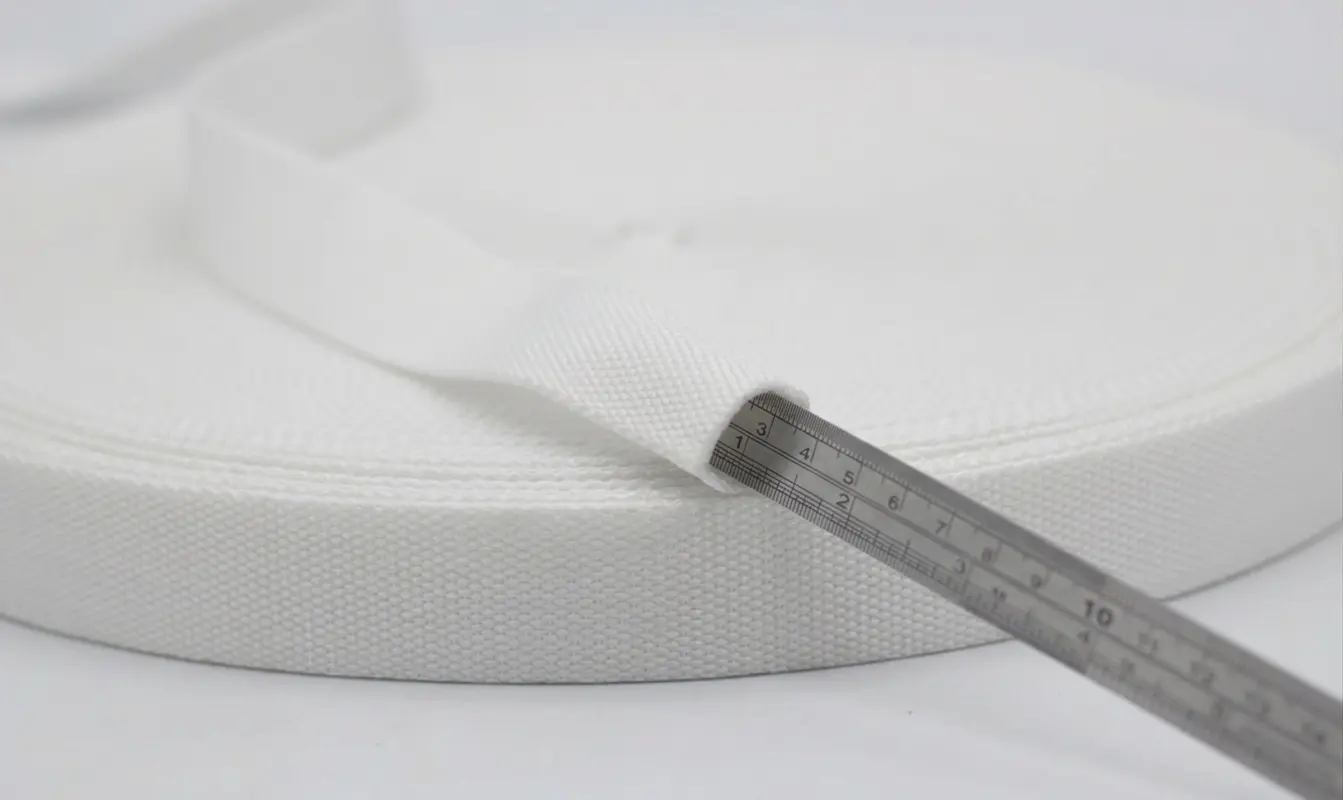
- Tubular Webbing: This is essentially a flattened tube (hollow in the middle). It is woven in a continuous spiral without edges. It feels softer and more pliable than flat webbing of the same strength.
For a general comparison of these weaves in Nylon, see our previous Flat vs. Tubular Nylon Guide. But for UHMWPE, the stakes are higher due to its slipperiness.
2. The Knot Problem: Why Tubular Wins
The biggest downside of UHMWPE is that it is slippery (low friction). Knots tend to unravel under cycling loads.
Flat UHMWPE webbing is stiff. When you tie a knot (like a water knot), the stiff fibers resist bending, leaving gaps inside the knot. These gaps allow the knot to "walk" or slip open.
Tubular UHMWPE webbing is pliable. Under load, the tube collapses and flattens out completely. This allows the webbing to wrap tightly around itself, increasing surface contact area within the knot. While we still recommend sewing over knotting for UHMWPE, Tubular webbing holds knots significantly better than Flat webbing.
3. Splicing: The Superpower of Tubular Webbing
This is a game-changer for hammock suspension (Whoopie Slings) and soft shackles.
- Flat Webbing: Cannot be spliced. You must sew it or knot it. Sewing UHMWPE requires specialized equipment, and knots reduce strength by up to 50%.
- Tubular Webbing: Can be spliced. Because it is hollow, you can thread one end of the webbing inside itself (burying the tail). When tension is applied, the outer layer constricts around the inner layer, creating a "Chinese finger trap" effect. A proper splice retains nearly 100% of the webbing's strength, unlike a knot.
4. Edge Resistance & Durability
Climbing Applications: When a climbing sling is loaded over a sharp rock edge, the geometry matters.
Tubular webbing has no "edge." It tends to roll over obstacles rather than shearing. Its double-layer construction (when flattened) provides a redundant safety factor; if one side is cut, the other may hold.
Flat webbing has a fixed edge. If loaded over a sharp corner, the stress concentrates on that edge, increasing the risk of cutting. However, flat webbing is often thinner and more compact for lightweight sewn runners (Alpine draws).
Summary: Application Guide
| Application | Recommended Structure | Why? |
|---|---|---|
| Hammock Suspension (Whoopie Slings) | Tubular | Must be spliceable to create adjustable loops. |
| Ultralight Alpine Runners (Sewn) | Flat | Thinner profile, less bulk on the harness. |
| Protective Chafe Sleeve | Tubular | Hollow center allows you to slide ropes or cables inside it. |
| Slackline Webbing | Flat | Provides a stable, flat surface for walking. |
| DIY Gear / Tied Slings | Tubular | Holds knots much more securely than flat tape. |
Conclusion
Don't just ask for "UHMWPE Webbing." Ask for the structure that fits your assembly method. If you have industrial sewing machines, Flat webbing is excellent for static, low-bulk straps. If you need adjustability, splicing capability, or better knot security, Tubular UHMWPE is the superior choice.
TMG Webbing offers custom widths and weave densities for both. Contact our engineers to discuss your specific load requirements.
Custom Webbing Orders
Custom webbing MOQ: 3,000 meters. Standard production lead time: 15 days after specification and sample approval. Confirm the delivery schedule for your exact order. Stock availability and finished-product quantities are quoted separately.
TMG Webbing holds GRS and OEKO-TEX STANDARD 100 certificates. Ask us to confirm the current certificate, holder and article scope for your material, color and finish. Recycled-content claims and transaction documentation depend on the order.