
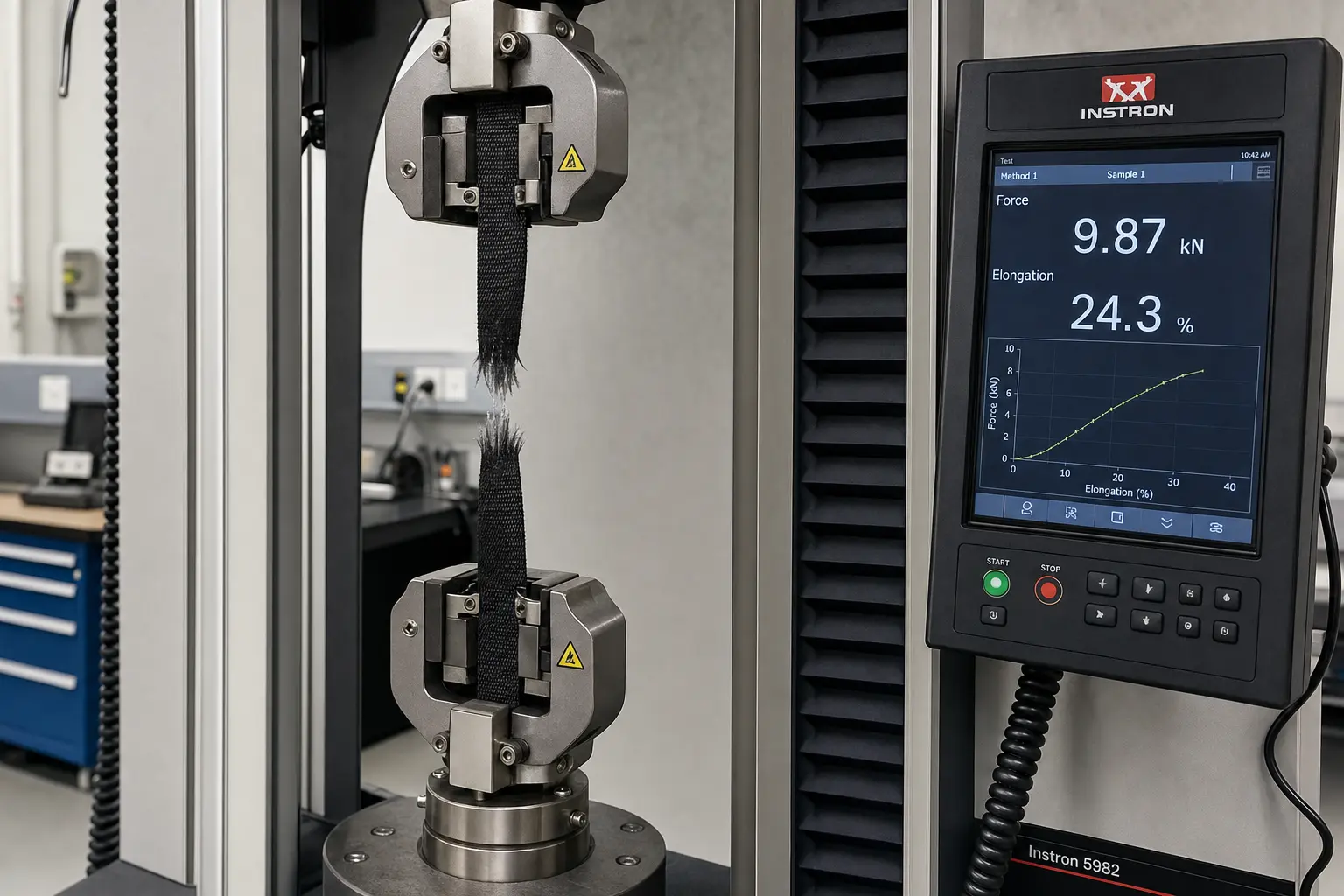
You just received a 12-page test report from your webbing supplier. It has tables, graphs, abbreviations like "ASTM D6775" and "ASTM G154," and numbers in units you are not sure how to interpret. What does it all mean — and more importantly, is the webbing actually good enough for your application?
This guide walks you through every section of a typical webbing test report: what each test measures, how to read the numbers, what red flags to watch for, and how to use the data to make confident procurement decisions. We write and review these reports daily at TMG Webbing, so this is the explanation we wish every buyer had.
What a Webbing Test Report Covers
A complete webbing test report from an accredited lab (SGS, BV, Intertek, or an ISO 17025 in-house lab) typically includes these sections:
| Test Section | Standard | What It Measures | Why It Matters |
|---|---|---|---|
| Tensile / Breaking Strength | ASTM D6775, ISO 13934-1 | Maximum force before rupture | Primary safety parameter — must meet or exceed spec |
| Elongation at Break | ASTM D6775, ISO 13934-1 | % stretch at the moment of rupture | Affects energy absorption, dimensional stability, and fit |
| UV / Accelerated Weathering | ASTM G154, ISO 4892-2 | Strength retention after UV exposure | Critical for outdoor/marine applications |
| Colorfastness | AATCC 16, ISO 105-C06 | Color change after light/wash/crock | Aesthetic + NIR compliance for military |
| Abraham / Martindale | ASTM D3884, ISO 12947 | Wear resistance under friction | High-contact applications (belts, harnesses) |
| Flammability | CFR 1610, NFPA 701 | Burn rate, after-flame, char length | Required for FR-rated and military gear |
Section 1: Tensile / Breaking Strength
This is the most critical number on any webbing test report. It tells you the maximum force the webbing can withstand before it breaks.
How the Test Works
Per ASTM D6775 (Standard Test Method for Breaking Strength and Elongation of Textile Webbing, Tape, and Braided Material):
- Specimens are conditioned at 23 ± 2°C and 50 ± 5% RH for 24 hours
- A specimen of specified length (typically 200–300 mm gauge length) is clamped in the grips of a universal testing machine (UTM)
- The machine pulls at a constant rate of 50 mm/min (2 in/min) until rupture
- The machine records: maximum force (N or lbf) and elongation at break (mm or %)
- A minimum of 5 specimens are tested; results are averaged
Reading the Numbers
A typical tensile test results table looks like this:
| Specimen | Breaking Force (N) | Breaking Force (lbf) | Elongation at Break (%) | Failure Mode |
|---|---|---|---|---|
| #1 | 28,450 | 6,394 | 22.3 | Webbing rupture |
| #2 | 28,120 | 6,320 | 21.8 | Webbing rupture |
| #3 | 29,100 | 6,540 | 23.1 | Webbing rupture |
| #4 | 27,980 | 6,291 | 21.5 | Webbing rupture |
| #5 | 28,750 | 6,464 | 22.7 | Webbing rupture |
| Average | 28,480 | 6,402 | 22.3 | — |
| Std. Dev. | 432 | 97 | 0.6 | — |
What to Check
- Does the average meet the specification? — Compare the average breaking force against the minimum required by your product spec or industry standard. In this example, the spec requires ≥ 25,000 N and the average is 28,480 N — a comfortable pass.
- Is the spread tight? — A high standard deviation relative to the average suggests inconsistent material or manufacturing. As a rule of thumb, the coefficient of variation (CV = std dev / average) should be under 5% for quality webbing. Here, CV = 432 / 28,480 = 1.5% — excellent.
- Failure mode — "Webbing rupture" is the expected failure mode. "Grip slip" or "jaw break" means the specimen failed at the clamp rather than in the gauge length, and the result may be unreliable. Any specimen with grip slip should be discarded and retested.
- Individual lows — Even if the average passes, check if any single specimen falls below the spec minimum. Most standards require every specimen to meet the minimum, not just the average.
Breaking Strength vs. Working Load Limit (WLL)
The breaking strength on a test report is not the safe working load. The relationship is defined by the safety factor:
Working Load Limit (WLL) = Breaking Strength ÷ Safety Factor
| Application | Typical Safety Factor | Standard Reference |
|---|---|---|
| General cargo tie-down | 3:1 | FMVSS 571.209, WSTDA-T1 |
| Passenger restraints / seatbelts | 5:1 to 10:1 | FMVSS 571.209, ECE R16 |
| Fall protection / safety harness | 10:1 (static), 5:1 (dynamic) | EN 354, EN 362, ANSI Z359 |
| Lifting / rigging slings | 4:1 to 7:1 | ASME B30.9, EN 1492 |
| Military / defense | Specified per MIL-DTL | MIL-W-17337, MIL-W-4088 |
Section 2: Elongation at Break
Elongation is measured simultaneously with tensile strength during the same ASTM D6775 test. It tells you how much the webbing stretches before it breaks.
Why Elongation Matters
High elongation is not inherently bad — it depends on the application:
- High elongation (20–30%) — Nylon's natural characteristic. Good for shock absorption (climbing, parachute, fall protection). Bad for dimensional stability (cargo straps that must hold tight, harnesses that must not shift).
- Low elongation (8–15%) — Polyester's natural characteristic. Good for cargo securement, marine rigging, and any application where the load must not shift. Less energy absorption means less forgiveness under shock.
- Very low elongation (2–5%) — UHMWPE (Dyneema/Spectra) territory. Extreme strength-to-weight ratio but almost no give. Excellent for static loads, requires careful engineering for dynamic applications.
Reading the Elongation Curve
Beyond the single "elongation at break" number, many test reports include a force-elongation curve (also called a stress-strain curve). This graph reveals:
- Initial modulus — The slope of the curve at low force. A steep initial slope means the webbing resists stretch under small loads (good for cargo, bad for shock absorption).
- Yield point — Where the curve begins to flatten. Past this point, the webbing will not fully recover its original length when the load is removed (permanent deformation).
- Toe region — The initial "S" curve at very low force. This is the webbing straightening and crimp redistribution, not actual material stretch. The true modulus starts after the toe region.
Elongation Comparison by Material
| Material | Elongation at Break | Typical Application | Behavior Under Cyclic Load |
|---|---|---|---|
| Nylon 6.6 | 18–30% | Parachute, climbing, fall arrest | Good recovery; retains >90% elongation after 1,000 cycles |
| Polyester (PET) | 8–15% | Cargo tie-down, marine, outdoor | Excellent recovery; minimal creep under sustained load |
| Polypropylene (PP) | 15–25% | Economy outdoor, buoyant applications | Poor recovery; significant creep under sustained load |
| UHMWPE (Dyneema) | 2–5% | High-performance rigging, armor | Excellent recovery; near-zero creep |
| Aramid (Kevlar) | 3–5% | FR gear, ballistic, heat protection | Good recovery; sensitive to flex fatigue |
Section 3: UV / Accelerated Weathering
For any webbing used outdoors — marine, outdoor gear, military, agricultural — the UV test section is as important as tensile data. A webbing that meets breaking strength fresh from the factory but loses 40% strength after one summer of sun exposure is a safety hazard.
How the Test Works (ASTM G154)
ASTM G154 (Standard Practice for Operating Fluorescent Ultraviolet (UV) Lamp Apparatus for Exposure of Materials) simulates years of outdoor UV exposure in weeks:
- Specimens are mounted in a QUV (accelerated weathering) chamber
- They are exposed to UVA-340 lamps (which simulate the critical 295–365 nm UV range of sunlight)
- Typical cycle: 8 hours UV at 60°C, 4 hours condensation at 50°C
- Exposure durations: commonly 200, 500, or 1,000 hours
- After exposure, specimens are retested for tensile strength and compared to unexposed controls
Reading the UV Results
| Material | Initial Breaking Strength (N) | After 200h QUV (N) | After 500h QUV (N) | Strength Retention @ 500h |
|---|---|---|---|---|
| Polyester 2" flat | 6,500 | 6,370 | 5,980 | 92% |
| Nylon 6.6 2" flat | 7,200 | 6,120 | 4,680 | 65% |
| PP 2" flat | 4,200 | 3,360 | 2,520 | 60% |
What to Check in UV Results
- Strength retention percentage — This is the key number. For outdoor applications, look for ≥ 80% retention at 500 hours for polyester, ≥ 70% for nylon with UV stabilizers.
- UV stabilizer claim vs. data — Many suppliers claim "UV resistant" without providing QUV data. If the report does not include accelerated weathering results, the claim is unverifiable.
- Exposure cycle details — Verify the test used UVA-340 lamps (not UVB-313, which is a harsher, less realistic spectrum). UVA-340 provides the best simulation of sunlight in the critical short-wavelength UV region.
- Comparison to control — The test should report both the unexposed control breaking strength and the post-exposure strength. Without the control, you cannot calculate retention.
Section 4: Colorfastness and NIR Compliance
For military and outdoor brand buyers, colorfastness testing is part of the qualification process. For military procurement specifically, NIR (near-infrared) reflectance compliance is a separate, mandatory test.
Standard Colorfastness Tests
- Light fastness (AATCC 16 Option 3) — Exposure to xenon arc lamp; rated Grade 1 (severe fade) to Grade 5 (no change). Mil-spec requires Grade 4 minimum.
- Washing fastness (ISO 105-C06) — Color change after washing cycles. Mil-spec requires Grade 4–5.
- Crocking / Rub fastness (AATCC 8) — Dry and wet rub test. Mil-spec requires Grade 4 dry, Grade 3–4 wet.
NIR Spectral Reflectance
Military-spec webbing must match the FS-595C spectral reflectance curve in both the visible range (400–700 nm) and the near-infrared range (700–1200 nm). The test report will show:
- Visible color match — ΔE value (CIE Lab) comparing the sample to the FS-595C color chip. Pass = ΔE ≤ 2.0.
- NIR reflectance curve — A spectral plot showing reflectance from 600–1200 nm. The sample curve must fall within the specified band for the color standard (e.g., Coyote Brown FS-34092).
A webbing that passes visual inspection but fails NIR testing will glow or appear as a dark void under night vision — a potentially fatal flaw in combat conditions.
Section 5: Abrasion Resistance
For webbing used in high-friction applications — belts, harnesses, pet collars, tactical gear — abrasion resistance determines service life.
Common Test Methods
- Martindale abrasion (ISO 12947) — The specimen is rubbed against an abrasive fabric under load. Results report cycles to fabric breakdown or weight loss at a set number of cycles.
- Taber abrasion (ASTM D3884) — Rotating abrasive wheels under load. Reports weight loss (mg) or appearance change after a set number of cycles.
- Wyzenbeek (ASTM D4157) — Back-and-forth rubbing over an abrasive screen. Common in the U.S.; reports cycles to yarn break or appearance change.
Reading Abrasion Data
The key is not the absolute number of cycles (which varies by test method, load, and abrasive medium) but the comparison between materials under identical test conditions. A polyester webbing showing 30,000 Martindale cycles to breakdown vs. a nylon at 20,000 cycles under the same test conditions tells you the polyester has superior abrasion resistance — even though nylon has higher tensile strength.
Red Flags: When a Test Report Should Concern You
- No test method specified — If the report lists results without citing the ASTM/ISO standard, the test conditions are unknown and the results are unverifiable.
- Only 1 or 2 specimens tested — Reliable tensile data requires a minimum of 5 specimens. Fewer than that and the statistical validity is questionable.
- Grip slip failures included in average — Any specimen that failed at the grip (not in the gauge length) should be discarded and replaced. If the report averages these in, the reported strength may be artificially low.
- No conditioning information — Nylon loses 10–15% tensile strength when wet. If the specimens were not conditioned at standard temperature and humidity, the results may not be reproducible.
- UV test with UVB-313 lamps — UVB-313 uses a shorter wavelength than natural sunlight and degrades materials faster than real-world conditions. Results are not comparable to UVA-340 data.
- Breaking strength exactly at the minimum — If every specimen breaks at exactly the spec minimum (e.g., all 5 at 25,000 N ± 50 N), it suggests selective reporting or test manipulation, not genuine quality.
- No lab accreditation — Reports from labs without ISO 17025 accreditation may not be accepted by regulators or auditors.
Quick Reference: Test Report Checklist
Use this checklist when reviewing any webbing test report:
- ☐ Test standard cited (ASTM D6775, ISO 13934-1, etc.)
- ☐ Laboratory accreditation (ISO 17025, CNAS, or equivalent)
- ☐ Sample identification (product code, batch/lot number, width, material)
- ☐ Conditioning parameters (23°C / 50% RH / 24 hrs)
- ☐ Minimum 5 specimens per test with individual results
- ☐ Average, standard deviation, and CV reported
- ☐ Failure mode documented for each specimen
- ☐ All specimens meet minimum (not just the average)
- ☐ UV data with UVA-340 lamp specification (for outdoor products)
- ☐ NIR reflectance curve included (for military-spec products)
- ☐ Test date within 12 months (for active qualifications)
What to Request from Your Supplier
When sourcing webbing for a regulated or safety-critical application, request these documents with your first order:
- Third-party test report — From an ISO 17025 accredited lab (SGS, BV, Intertek, TUV) covering tensile, elongation, and UV (if outdoor). The report must be for the exact product code you are ordering, not a generic material category.
- Material certificate of conformance — A document from the manufacturer certifying that the specific production lot meets the stated specification.
- UV aging data — Minimum 500 hours ASTM G154 (UVA-340) with strength retention percentage. If the supplier cannot provide this, they have not tested it.
- NIR test report — For military colors: spectral reflectance data across 600–1200 nm with ΔE and IR compliance statement.
At TMG Webbing, we provide full material test data packages with every production order, including third-party test reports from accredited laboratories. For new product qualifications, we produce test lots as small as 100 kg with complete QC documentation before committing to full production.