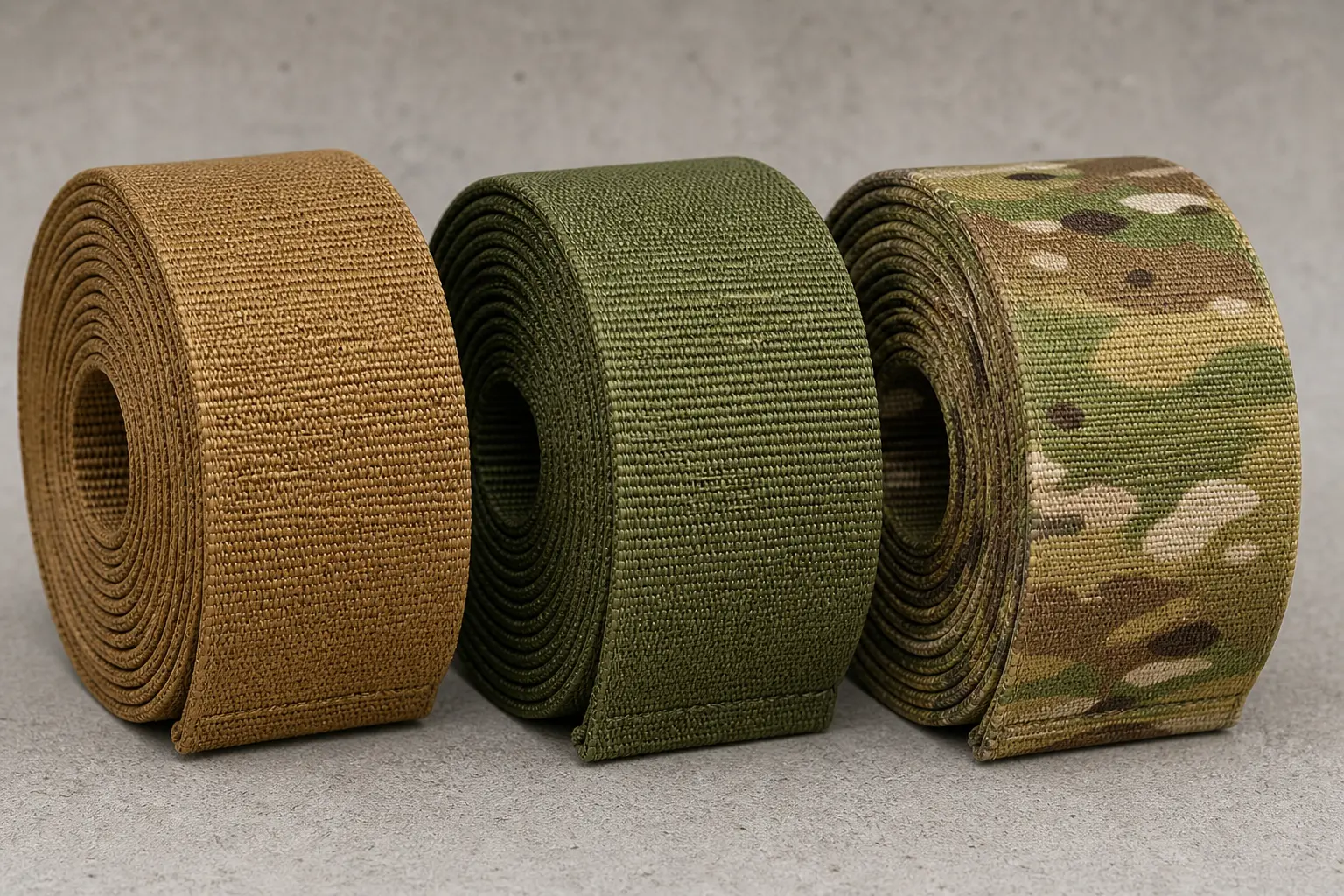
If you are sourcing webbing for a U.S. military contract, NATO procurement, or any defense application, color compliance is not optional — it is a pass/fail criterion. The wrong shade of Coyote Brown or a failed NIR (Near-Infrared) reflectance test will reject an entire production lot, no matter how perfect the tensile strength or weave construction.
This guide covers every color standard you need to know: the Federal Standard 595C / AMS-STD-595A color system, the specific codes for Coyote Brown, Ranger Green, Foliage Green, and Tan 499, the NIR/IRR compliance requirements that make military colors fundamentally different from commercial ones, and how MultiCam and other camouflage patterns fit into the specification framework.
The Federal Standard 595C Color System: How Mil-Spec Colors Are Defined
All U.S. military colors — whether for coatings, textiles, or webbing — are defined by Federal Standard 595C (now maintained as AMS-STD-595A). This is not a Pantone book. It is a government-maintained color index where each color has a unique 5-digit code, a physical color chip for visual matching, and defined spectral reflectance curves.
How to Read a FS-595C Code
The 5-digit code follows a specific structure:
- First digit — Gloss level: 1 = Flat (matte), 2 = Semi-gloss, 3 = Lusterless/Gloss
- Second digit — Color class: 0 = Black, 1 = Brown/Earth tones, 2 = Red/Orange, 3 = Tan/Drab, 4 = Green, 5 = Blue, 6 = Gray, 7 = White, 8 = Yellow, 9 = Special
- Last three digits — Sequential number for the specific shade
For example, FS-34092 (Coyote Brown #498) breaks down as: 3 (lusterless), 4 (green class — brown-green earth tones are classified here), 092 (specific shade). The shorthand "#498" used by many manufacturers refers to the last three digits of the full FS code.
The Big Four: Mil-Spec Webbing Color Standards
For military webbing, four solid colors dominate procurement specifications:
| Color Name | FS-595C Code | Shorthand | Hex (Approx.) | Primary Use |
|---|---|---|---|---|
| Coyote Brown | 34092 | #498 | #796852 | USMC, Army OCP gear, general desert/arid |
| Ranger Green | 34076 | — | #605B50 | Army, SOF, temperate/woodland gear |
| Foliage Green | 34151 | #504 | #4A5240 | Navy, AOR system, maritime gear |
| Tan 499 | 33246 | #499 | #C2A67D | Desert operations, USAF, ABU gear |
Coyote Brown (FS-34092 / #498)
Coyote Brown is the dominant military webbing color since the U.S. Army adopted OCP (Operational Camouflage Pattern) in 2015 and the USMC designated it for desert MCCUU gear. It is a warm, medium-dark brown with a subtle greenish undertone — designed to blend across desert, scrubland, and transitional terrain.
Key specifications:
- FS-595C code: 34092 (lusterless), 24092 (semi-gloss)
- RGB reference: approximately 121, 104, 82
- Visible color: warm brown with low saturation
- NIR reflectance: must match the FS-595C spectral curve in the 600–1200 nm range
The critical point for Coyote Brown webbing: the same dye formula that produces correct visible color may fail NIR testing. NIR compliance requires specific dye chemistry that reflects infrared light at the same level as the surrounding terrain. A webbing strap that looks perfect to the eye but reflects IR differently than the FS-595C chip will glow under night vision — a potentially fatal flaw in combat.
Ranger Green (FS-34076)
Ranger Green is a muted, gray-green that has become the preferred solid color for Army and Special Operations Forces webbing in temperate and woodland environments. It is darker and cooler than Foliage Green, with significantly less yellow in its composition.
Key specifications:
- FS-595C code: 34076 (lusterless)
- RGB reference: approximately 96, 91, 80
- Visible color: dark, desaturated green with strong gray component
- Higher black content (K=62%) than Coyote Brown (K=53%) — deeper and less warm
Ranger Green's low saturation is deliberate. In the field, high-saturation greens appear artificially vivid against natural foliage, especially under varying light conditions. The gray component helps the color shift naturally between sunlight, shadow, and overcast conditions without "popping" visually.
Foliage Green (FS-34151 / #504)
Foliage Green is the U.S. Navy's primary webbing color, used across AOR (Area of Responsibility) gear and maritime equipment. It is a mid-tone green with more chroma than Ranger Green but darker than the older OD Green (FS-34088).
Key specifications:
- FS-595C code: 34151 (lusterless)
- Visible color: medium olive-green, more saturated than Ranger Green
- Primary user: U.S. Navy, AOR-1/AOR-2 equipment
- Often specified alongside Tan 499 for two-color maritime/desert kit
Tan 499 (FS-33246 / #499)
Tan 499 is a light, sandy tan used primarily for desert operations and U.S. Air Force ABU (Airman Battle Uniform) gear. It is the lightest of the four standard mil-spec webbing colors.
Key specifications:
- FS-595C code: 33246 (lusterless)
- Visible color: light tan/sand with warm undertone
- Primary use: desert operations, USAF, arid terrain equipment
- Often paired with Coyote Brown for two-tone desert gear assemblies
NIR/IRR Compliance: The Invisible Requirement
Understanding color is only half the requirement. NIR (Near-Infrared) compliance — also called IRR (Infrared Reflectance) compliance — is the characteristic that separates mil-spec webbing from commercial webbing.
What Is NIR Reflectance?
Night vision devices (NVDs) used by military forces do not amplify visible light — they detect near-infrared radiation in the 700–1200 nm wavelength range. Natural terrain (soil, vegetation, rock) reflects NIR at predictable levels. Military equipment must match these levels so that it does not appear as a bright or dark anomaly under NVGs (Night Vision Goggles).
A webbing strap dyed with standard commercial dyes will often appear bright white or dark black under NVGs, even if the visible color looks correct. This is because commercial dyes are formulated for visible-spectrum appearance only — they are not engineered for the NIR reflectance profile that matches natural terrain.
How NIR Compliance Is Tested
Mil-spec webbing color compliance involves two tests:
- Visible color match — Spectrophotometer reading compared to the FS-595C color chip under D65 illuminant (standard daylight). Acceptable tolerance is typically ΔE ≤ 2.0 (CIE Lab).
- NIR spectral reflectance match — Reflectance curve measured across 600–1200 nm and compared to the FS-595C chip's IR curve. The webbing must fall within the specified reflectance band at all wavelengths.
Both tests must pass. A webbing that is visually perfect but NIR-failing is non-conforming material and will be rejected.
NIR Reflectance by Color (Typical Ranges)
| Color | Visible Reflectance | NIR Reflectance (700–900 nm) | NIR Reflectance (900–1200 nm) | Failure Mode |
|---|---|---|---|---|
| Coyote Brown | 12–18% | 25–40% | 35–50% | Too low → appears black under NVG; Too high → appears white |
| Ranger Green | 8–14% | 20–35% | 30–45% | Same as Coyote — must match green foliage NIR curve |
| Foliage Green | 10–16% | 25–40% | 35–50% | Must match maritime vegetation NIR profile |
| Tan 499 | 25–35% | 40–55% | 45–60% | Sand/soil NIR profile; too low makes it "disappear" abnormally |
MultiCam and Camouflage Pattern Webbing: A Different Standard
MultiCam, MARPAT, AOR, CADPAT, and other camouflage pattern webbing follow a different compliance framework than solid-color webbing.
Jacquard Woven vs. Printed Camouflage
There are two manufacturing methods for camouflage pattern webbing:
| Feature | Jacquard Woven | Printed/Transfer |
|---|---|---|
| Pattern integration | Woven into the fabric structure | Applied to the surface after weaving |
| Colorfastness (wash) | Excellent — ISO 105-C06 Grade 4–5 | Good — ISO 105-C06 Grade 3–4 |
| NIR compliance | Built into yarn dyeing — permanent | Applied via NIR-compliant inks — may degrade |
| UV colorfastness | 500+ hours (AATCC 16 Option 3) | 200–300 hours before visible fading |
| Abrasion resistance | Pattern cannot wear off | Surface pattern can abrade with heavy use |
| Minimum order | Higher (custom jacquard setup) | Lower (digital printing setup) |
| Cost per yard | Higher initial, lower lifecycle cost | Lower initial, potential replacement cost |
MultiCam-Specific Requirements
MultiCam webbing used in U.S. military procurement must comply with MIL-DTL-55301 (or the earlier MIL-A-A-55301). Key requirements:
- Pattern accuracy — Each color within the MultiCam pattern must individually meet its designated NIR reflectance specification
- Pattern registration — The woven or printed pattern must align within specified tolerances across the webbing width
- Licensed pattern — MultiCam is a registered trademark of Crye Precision. Legitimate production requires a licensing agreement
- Berry Amendment compliance — For U.S. DoD procurement, webbing must be manufactured in the United States from domestically produced materials (unless a waiver applies)
Other Camouflage Standards
Beyond MultiCam, major camouflage pattern webbing standards include:
- MARPAT (USMC) — Marine Corps patent-protected digital camo; IRR compliance per USMC specification
- AOR-1 / AOR-2 (Navy) — Navy-specific digital patterns; NIR compliance per NSW standards
- CADPAT (Canadian) — Canadian Forces digital pattern; IRR per Canadian DND spec
- AMCU (Australian) — Australian Multicam Camouflage Uniform; NIR per ADF standard
- OCP (U.S. Army) — Scorpion W2 pattern; the Army's current standard
Colorfastness: Why Mil-Spec Colors Must Outlast Commercial Ones
Military webbing must maintain color accuracy through harsh conditions that would destroy commercial webbing color. The key colorfastness tests for mil-spec webbing include:
| Test | Standard | Mil-Spec Requirement | Typical Commercial Grade |
|---|---|---|---|
| Light / UV fastness | AATCC 16 Option 3 | Grade 4 minimum (500+ hours) | Grade 2–3 (100–200 hours) |
| Washing fastness | ISO 105-C06 | Grade 4–5 | Grade 3–4 |
| Crocking (rub) | AATCC 8 | Grade 4 (dry), Grade 3–4 (wet) | Grade 3 (dry), Grade 2–3 (wet) |
| Perspiration | ISO 105-E04 | Grade 4 | Grade 3 |
| Seawater | ISO 105-E02 | Grade 4 (for maritime spec) | Grade 3 |
Dye Lot Management: Controlling Color Consistency
One of the most challenging aspects of mil-spec webbing production is dye lot consistency. Even with the same dye formula, variations in water chemistry, temperature, time, and yarn lot can shift the final color enough to fail the ΔE ≤ 2.0 tolerance.
Best Practices for Color Consistency
- Lab dip approval — Before production, submit 2–3 lab dip samples to the buyer for spectrophotometer verification against the FS-595C chip
- Batch-to-batch control — Each production batch is measured and recorded. ΔE between batches should not exceed 1.5
- Yarn lot tracking — Use yarn from the same lot number for the entire production run when possible
- Continuous monitoring — Inline spectrophotometer readings during dyeing catch drift before it becomes a rejection
- NIR verification — Test NIR reflectance on each dye lot, not just the first batch
Common Mistakes in Mil-Spec Color Procurement
"Commercial Coyote Brown is the same as mil-spec Coyote Brown"
It is not. Many suppliers offer a "Coyote Brown" that matches the visible color of FS-34092 but has never been tested for NIR compliance. Without IRR certification, the webbing may look identical to the eye but will fail night vision detection testing. Always request NIR test data — not just a color swatch.
"If it passes visual inspection, it will pass NIR"
Visual inspection and NIR compliance are independent tests. A webbing sample can be a perfect visual match (ΔE < 1.0) and still fail NIR by a wide margin. The dye chemistry for visible color and IR reflectance are separate properties — they must be engineered together.
"Ranger Green and OD Green are interchangeable"
They are completely different colors. OD Green (FS-34088) is a World War II–era color with higher chroma and a distinctly yellow-green cast. Ranger Green (FS-34076) is a modern, desaturated gray-green designed for NIR compliance and multi-environment performance. Using OD Green where Ranger Green is specified will fail both visual and NIR testing.
"Berry Amendment doesn't apply to webbing"
For U.S. DoD contracts, the Berry Amendment (10 USC §2533a) applies to all textile items including webbing. This means the webbing must be manufactured in the U.S. from domestically produced fibers. Non-compliant webbing cannot be used in DoD contracts regardless of color accuracy — unless a specific waiver is granted.
How to Specify Mil-Spec Webbing Color in Your RFQ
When requesting a quote for mil-spec webbing, include these color-specific requirements to avoid costly rejections:
- FS-595C color code — Always use the full 5-digit code (e.g., 34092, not just "#498")
- NIR compliance requirement — State "NIR/IRR compliant per FS-595C spectral curve"
- Colorfastness grade — Specify minimum grades per AATCC/ISO standards
- Acceptable ΔE tolerance — Typically ≤ 2.0 CIE Lab; tighter for critical applications
- Test report requirements — Request third-party (SGS, BV, Intertek) color and NIR test reports with each shipment
- Dye lot approval process — Define lab dip approval workflow before production starts
TMG Webbing: Mil-Spec Color Compliance
TMG Webbing manufactures mil-spec webbing with full color and NIR compliance documentation. Our production capabilities include:
- All FS-595C solid colors — Coyote Brown #498, Ranger Green, Foliage Green #504, Tan 499, and custom FS-595C colors on request
- Jacquard woven camouflage — MultiCam, AOR-1, AOR-2, CADPAT, AMCU, and custom patterns with built-in NIR compliance
- NIR test data — Every production lot is tested for visible color (ΔE) and NIR spectral reflectance compliance
- Third-party certification — SGS/BV/Intertek test reports available for all color-critical orders
- Dye lot management — Full traceability from yarn lot through finished webbing
Whether you need 500 yards of Coyote Brown for a prototype or 50,000 yards of MultiCam jacquard for a defense contract, we provide the color compliance documentation that protects your procurement from rejection.