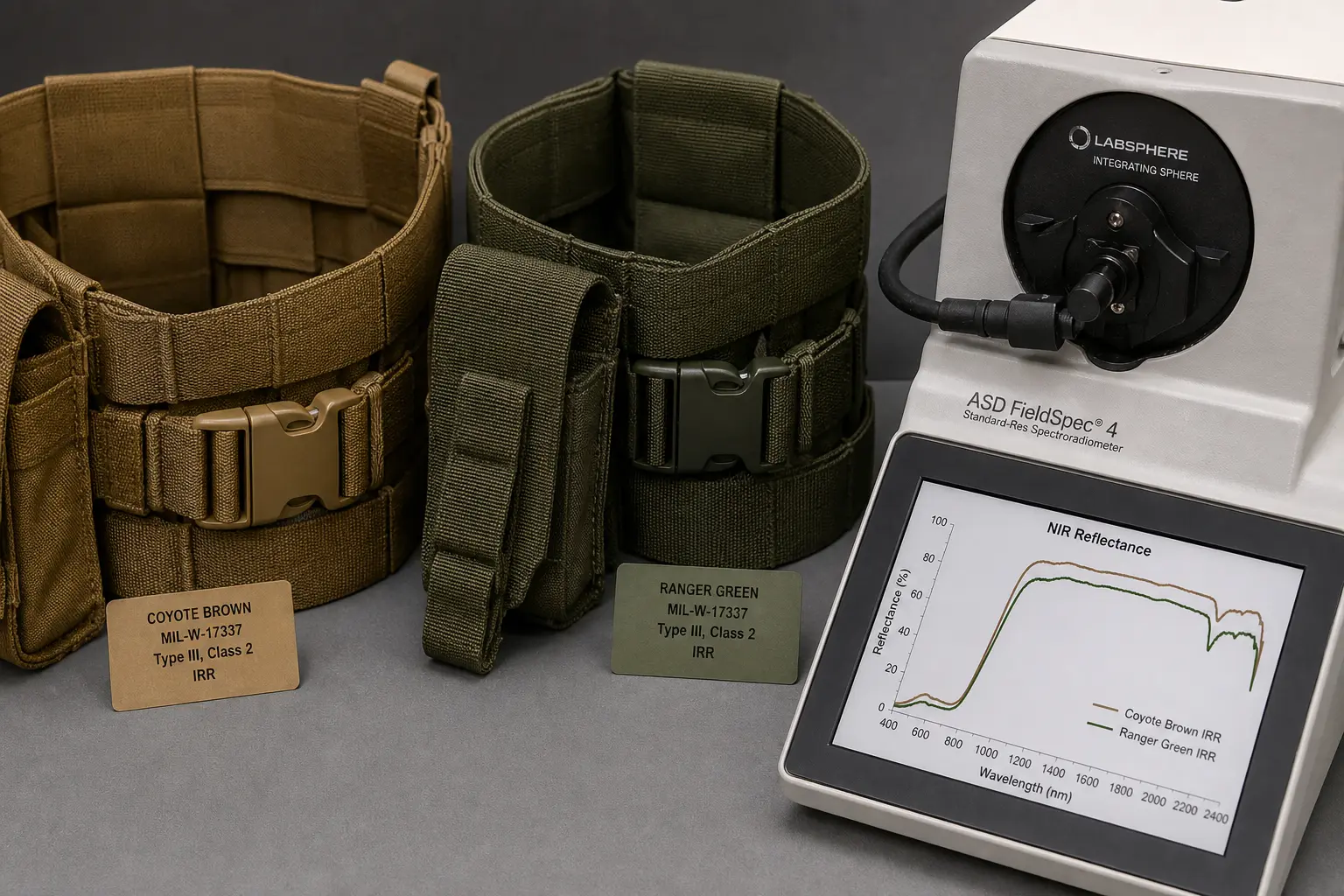
A Generation 3 night-vision device amplifies ambient near-infrared light. It cannot "see" color in the visible sense. What it detects is the spectral reflectance curve of every material in its field of view. Natural vegetation — grass, leaves, bark — reflects near-infrared light in a characteristic pattern between 700 and 1,200 nm. If a piece of webbing reflects NIR light at a higher or lower level than its background, it creates contrast. That contrast is visible to the operator even if the webbing is dyed in perfect visual camouflage.
This is the problem IRR webbing solves. IRR stands for Infrared Reflectance (sometimes written Infra-Red Resistant or IR-Reflective depending on the application context). IRR webbing uses specialized dye systems engineered to match the NIR reflectance signature of natural environments, so that the webbing disappears under night vision in the same way it disappears visually.
This guide explains the underlying physics, the standards framework, how to read a compliance report, and what to watch out for when sourcing IRR webbing for defense and tactical applications.
1. Why Standard Webbing Fails Night Vision
The human eye perceives light from approximately 380 to 700 nm. Night-vision devices (NVDs) — particularly Generation 2+ and Generation 3 image intensifier tubes — operate primarily in the near-infrared (NIR) band: 700 to 900 nm, with sensitivity extending to around 1,200 nm.
Here is the core problem: the relationship between a dye's visible color and its NIR reflectance is essentially random for conventional carbon-based dyes. A standard olive drab dye is engineered to absorb specific wavelengths of visible light to produce that green-brown hue. What it does in the NIR is a byproduct of its molecular structure — not designed, not controlled.
In practice, most conventional dyed fabrics exhibit NIR reflectance values that are far too high:
| Material / Color | Visible Appearance | NIR Reflectance @ 800 nm (typical) | NVD Appearance |
|---|---|---|---|
| Natural deciduous leaf | Green | ~45–55% | Medium gray (baseline) |
| Standard OD green nylon | Olive Drab | ~60–75% | Bright white — high contrast |
| Standard black nylon | Black | ~5–15% | Dark black — high contrast |
| IRR Ranger Green (compliant) | Ranger Green | ~35–50% | Medium gray (blends with vegetation) |
| IRR Coyote Brown 498 (compliant) | Coyote Brown | ~28–50% | Medium gray (blends with arid terrain) |
The key insight: both a too-bright and a too-dark material create detectable contrast. Standard black webbing appears as a dark silhouette against medium-gray vegetation. Standard OD green appears as a bright blob. Only a material with calibrated NIR reflectance within the target range blends in.
The "Green Spike" Problem
Many synthetic dyes exhibit an artifact called the "green spike" — a sharp increase in reflectance at the 700–800 nm boundary that does not match any natural material. When viewed through a Gen 2+ device, this creates a characteristic halo or bloom effect around webbing components, even on gear otherwise correctly camouflaged with IRR fabric. The patch of webbing literally glows.
This is why it is insufficient to source IRR-compliant fabric and then attach standard webbing. Every component — MOLLE loops, shoulder straps, waist belts, chest harnesses — must use IRR-treated material throughout the assembly.
2. How IRR Dyes Work
IRR dyeing is not a surface coating applied after weaving. It is a fundamental modification to the dye chemistry used to color the yarn or the woven fabric. There are three primary approaches:
A. Solution Dyeing (Dope Dyeing)
IRR-active pigment particles are introduced into the polymer melt before extrusion. The pigment is dispersed throughout the fiber cross-section, not just on the surface. Benefits:
- IRR performance does not degrade with washing, abrasion, or UV exposure
- Color and IRR are permanently bound to the fiber structure
- Best option for high-cycle load-bearing applications where abrasion is severe
Limitation: color is fixed at extrusion. Changing color requires a new batch of yarn — minimum quantities are higher (typically 2,000–5,000 m per color).
B. Piece Dyeing with IRR-Active Disperse Dyes
The woven webbing is dyed in a dye bath using disperse dyes specifically selected for their NIR behavior. Conventional disperse dyes are screened and replaced with IRR-compliant alternatives that:
- Absorb visible light to achieve the target color
- Produce a controlled, calibrated NIR reflectance in the 700–1,200 nm range
- Meet AATCC 16 / ISO 105-B color fastness ≥ Grade 4
This is the most common approach for nylon and polyester webbing production. MOQ is lower (500–1,000 m per color), and color matching is more flexible.
C. Transfer Printing for Camouflage IRR Webbing
For patterned camouflage webbing (MultiCam, Woodland, Desert MARPAT), IRR inks are used in the printing process. Each ink color in the pattern must independently meet its NIR target. This is technically demanding: the printer must formulate inks for visible appearance AND NIR performance simultaneously, and verify that ink layering does not create additive NIR errors.
3. Standards Framework
IRR webbing is governed by a layered set of US military and NATO standards. Understanding which standard applies to your procurement is critical.
MIL-W-17337 (US Navy, General Military Use)
The primary MIL-W-17337 specification covers woven nylon webbing for load-bearing use. IRR requirements are defined in the color and finish tables within the specification. Key requirements for IRR-compliant lots:
- NIR reflectance measured per MIL-PRF-29132 test method
- Reflectance limits defined by color code (e.g., Coyote 498, Ranger Green, MultiCam)
- Color fastness to light: minimum AATCC 16 Grade 4 (equivalent to 40 AATCC Fading Units)
- Breaking strength and elongation requirements unchanged from standard webbing
A-A-55301 (Commercial Item Description, Polyester Webbing)
Covers polyester woven webbing as a commercial item description. IRR variants require the same NIR reflectance documentation. Often specified in procurement for non-combat tactical gear where cost is more sensitive.
STANAG 2338 (NATO — IRR Green for Military Equipment)
NATO's primary standard for infrared-reflective green on military equipment surfaces. Defines the reflectance window for NATO Green in the NIR range. Webbing exported to NATO member nations (UK, Germany, France, Sweden, Finland, Poland) must comply with this standard for procurement acceptance.
STANAG 4606 (NATO — Spectral Signature)
Broader NATO standard covering spectral signature management across UV, visible, NIR, and thermal infrared bands. Increasingly referenced in next-generation soldier system procurements that require multi-spectral concealment beyond just NIR.
IRR Reflectance Windows by Color (Reference Values)
| Color / Shade | 600–700 nm (Visual Match) | 700–800 nm (IR Signature Control) | 800–1200 nm (NVD Stealth) |
|---|---|---|---|
| Coyote Brown 498 | 8–26% | 28–50% | 35–65% |
| Ranger Green | 6–22% | 25–48% | 32–60% |
| MultiCam (per zone) | Variable by zone | Zone-specific targets | Must not exceed +10% of target fabric |
| Woodland Green (darker zones) | 4–18% | 22–44% | 30–55% |
| Black (IRR-treated) | 2–10% | 8–22% | 10–30% |
Note: These are reference ranges based on published MIL-SPEC and procurement documentation. Specific program requirements may differ. Always request batch test reports against the applicable standard.
4. How to Verify IRR Compliance
Visual inspection cannot verify IRR compliance. A compliant and non-compliant swatch look identical in daylight. Verification requires spectrophotometric testing — a laboratory instrument measures reflectance at each wavelength from approximately 350 nm to 2,500 nm and plots the result as a spectral curve.
What a Compliant Test Report Must Show
When requesting a test report from your supplier or a third-party lab (SGS, Intertek, BV), the report should include:
- Instrument make/model — Typically a Shimadzu UV-2600, PerkinElmer Lambda, or equivalent double-beam spectrophotometer with integrating sphere
- Measurement geometry — Di:8° (diffuse illumination, 8° detection) or di:0° as specified by the test method
- Wavelength range — Minimum 600–1,200 nm; full spectrum 350–2,500 nm for STANAG 4606 compliance
- Measurement interval — 10 nm or finer
- Reference standard used — PTFE or BaSO₄ white reference tile with calibration date
- Actual reflectance values at each measured wavelength — not just a pass/fail statement
- Applicable specification and lot number — links the result to the specific production batch
A test report that only states "Meets MIL-W-17337 IRR requirements" without providing the underlying spectral data is insufficient for serious procurement. Demand the curve data.
For guidance on reading the full set of parameters in a webbing test report — including tensile strength, elongation, and color fastness — see our Webbing Test Report Reading Guide.
Field Verification
A useful (though not definitive) field check: a Gen 2 or Gen 3 NVG or monocular. Under NIR-rich ambient light (overcast daylight or near a 940 nm IR illuminator), non-compliant webbing will appear distinctly brighter or darker than surrounding vegetation. This is not a replacement for spectrophotometric certification, but it can flag obvious failures before expensive third-party testing.
5. Material Considerations for IRR Webbing
Nylon 6.6 vs Polyester
Both nylon and polyester can carry IRR treatments, but they behave differently in the dyeing process. The choice has implications for IRR performance durability:
| Property | Nylon 6.6 (High-Tenacity) | Polyester (PES) |
|---|---|---|
| Dye class used | Acid dyes + IRR-active dye bath | Disperse dyes + IRR-active disperse |
| IRR dye penetration | Deep fiber penetration, excellent wash durability | Good penetration at high temperature (130°C) |
| Typical breaking strength (25 mm) | ≥ 5,000 N (MIL-W-17337 compliant) | ≥ 4,200 N (A-A-55301 compliant) |
| UV resistance of IRR dyes | Good; AATCC 16 Grade 4 | Very good; AATCC 16 Grade 4–5 |
| Water absorption | ~4.5% — slight NIR shift when wet | ~0.4% — stable NIR under all humidity |
| Preferred use | Load-bearing, parachute, jump harness | Ground force gear, lower-weight applications |
Important note on nylon moisture: Wet nylon has slightly elevated NIR reflectance compared to dry. For webbing used in amphibious or wet-environment operations, confirm that the IRR test report was measured on conditioned (dry) samples as per the specification, and consider whether wet-state NIR performance needs separate qualification.
Compatibility with Other Finishes
IRR webbing is frequently combined with functional finishes. Compatibility must be verified on a case-by-case basis:
- Flame retardant (FR) finishes: Most FR chemistry is compatible with IRR dyes. However, certain phosphorus-based FR agents can shift NIR reflectance by 3–8% — enough to push borderline lots out of compliance. Specify that IRR testing must be performed after FR application.
- DWR (water repellent) coatings: Fluorocarbon-free DWR finishes are generally compatible. Silicone-based coatings can increase NIR reflectance by creating a high-luster surface. Use matte or semi-matte finish DWR where IRR compliance is required.
- Anti-static treatments: Generally no NIR impact at standard application weights.
For a comprehensive overview of functional finishes and their interactions, see our Webbing Finishing Treatments Guide.
6. IRR Webbing in System Integration
A common procurement mistake is treating IRR webbing as a single-material specification rather than a systems requirement. Modern military gear — a plate carrier, for example — is an assembly of multiple materials that must achieve collective NIR compliance:
- Shell fabric (IRR-treated cordura or ripstop)
- Load-bearing webbing (IRR-treated, MIL-W-17337)
- MOLLE loop webbing (IRR-treated, typically 1" or 1.5" wide)
- Buckles and hardware (anodized or coated to suppress NIR glint)
- Hook and loop fasteners (IRR-compliant hook-and-loop systems exist; standard Velcro fails NIR)
- Shoulder pad foam and cover material
- Drag handles (separate webbing component, must also be IRR)
When a procurement office specifies "IRR webbing," it means every woven component on the assembly must carry IRR treatment. Substituting one compliant part while using standard webbing elsewhere creates a patchwork of NIR signatures that is often more detectable than all-standard gear, because the contrast between compliant and non-compliant components creates a distinct pattern.
Color Matching Between Components
IRR dyeing chemistry differs from standard dyeing chemistry. When multiple suppliers provide different components (one supplier for shell fabric, another for webbing), it is entirely possible to have two pieces of "Coyote Brown" that match visually but have different NIR reflectance curves. Color matching must be done under both D65 standard illuminant (visible) and verified against the same NIR reference.
Request that your webbing supplier provide a spectral reference file (.csv or .sp) from their spectrophotometer for the lot. Cross-check against the reference file from the fabric supplier. The NIR curves should overlap within the tolerance band of the applicable standard.
7. Pricing, MOQ, and Lead Times
IRR webbing commands a premium over standard mil-spec webbing due to the cost of IRR-active dyes, additional testing, and tighter process controls. Typical cost premiums for 2026:
| Webbing Type | Approx. Premium vs Standard | Typical MOQ | Lead Time |
|---|---|---|---|
| IRR solid color (nylon, stock shades) | +15–20% | 500–1,000 m | 15–25 days |
| IRR solid color (custom Pantone match) | +20–30% | 1,000–2,000 m | 25–35 days |
| IRR camouflage printed (screen print) | +30–40% | 2,000–3,000 m | 30–45 days |
| IRR camouflage printed (digital print) | +35–50% | 500–1,000 m | 25–35 days |
| IRR + FR dual-function | +40–60% | 2,000–5,000 m | 35–50 days |
For a detailed breakdown of MOQ economics and strategies to reduce minimum order requirements, see our Webbing MOQ Guide.
8. Red Flags When Sourcing IRR Webbing
The IRR webbing market has suppliers ranging from genuine specialists to traders who apply the "IRR" label without technical backing. Watch for these warning signs:
- No spectral data in the test report. A report that says "pass" without providing the reflectance curve is not a compliant test report. Real IRR tests produce a graph and a table of values.
- Testing done before finishing. If the test was performed on undyed yarn or unfinished greige fabric, it tells you nothing about the finished webbing.
- IRR claimed on standard product codes. Some suppliers add "IRR" to a product listing for a standard nylon webbing without changing the dye system. Ask for the specific lot-tested sample and its test date.
- Single-wavelength testing. A measurement at one NIR wavelength (e.g., 850 nm only) does not characterize the full spectral curve. The requirement is typically measured at 10 nm intervals across the full range.
- Color fastness not tested after IRR dyeing. IRR dyes can have lower wash fastness than conventional dyes. Color fastness should be tested on the final IRR-treated product, not on a standard version.
- No batch number on test report. Without batch traceability, there is no guarantee the tested lot matches what was shipped.
9. TMG Webbing IRR Capabilities
TMG Webbing manufactures IRR-compliant nylon and polyester webbing for defense contractors, tactical gear brands, and government procurement programs. Our IRR production process includes:
- Piece dyeing with screened IRR-active dye systems — all IRR dye lots are selected from approved dye libraries pre-screened for NIR behavior
- In-house spectrophotometric testing — every production lot is measured on a calibrated instrument against the applicable standard before release
- Batch-specific test reports — spectral curve data (350–1,200 nm) provided with each shipment, including color fastness and tensile strength in the same document
- IRR + FR and IRR + DWR dual-function capability — with post-finish retesting to confirm IRR compliance is maintained after functional treatment
- MIL-W-17337 and A-A-55301 compliance for applicable color codes
Standard IRR colors in stock: Coyote Brown 498, Ranger Green, OD Green, Black (IRR). Custom color matching available with 2,000 m MOQ and 35-day lead time.
Request IRR Webbing Samples & Spectral Data
Sourcing IRR webbing for a defense or tactical gear program? Request a sample kit with accompanying batch spectral reports — no obligation.
Request IRR Samples View Military WebbingFrequently Asked Questions
What does IRR stand for in military webbing?
IRR stands for Infrared Reflectance (or Infrared Resistant). IRR webbing is engineered so its near-infrared spectral signature matches natural vegetation in the 700–900 nm wavelength range, rendering it invisible to Generation 2 and Generation 3 night-vision devices.
Why does standard webbing fail night vision detection tests?
Conventional carbon-based dyes reflect near-infrared light unpredictably — often appearing as bright white or gray blobs under night vision goggles regardless of their visible color. A standard olive drab webbing can have NIR reflectance above 60–75%, while natural vegetation typically sits between 35–50% in the 700–900 nm range. The discrepancy creates contrast detectable by any Gen 2+ device.
Which standards govern IRR webbing?
The primary US standards are MIL-W-17337 (nylon webbing with IRR requirements) and A-A-55301 (polyester webbing). NATO STANAG 2338 defines IRR green color for equipment. STANAG 4606 covers the broader spectral signature standard for materials.
Can I verify IRR compliance without a full lab test?
No. IRR compliance can only be verified with a spectrophotometer measuring reflectance at specific wavelength intervals (typically every 10 nm from 600–1,200 nm). Visual inspection is completely unreliable — a non-compliant webbing can look identical to a compliant one in daylight. A Gen 3 NVG field check is useful for flagging obvious failures but is not a substitute for spectrophotometric certification.
Does IRR webbing cost more than standard webbing?
Yes, typically 15–35% more than equivalent standard mil-spec webbing. The premium reflects IRR-active dyes (3–5× more expensive than conventional dyes), additional spectrophotometric QC testing per batch, and tighter process controls during dyeing. IRR + FR dual-function webbing carries a 40–60% premium.