
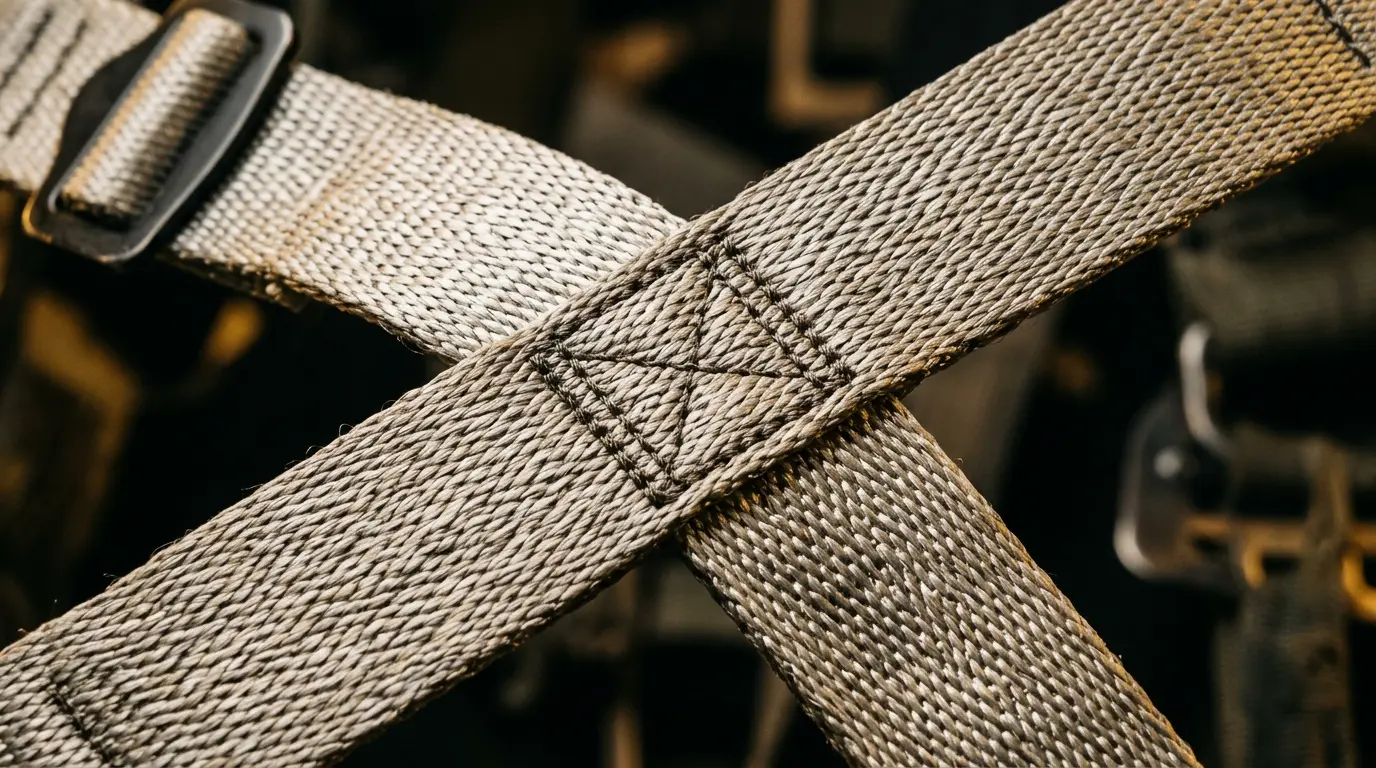
Every gram counts at altitude. When a soldier, paramedic, or cargo pallet is descending under a parachute, the harness webbing is the only thing standing between the load and the ground. For decades, the material of choice was Type 6.6 nylon, governed by specifications like MIL-W-4088K. But a new class of ultra-high-performance fibers—chief among them UHMWPE (Ultra-High Molecular Weight Polyethylene), sold under brand names like Dyneema and Spectra—is rewriting the engineering rules of parachute design.
This guide is written for engineers, procurement officers, parachute manufacturers, and tactical brands evaluating UHMWPE webbing as a material upgrade for their parachute components. We'll compare it against traditional nylon, examine where it excels, where it has limits, and how to approach sourcing and qualification.
What Is UHMWPE and Why Parachute Engineers Are Paying Attention
UHMWPE is a subset of polyethylene with an exceptionally long molecular chain—molecular weight typically above 3.5 million g/mol. This long-chain structure produces a material with extraordinary tensile strength while remaining significantly lighter than most engineering materials.
In parachute applications, three UHMWPE properties stand out above all others:
- Strength-to-weight ratio: UHMWPE has a tensile strength approximately 15x greater than steel by weight. A 25mm UHMWPE webbing with a 3,500 kg breaking strength weighs roughly 35-40% less than an equivalent nylon webbing.
- Zero moisture absorption: UHMWPE does not absorb water—unlike nylon, which can absorb up to 8-10% of its weight. This means no strength loss from saturation and no dimensional change after prolonged moisture exposure.
- Chemical inertness: UHMWPE resists saltwater, most chemicals, and biological fluids. For maritime parachute operations (naval rescue, amphibious insertions), this is a decisive advantage over nylon.
UHMWPE vs. Nylon for Parachute Webbing: Head-to-Head
Both materials have a legitimate place in parachute engineering. The right choice depends on the specific application, certification requirements, and operational environment.
Breaking Strength and Stretch
Nylon webbing for parachute harnesses (per MIL-W-4088K) achieves breaking strengths in the 2,700-7,000 kg range depending on type and width. UHMWPE webbing of equivalent or greater breaking strength achieves it at 40-60% lower weight. This weight reduction directly benefits:
- Sport and competition parachutes — every gram saved in the harness is additional altitude or range
- Reserve parachutes — jumper weight savings accumulate across multiple reserve setups
- Cargo extraction systems — lighter harness assemblies reduce overall system drag
Nylon does have one mechanical advantage: controlled elasticity. Nylon webbing stretches 15-25% under load, which helps absorb deployment shock. UHMWPE webbing is much stiffer (typically <5% stretch at breaking strength), meaning the system designer must account for shock loads through other design mechanisms—stitching patterns, hardware geometry, or auxiliary energy absorption elements.
Temperature Performance
For parachute operations in extreme cold, UHMWPE has a clear edge. Nylon loses ductility and becomes increasingly brittle below approximately -30°C. UHMWPE retains its mechanical properties down to cryogenic temperatures, with no reported embrittlement down to -196°C.
The trade-off is high-heat resistance. UHMWPE begins to soften around 130-140°C and melts at 144-152°C. In contrast, aramid fibers (Kevlar) maintain integrity up to 425°C. If your parachute system operates near a heat source or in an environment where flame exposure is possible, aramid webbing may be the appropriate choice. For a full comparison, see our Kevlar vs. Dyneema/UHMWPE comparison guide.
UV and Weather Resistance
Parachute systems spend significant time deployed at altitude under intense UV radiation. Nylon webbing can lose up to 30% of its tensile strength after 500 hours of accelerated UV exposure, even with UV-resistant finishes. UHMWPE's closed molecular structure absorbs essentially no UV radiation, providing natural resistance to photodegradation without additional treatment.
For systems that may be deployed from high-altitude aircraft or stored on vehicle rooftops for extended periods, this UV stability is a significant operational advantage. For a deeper look at outdoor webbing lifespan, read our UV resistance and webbing lifespan guide.
Where UHMWPE Webbing Fits in Parachute System Design
UHMWPE webbing is not a universal replacement for nylon in all parachute applications. Understanding where it adds the most value helps engineers make better specification decisions.
Best-Fit Applications
- Personnel reserve parachutes — weight savings accumulate across the harness, and the lower weight improves overall flight performance
- High-altitude military operations — UHMWPE's cold-temperature ductility and UV resistance suit high-altitude, long-delay deployment scenarios
- Maritime and naval rescue parachutes — UHMWPE's resistance to saltwater and biological fluids eliminates the moisture-related degradation risk
- Cargo extraction webbing and bridles — UHMWPE's high strength at low weight reduces the mass of the extraction system itself, improving payload capacity
- Sport and competition parachutes — canopy design competitions and formation skydiving where harness weight is a performance variable
Where Nylon Remains the Standard
- Systems with MIL-W-4088K compliance requirements — this specification was written for nylon; switching to UHMWPE requires re-certification
- High-heat environments — UHMWPE's low melting point makes it unsuitable near engine exhausts or in proximity to pyrotechnic charges
- Applications requiring controlled stretch — where the shock-absorbing elongation of nylon is a designed safety feature
Custom UHMWPE Webbing for Parachute Systems: What to Specify
Sourcing UHMWPE webbing for parachute applications requires attention to specific parameters that differ from standard industrial webbing. Here's what your specification sheet should include:
- Breaking strength target — Specify minimum breaking strength in kg or lbs, not just width. A 38mm webbing can range from 1,500 kg to 5,000 kg depending on fiber count and construction.
- Width and thickness tolerances — Parachute harness construction often requires precise width control for routing through hardware. Specify +/- tolerances appropriate for your components.
- Weave construction — Flat woven UHMWPE is most common. Tubular UHMWPE (for soft links or sewn loops) is also available. Tubular construction can affect weight and flexibility.
- Stretch requirements — Specify maximum elongation at working load if the system design requires controlled stretch.
- Finish treatment — If UV or abrasion resistance beyond UHMWPE's inherent properties is needed, specify coating or finishing treatments.
- Certification and traceability — For military and aerospace applications, request lot-specific test certificates showing actual breaking strength, elongation, and width.
TMG Webbing manufactures custom UHMWPE webbing to your exact specification. Our high-performance webbing catalog covers standard widths from 12mm to 100mm, with breaking strengths from 500 kg to 8,000 kg.
The Sewing Challenge: Processing UHMWPE for Parachute Hardware
UHMWPE's outstanding strength comes with a manufacturing complexity: the same properties that make it strong also make it difficult to cut and sew. The fibers are extremely slippery and have low surface friction, meaning standard stitching patterns can pull out under sustained cyclic loading.
For parachute webbing assemblies, UHMWPE requires:
- Specialized sewing thread — High-tenacity UHMWPE or aramid thread with a minimum of 3-4 stitches per centimeter in critical load paths
- Heat-sealed or ultrasonic-cut edges — Precision cutting to prevent fiber fraying, which can compromise strength at cut points
- Reinforcement stitching patterns — Box-X patterns, bar tacks, and load path stitching rather than simple linear seams
TMG Webbing works with certified parachute assembly partners who specialize in UHMWPE processing. We can also supply pre-finished webbing cut to your specification. For more on the processing challenges of UHMWPE, read our guide to sewing and cutting UHMWPE webbing.
Sourcing Checklist: UHMWPE Parachute Webbing
Before placing an order or qualifying a supplier for UHMWPE parachute webbing, verify the following:
- Fiber source: UHMWPE is produced by a limited number of global manufacturers (DSM, Asahi Kasei, others). Ask your supplier for the fiber brand and grade to ensure consistency across orders.
- Lot-specific test reports: Every production lot should come with certified breaking strength test data. Do not accept "typical values" alone—request the actual test results for your specific lot.
- Width and thickness certification: Verify actual measured values against your specification tolerance.
- Processing compatibility: Confirm the supplier's experience with UHMWPE parachute webbing specifically, not just general industrial UHMWPE webbing. The sewing and finishing requirements differ significantly.
- Lead time and inventory: UHMWPE fiber supply is tighter than commodity materials. Verify lead times and minimum order quantities upfront.
- Color availability: UHMWPE takes dye differently than nylon. Standard natural (white) UHMWPE is most readily available; custom colors require longer lead times and higher minimums.
TMG Webbing: Your UHMWPE Parachute Webbing Partner
Whether you're engineering a next-generation tactical parachute, sourcing harness webbing for a rescue program, or building competition-grade sport equipment, TMG Webbing provides factory-direct access to high-performance UHMWPE webbing manufactured to your exact specifications.
We understand the critical nature of parachute components. Every meter of webbing we produce undergoes individual breaking strength verification, with full traceability from raw fiber to finished product.
Ready to discuss your UHMWPE parachute webbing requirements? Contact our technical team with your specification sheet for a custom quote and sample lead time.