
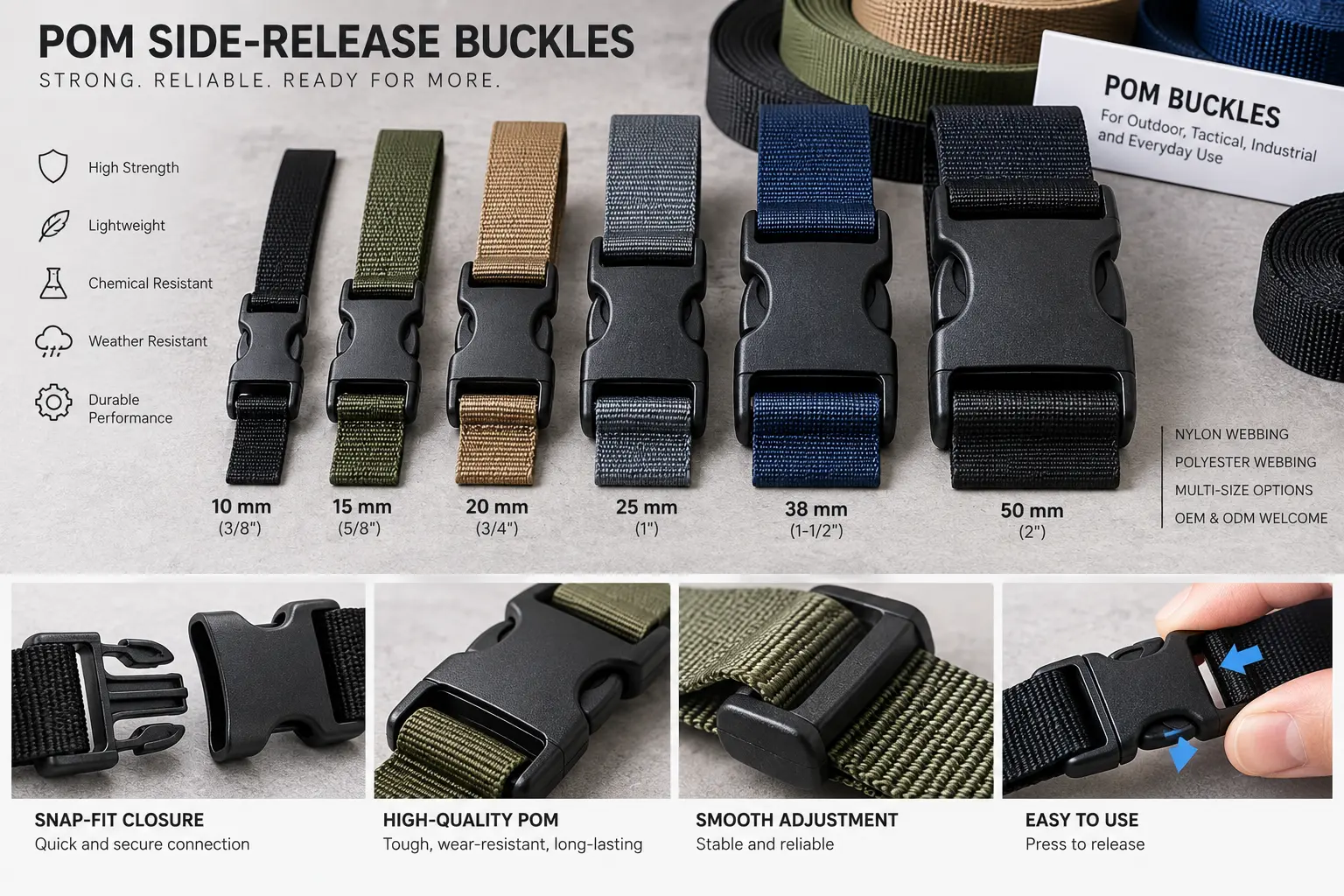
The side-release buckle is one of the quietest engineering successes in modern gear. It appears on tactical vests, pet harnesses, baby carriers, medical straps, and backpacks — and in load-bearing applications, the buckle, not the webbing, is usually the weakest link in the assembly. That is why the buckle material matters so much: POM (polyoxymethylene, also known as acetal) has become the default choice for serious side-release hardware, and choosing it correctly is a genuine engineering decision, not an afterthought.
This guide is written for product designers and OEMs specifying plastic buckles for load-bearing webbing. It covers why POM dominates the category, realistic strength ratings by buckle size, POM vs nylon vs metal trade-offs, the webbing compatibility factors that cause field failures, and the custom color and logo options available at production volume. For the broader hardware landscape, see the webbing hardware and buckles guide.
Why POM Dominates Side-Release Buckles
POM is a high-crystallinity engineering plastic with a property profile that happens to be nearly ideal for buckles:
- Snap-fit retention: The side-release mechanism depends on flexing latches that must spring back thousands of times. POM's fatigue resistance keeps the snap firm after years of use, where cheaper plastics go soft or crack.
- Stiffness & creep resistance: POM barely deforms under sustained load, so the buckle holds its shape and its strength.
- Low friction & dimensional stability: Molded to tight tolerances, POM parts release cleanly and stay consistent across production lots.
- Cold & wet performance: POM absorbs virtually no water and keeps good impact strength in cold conditions — critical for outdoor, tactical, and winter gear.
- Special grades: Flame-retardant POM grades meet the strict flammability requirements of child-safety seats and some medical applications.
Strength Ratings by Buckle Size
Buckle strength scales with size, and the numbers below are realistic tensile (straight-pull) ranges for quality molded side-release buckles. Always confirm the manufacturer's rating for the specific part — and remember that cross-loading the gate sideways produces far lower failure loads than straight tensile.
| Buckle Size | Typical Breaking Strength | Common Applications |
|---|---|---|
| 20 mm | 50-70 kgf | Light straps, pet collars, small bags |
| 25 mm | 70-100 kgf | Backpacks, dog harnesses, general gear |
| 38 mm | 100-150 kgf | Tactical vests, heavy packs, safety straps |
| 50 mm | 150-250 kgf | Heavy load-bearing, military & rescue |
For load-bearing applications, apply a safety factor of at least 3-4: a strap with a 100 kg working load needs a buckle rated comfortably above 300-400 kgf. And test the full assembly — webbing, stitching, and buckle together — because a well-stitched nylon strap usually outstrengths the plastic hardware attached to it. If your application is genuinely life-safety (fall protection, rescue), plastic side-release buckles are generally not the right fastener at all; see the safety webbing guide for that domain.
POM vs Nylon vs Metal Buckles
| Attribute | POM (Acetal) | Nylon (PA66) | Metal (Zinc/Steel) |
|---|---|---|---|
| Tensile strength | High | High | Highest |
| Fatigue / cycles | Excellent | Good | Excellent |
| Water uptake | Negligible | Absorbs, weakens | None (can rust) |
| Cold performance | Good | Degrades when wet + cold | Good |
| Weight | Light | Light | Heavy |
| Cost | Mid | Low-Mid | Mid-High |
| Best for | Load-bearing, outdoor, cold | Consumer straps | Extreme loads, dress, premium |
The practical summary: POM for load-bearing plastic hardware, nylon for cost-driven consumer straps, metal where the load or the aesthetic demands it. Many products mix all three — a tactical pack might use a POM side-release on the waist belt, metal ladder locks on shoulder straps, and nylon cord locks elsewhere.
Webbing Compatibility: The Failures Nobody Tests
Most buckle field failures are compatibility failures, not material failures. Check three dimensions when specifying:
- Width match: The buckle slot must equal the webbing width exactly. Too wide and the webbing slips and pivots; too narrow and it will not seat or will abrade. Standard widths are 20, 25, 38, and 50 mm.
- Thickness / stack height: The slot depth must fit the webbing plus anything laminated or stitched to it. Standard webbing runs 1.5-2.5 mm, but TPU-coated webbing, reinforced straps, and box-stitched overlaps are thicker. A 25 mm buckle for standard webbing may not close over a coated strap.
- Weave surface: Slick coated webbing needs a buckle with more positive retention; soft thick webbing can jam in a tight gate.
The safest practice: send your actual webbing to the hardware supplier and test the mated pair, then assemble and pull-test the complete product. For pet and tactical programs, the bulk webbing sourcing guide and the hardware guide cover matching widths and hardware across a full product line.
Custom Colors, Logos, and Compliance
At production volume, POM buckles are highly customizable:
- Color matching: Molded in custom colors to match a Pantone or your webbing colorway — the standard for brand programs.
- Logo options: Embossed (molded-in), debossed, or pad-printed logos on the buckle face; molded-in logos are the most durable.
- Compliance grades: Flame-retardant POM for child-safety seats; food-contact and skin-contact safe grades for medical and baby products; UV-stabilized grades for outdoor service.
- MOQ reality: Custom-molded buckles typically start at 5,000-10,000 pieces per design (tooling amortized); custom colors on existing molds start lower.
Pairing custom buckles with custom webbing in one program shortens the supply chain and guarantees dimensional compatibility — one of the quiet advantages of sourcing hardware and webbing from a coordinated supplier.
Match Your Webbing to the Right Buckle
TMG Webbing manufactures load-bearing nylon and polyester webbing and coordinates POM buckle supply matched to your exact width and thickness, with custom colors and logo programs at production volume. Send your strap spec, target working load, and hardware requirements — our engineering team responds with a compatibility review and quote within 48 hours.
Request a Hardware Quote Talk to an EngineerFrequently Asked Questions
What is a POM buckle?
A POM buckle is a plastic buckle molded from polyoxymethylene (POM, also called acetal or Delrin) — a high-strength engineering plastic with excellent stiffness, fatigue resistance, and dimensional stability. POM is the standard material for side-release buckles on tactical vests, pet harnesses, backpacks, and medical straps because it holds its snap-fit detents over thousands of cycles and performs in cold weather where cheaper plastics turn brittle.
How strong is a POM side-release buckle?
Typical breaking strengths by size: a 20mm side-release buckle holds roughly 50-70 kgf, a 25mm buckle 70-100 kgf, a 38mm buckle 100-150 kgf, and a 50mm heavy-duty buckle 150-250 kgf in tensile testing. The practical working load should be kept well below breaking strength with a safety factor of at least 3-4 for load-bearing applications. Note that side-load (cross-loading the gate) is far weaker than straight tensile — always check how the manufacturer rates the part.
POM or nylon buckles — which is better for webbing?
POM is stiffer, more fatigue-resistant, and keeps its snap-fit feel over more cycles; it also performs well cold and doesn't absorb water. Nylon (polyamide) buckles are slightly tougher against impact and cheaper but absorb moisture, which degrades their strength and low-temperature behavior. For load-bearing and cold-weather gear, POM is usually preferred; for low-cost consumer straps, nylon is common. Flame-retardant POM grades are used in child-safety seats.
How do I match a buckle to my webbing?
Match three things: (1) width — the buckle slot must equal the webbing width (20/25/38/50mm standards); (2) thickness — the slot depth must fit your webbing plus any coating or reinforcement, usually 1.5-2.5mm for standard webbing; and (3) strength — the buckle's rated strength must meet your working load with a safety factor, considering that a stitched webbing strap is often stronger than the plastic buckle. Test the full assembly, not just the components.