
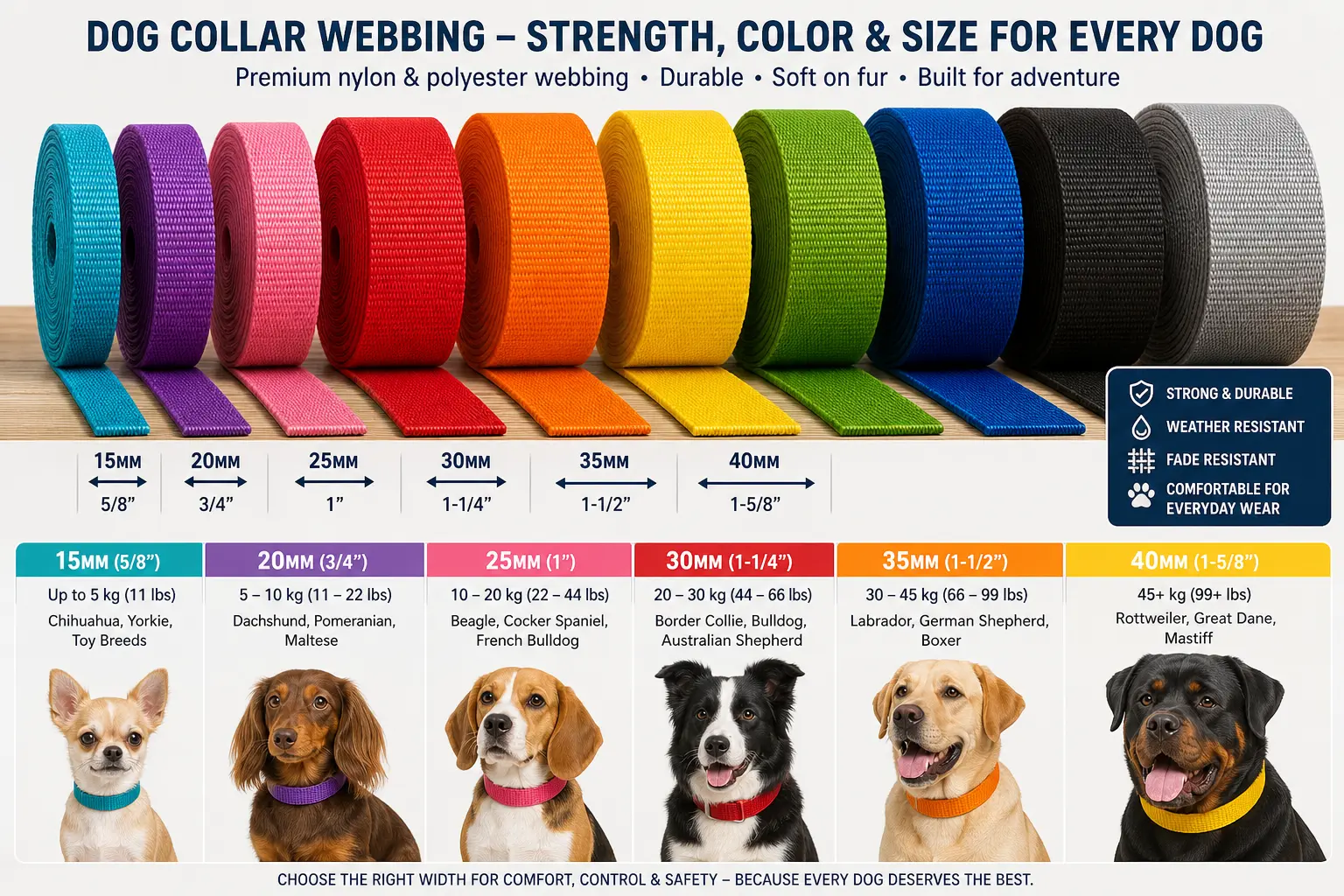
The global dog collar, leash, and harness market reached $4.28 billion in 2026 and is projected to hit $8.42 billion by 2035 (7.5% CAGR). Behind every collar is a strip of webbing — and the material you choose directly determines whether your product holds up to a 50 kg puller or snaps on the first walk.
This guide covers everything a pet product brand, distributor, or contract manufacturer needs to know about selecting webbing for dog collars: material comparison, breed-specific width sizing, tensile strength requirements, printing options, hardware pairing, and MOQ expectations.
Material Comparison: Nylon, Polyester, and Polypropylene
Three materials dominate the dog collar webbing market. Each has a clear role — choosing the wrong one is the most common sourcing mistake we see from new pet brands.
| Property | Nylon | Polyester | Polypropylene (PP) |
|---|---|---|---|
| Tensile Strength | Highest (2,000–4,500 N for 25 mm) | High (1,800–3,800 N for 25 mm) | Low (800–1,500 N for 25 mm) |
| UV / Fading Resistance | Moderate — fades after prolonged sun exposure | Excellent — best for outdoor use | Poor — becomes brittle with UV exposure |
| Absorbency | Absorbs water, dries slowly, stretches when wet | Does not absorb water, dries fast, mildew-resistant | Does not absorb water, floats |
| Softness / Hand Feel | Very soft, high gloss finish | Soft, matte finish | Rough, stiff hand feel |
| Custom Printing | Screen print only | Screen print + sublimation (full color) | Screen print only |
| Cost (25 mm, stock color) | $$$ Premium | $$ Mid-range | $ Budget |
| Best For | Heavy-duty collars, tactical harnesses, large breeds | Fashion collars, sublimation designs, outdoor/all-weather | Promo items, cat collars, low-cost accessories |
When to Choose Nylon
Nylon webbing delivers the highest tensile strength and abrasion resistance of the three materials. Its soft hand feel and glossy finish make it the preferred choice for premium and heavy-duty dog collars. The trade-off: nylon absorbs moisture (about 4–6% of its weight), which can lead to slight elongation when wet and slower drying times. For dogs that swim frequently, this matters.
Ideal use cases: Working dog collars, tactical harnesses, large/giant breed collars (40–50 kg+), training collars where durability is paramount.
When to Choose Polyester
Polyester webbing is the most versatile option for dog collars. It offers nearly the same strength as nylon with two critical advantages: superior UV resistance and zero water absorption. Polyester also supports heat sublimation printing, which means full-color, photo-quality designs can be permanently fused into the webbing fiber — not sitting on top as a surface print that cracks or fades.
Ideal use cases: Fashion and branded collars, outdoor/all-weather products, sublimation-printed designs, medium-to-large breed collars, leashes that get wet.
When to Avoid Polypropylene
PP webbing is the cheapest option — and it shows. With roughly half the tensile strength of nylon, a rough texture that can chafe thin-skinned breeds, and rapid UV degradation that makes it brittle over time, PP is only suitable for low-stakes applications: cat collars, promotional giveaway items, and lightweight accessories for toy breeds under 3 kg. We do not recommend PP webbing for any dog collar intended for breeds over 10 kg.
Breed-Specific Webbing Width Guide
Width determines two things: how well force is distributed across the dog's neck, and whether the collar has enough structural cross-section to meet strength requirements. The right width prevents both escape (too narrow/loose) and tracheal damage (too narrow on a strong puller).
| Dog Weight | Recommended Webbing Width | Typical Breeds | Min. Tensile Strength* |
|---|---|---|---|
| Under 5 kg (toy breeds) | 10–15 mm | Chihuahua, Yorkshire Terrier, Maltese | 500 N |
| 5–10 kg (small breeds) | 15–20 mm | Miniature Dachshund, Pomeranian, Shih Tzu | 800 N |
| 10–20 kg (small-medium) | 20–25 mm | Beagle, French Bulldog, Cocker Spaniel | 1,200 N |
| 20–35 kg (medium-large) | 25–30 mm | Labrador, Border Collie, Boxer | 1,800 N |
| 35–50 kg (large breeds) | 35–40 mm | Rottweiler, German Shepherd, Weimaraner | 2,500 N |
| 50 kg+ (giant breeds) | 40–50 mm | Great Dane, Mastiff, Saint Bernard | 3,500 N |
| Sighthounds (any weight) | ≥ 40 mm | Greyhound, Whippet, Saluki | 1,800 N |
*Minimum tensile strength based on the 7× body weight safety standard (see below). Values shown for the upper end of each weight class.
Why Sighthounds Need Extra Width
Sighthounds (greyhounds, whippets, salukis) have a unique anatomical feature: their head is narrower than their neck. Standard collars easily slip over their head — making wide webbing (minimum 40 mm) essential for safety. Wide collars also distribute pressure more evenly across their long, delicate necks, reducing the risk of tracheal injury.
The Two-Finger Fit Rule
Regardless of webbing width, the collar should allow exactly two flat fingers to fit between the webbing and the dog's neck. Too loose (fingers slide freely) = escape risk. Too tight (can't insert two fingers) = chafing and circulation restriction. For puppies, re-check fit every 2–3 weeks.
Tensile Strength Requirements: The 7× Body Weight Rule
The industry benchmark for dog collar and leash safety comes from ASTM D5034 (strip method tensile testing): the assembled product — webbing plus hardware — must withstand 7 times the dog's body weight without breaking. This is not a regulatory requirement in most markets (no mandatory standard currently exists in the US, UK, or EU), but it's the minimum threshold responsible manufacturers use.
Worked Example
A 30 kg Labrador requires a collar that holds at least 30 kg × 7 = 210 kg of force (≈ 2,060 N). A 25 mm nylon webbing at 2,500 N tensile strength provides a safety margin. A 25 mm PP webbing at 1,200 N would fail.
Shock Loading Matters More Than Static Strength
A dog lunging at full speed generates peak forces of 2–3× their body weight in a fraction of a second. Combined with the 7× safety factor, your hardware (buckles, D-rings) and stitching must handle these transient shock loads. This is why a 600 N webbing on a 30 kg dog isn't safe — the shock load alone can exceed 900 N, and the safety factor requires 2,060 N total.
Quality Testing Standards for Pet Webbing
Beyond tensile strength, professional pet product manufacturers test for:
- Colorfastness (AATCC 116 / AATCC 107): Dry rub ≥ 4.0, wet rub ≥ 3.5, wash color change ≥ 3.5. Low colorfastness webbing stains the dog's coat — a fast way to lose customer trust.
- Corrosion resistance (ASTM B117): Hardware exposed to 1% salt spray for 24 hours must show no visible corrosion. Zinc alloy buckles fail this test; stainless steel or PVD-coated hardware passes.
- Impact/shock test: A weight equal to the dog's body weight is dropped on the collar to simulate a sudden lunge. The entire assembly (webbing + hardware + stitching) must remain intact.
For a detailed walkthrough of how to read these test results, see our Webbing Test Report Guide.
Webbing Thickness and Weave Structure
Width isn't the only dimension that matters. Two collars of the same width can perform very differently depending on thickness and weave structure.
- Thickness: Standard dog collar webbing ranges from 0.8–2.0 mm. Thicker webbing distributes force better and lasts longer under abrasion. Giant breed collars should use ≥ 1.8 mm thickness.
- Plain weave vs. twill weave: Plain weave offers a tighter, flatter surface — ideal for printed collars. Twill weave is softer and more flexible — better for comfort-sensitive applications and heavy-duty use.
- Density (picks per inch): Higher density webbing has more yarn per centimeter, which directly correlates with higher tensile strength. Inspect samples with a magnifier — loose, gappy weaves indicate lower quality.
Custom Printing: Sublimation vs Screen Print vs Jacquard
Branded pet collars are the fastest-growing segment in the $4.3B market. The printing method you choose determines the visual quality, durability, and MOQ of your product.
| Method | Material | Color Capability | Durability | Typical MOQ |
|---|---|---|---|---|
| Heat Sublimation | Polyester only | Full-color, photo-quality, gradient | Permanent — fused into fiber, won't crack or peel | 500–1,000 m |
| Screen Print | Nylon or polyester | 1–4 spot colors, no gradients | Surface layer — can crack after 6–12 months of heavy use | 300–500 m |
| Jacquard Weave | Any material | Limited to woven pattern colors (typically 2–6) | Permanent — pattern is part of the weave structure | 3,000–10,000 m |
Recommendation for pet brands: If you need full-color branding, sublimation on polyester is the clear winner. The design becomes part of the webbing itself — it survives washing, UV exposure, and doggy pool parties. For multi-color patterns without photography, jacquard delivers a premium woven look that commands higher retail prices.
Hardware Pairing: Buckles, D-Rings, and Tri-Glides
The strongest webbing is worthless if the hardware fails first. When sourcing dog collar components, match hardware rating to the webbing's tensile capacity:
- Side-release buckles: The weakest point in most collars. Plastic (acetal/POM) buckles are standard for small/medium breeds (rated 50–150 kg breaking force). For large breeds, specify metal side-release buckles (stainless steel or aluminum alloy, rated 200–400 kg) or a quick-release metal buckle.
- D-rings: Must be welded (not cast) stainless steel. Cast D-rings have micro-voids that become crack points under load. Minimum 3.0 mm wire diameter for medium breeds, 4.0 mm for large/giant breeds.
- Tri-glides (sliders): Aluminum or stainless steel. Zinc alloy tri-glides corrode in salt-spray testing and should be avoided for outdoor products.
- Stitching: The connection between webbing and hardware is only as strong as the stitch pattern. Box-x stitch patterns (4 rows of zigzag) provide the highest pull-out resistance — critical at the buckle and D-ring attachment points.
UV Exposure and Outdoor Durability
Dogs spend significant time outdoors, and UV degradation is a real concern for collar longevity — especially in markets like Australia, the American Southwest, and Southern Europe.
- Polyester inherently resists UV — no additional treatment needed for normal outdoor use (3–5 year expected collar life).
- Nylon loses approximately 15–25% tensile strength after 1,000 hours of UV exposure (per ASTM G154 testing). For sunny climates, specify UV-resistant finishing treatment or accept more frequent replacement.
- PP webbing becomes brittle after just 200–400 UV hours — unsuitable for regular outdoor use.
MOQ and Sourcing: What Pet Brands Should Expect
Webbing MOQ for pet products follows the same logic as general minimum order quantity rules, with some pet-specific considerations:
- Standard nylon/polyester in stock colors: 300–1,000 m MOQ (typical widths: 15, 20, 25 mm)
- Sublimation polyester (custom design): 500–1,000 m MOQ — requires dedicated dye-sub setup
- Jacquard pattern webbing: 3,000–10,000 m MOQ — jacquard loom programming and sampling add significant setup cost
- Custom width (non-standard): Adds 200–500 m to the base MOQ for loom reed changeover
Pro tip: Many webbing factories maintain stock programs in the most popular pet collar colors (black, red, blue, green, orange, pink). If your brand uses stock colors on standard widths, you can often order as little as 100–300 m with no setup charges — ideal for launching a new product line without heavy inventory commitment.
Common Mistakes When Sourcing Dog Collar Webbing
- Matching width but ignoring strength: A 25 mm PP webbing looks the same as 25 mm nylon but has less than half the breaking strength. Always specify material and width.
- Using zinc alloy hardware on outdoor products: It corrodes within months. Pay the premium for stainless steel or PVD-coated hardware — your returns and reviews will thank you.
- Skipping the shock load calculation: Static tensile strength isn't enough. Factor in 2–3× shock loading on top of the 7× body weight safety rule.
- Printing on nylon instead of polyester for sublimation: Sublimation only bonds with polyester fibers. Nylon requires screen printing — and screen prints crack and fade.
- One width for all sizes: Using 20 mm webbing for every size from Chihuahua to Rottweiler is a common cost-cutting mistake. Width must scale with breed size for safety and comfort.
Quick-Reference Selection Guide
| Product Type | Recommended Webbing | Width | Why |
|---|---|---|---|
| Fashion collar (sublimation design) | Polyester, sublimation-printed | 15–25 mm | Full-color print, UV resistant, fast drying |
| Heavy-duty / tactical collar | Nylon, twill weave | 35–50 mm | Maximum tensile strength and abrasion resistance |
| Everyday collar (mid-range brand) | Polyester or nylon, solid color | 20–30 mm | Good balance of strength, comfort, and cost |
| Waterproof / swim collar | Polyester (quick-dry, non-absorbent) | 20–25 mm | Won't absorb water or stretch when wet |
| Premium woven brand collar | Jacquard weave, polyester | 20–35 mm | Woven-in logo/pattern, premium retail appeal |
| Promo / budget collar | PP (toy breeds only) | 10–15 mm | Lowest cost; limited to dogs under 10 kg |
Ready to source webbing for your pet product line? Contact TMG Webbing — we stock 15, 20, 25, 30, 35, and 40 mm widths in nylon and polyester, offer sublimation and jacquard customization, and can ship sample packs within 3 business days. Tell us your target breed and we'll recommend the right spec.