You find a webbing supplier that checks every box — material, width, tensile strength — and then they quote an MOQ of 3,000 meters. Your project needs 500. Now what?
Minimum Order Quantity (MOQ) is one of the most frustrating barriers for B2B buyers sourcing custom webbing, especially small brands, startup gear companies, and procurement teams running pilot programs. But MOQ isn't arbitrary. It's driven by real production economics: loom setup time, dye bath minimums, and the cost of stopping a production line to change over to your specification.
This guide explains why webbing MOQ exists, what's considered fair by industry standards, how minimums differ by material and customization level, and — most importantly — 5 strategies to order below MOQ without sacrificing quality.
Why Webbing Factories Set MOQ: The Real Cost Drivers
Every custom webbing order triggers a series of fixed setup costs that are the same whether you order 200 meters or 20,000. MOQ exists so the factory can spread these costs across enough volume to remain profitable. Here's what drives them:
1. Loom Setup and Changeover
Changing a needle loom from one webbing specification to another involves:
- Reed and heddle change: Switching webbing width requires a different reed (the comb-like part that beats the weft). This takes 30–90 minutes of skilled labor.
- Yarn threading: Every warp end must be hand-threaded through the heddles and reed. For a 50mm webbing with 200+ ends, this alone can take 1–2 hours.
- Tension calibration: The loom must be tensioned and test-run until the weave meets spec. First-off webbing is typically 10–30 meters of scrap.
This setup cost is fixed — it's the same for 100 m or 10,000 m. That's why small orders carry a much higher per-meter cost.
2. Dye Bath Minimums
If your webbing requires a custom color, the dye house faces its own MOQ constraints:
- Dye vessel capacity: Industrial dye kettles hold 100–500 kg of yarn per batch. Running a 10 kg batch wastes the same energy and chemicals as a full load.
- Color matching time: Computerized color matching (X-Rite, Datacolor) and lab-dip approval add 2–5 days per color. Each color is a separate project.
- Dye lot consistency: A single dye lot guarantees color uniformity. Splitting an order across multiple dye lots risks visible shade variation — especially critical for military and outdoor brand applications.
3. Finishing and Coating Lines
Functional finishes (UV-resistant, flame-retardant, waterproof DWR, NIR-compliant) require continuous processing through a padding mangle or coating line. These machines have a minimum run length of 200–500 meters — below that, the chemical bath ratio is imbalanced and finish consistency cannot be guaranteed. For a deep dive into what each finish does and how it's applied, see our Webbing Finishing Treatments Guide.
Typical Webbing MOQ by Material and Customization
MOQ varies dramatically based on what you're ordering. Below are industry-standard ranges based on material type and customization level. Use this as a benchmark when evaluating whether a supplier's MOQ is reasonable — or inflated.
| Scenario | Typical MOQ | Why |
|---|---|---|
| Stock webbing (standard width, standard color, in inventory) | 100–300 m | No setup required; selling from existing stock |
| Polyester webbing, stock color, custom width | 500–1,000 m | Loom changeover only; no dye setup |
| Nylon webbing, custom color, standard weave | 1,000–2,000 m | Dye lot minimum + loom setup |
| Mil-Spec webbing (e.g., MIL-W-17337, MIL-W-4088) | 1,000–3,000 m | Spec compliance testing + documentation per batch |
| UHMWPE / Dyneema® webbing, custom spec | 2,000–5,000 m | Premium yarn minimums + special handling + low demand frequency |
| Aramid / Kevlar® webbing, custom spec | 2,000–5,000 m | Same as UHMWPE; aramid yarn is produced in large lots |
| Jacquard pattern webbing, custom design | 3,000–10,000 m | Jacquard head programming + extensive sampling + long production runs |
| IRR (Infrared Reflectance) webbing, Mil-Spec | 3,000–5,000 m | NIR coating line minimum + spectrophotometer verification per lot |
Key takeaway: If a supplier quotes you 5,000 m MOQ for a standard polyester webbing in a stock color, that's above market rate. If they quote 2,000 m for custom UHMWPE, that's competitive.
MOQ vs. Unit Price: The Volume-Discount Curve
Understanding how volume affects per-meter pricing helps you find the sweet spot between inventory risk and unit cost. Below is a representative pricing curve for a 25mm nylon webbing, custom color:
| Order Quantity | Unit Price (USD/m) | Total Cost | vs. 500 m Baseline |
|---|---|---|---|
| 500 m (below MOQ + surcharge) | $0.72 | $360 | Baseline |
| 1,000 m (standard MOQ) | $0.55 | $550 | −24% per meter |
| 3,000 m | $0.42 | $1,260 | −42% per meter |
| 5,000 m | $0.36 | $1,800 | −50% per meter |
| 10,000 m | $0.30 | $3,000 | −58% per meter |
Notice the math: doubling from 500 m to 1,000 m drops per-meter cost by 24%, but your total spend only increases 53%. The biggest savings are in the first jump past MOQ. Beyond 5,000 m, the curve flattens — most factories have squeezed out their fixed costs by then.
5 Strategies to Order Below MOQ
You don't always have to meet a supplier's listed MOQ. Here are five proven approaches:
Strategy 1: Pay a Small-Order Surcharge
Most factories will accept orders below MOQ if you pay a surcharge — typically 15–30% of the standard price. This covers their fixed setup costs that would otherwise be unprofitable.
Example: A 500 m order at MOQ price of $0.55/m with a 25% surcharge = $0.69/m. Total: $345 instead of $275 at full MOQ volume — but you only carry 500 m of inventory instead of 1,000 m.
When to use: Pilot programs, prototype sampling, or initial market testing where you don't want to commit to full production volume.
Strategy 2: Order from Stock Programs
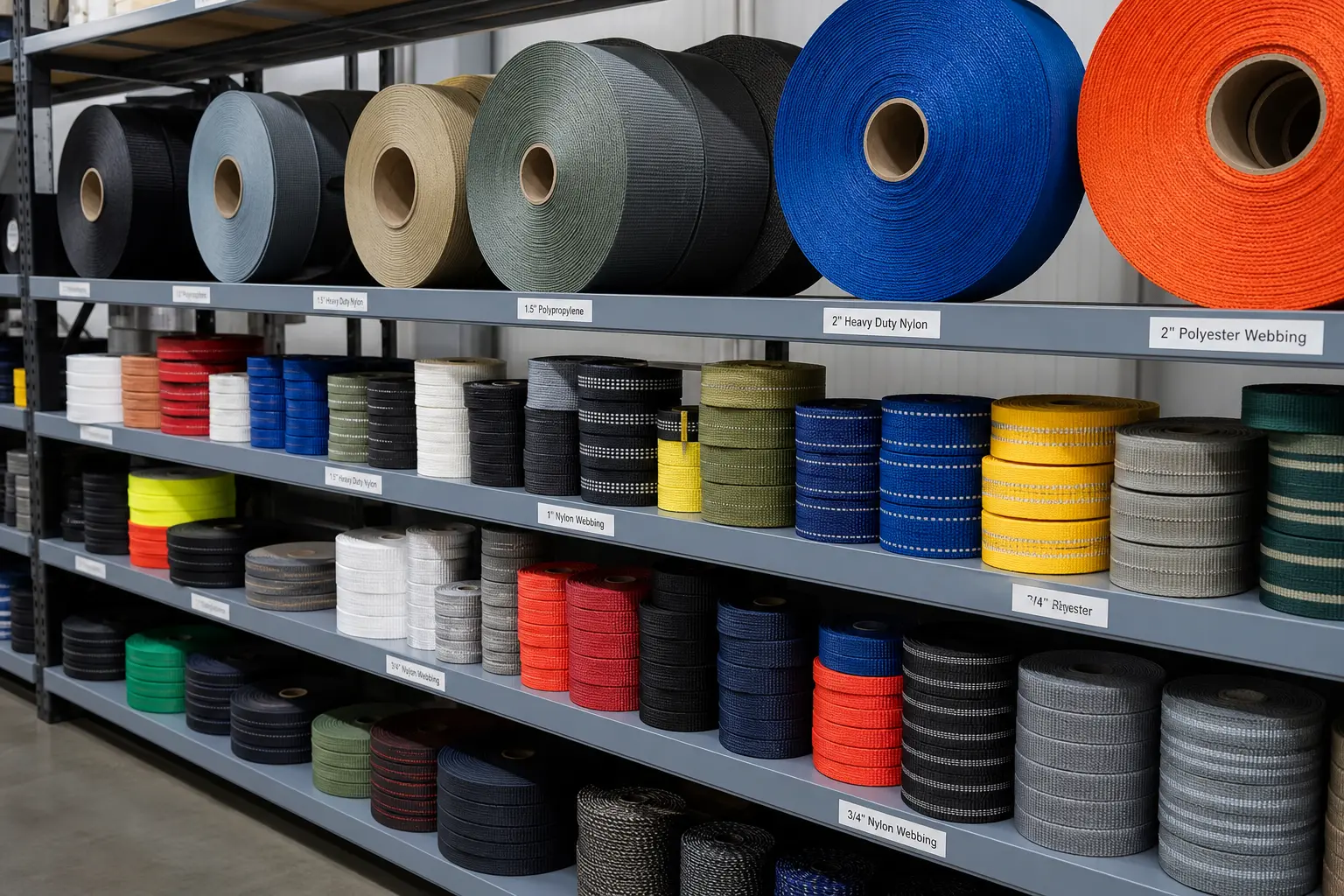
Many webbing manufacturers maintain inventory of popular specifications in standard colors (black, white, olive drab, coyote brown). These "stock programs" allow you to order as little as 100–300 meters because no production setup is required.
Ask your supplier: "Do you have this specification in stock? What colors and widths are available from inventory?"
Limitation: You're limited to whatever widths, materials, and colors the factory chooses to stock. Custom specs are not available through stock programs.
Strategy 3: Split MOQ Across Colors
If you need multiple colors on the same base specification, ask whether the factory will allow you to split the total MOQ across colors. Instead of 1,000 m per color × 3 colors = 3,000 m, you might negotiate 1,000 m total across 3 colors (e.g., 350/350/300 m).
Important caveat: Each color still requires a separate dye lot. Some factories will agree to this but set a minimum per color (e.g., 200 m per color minimum). Always confirm the per-color minimum, not just the total.
Strategy 4: Combine Orders with a Group Buy
If you're part of an industry network or buying group, consider pooling demand. Two or three brands that each need 300 m of the same specification can combine into a single 900–1,000 m order that meets MOQ — and each brand gets a lower per-meter price.
Works best for: Common specifications (e.g., 25mm black nylon, 50mm polyester) where multiple buyers have overlapping needs.
Strategy 5: Negotiate a Trial Order with Commitment
Offer to place a small initial order (e.g., 300–500 m) with a written commitment to a larger follow-up order within a specified timeframe (e.g., 90 days). This reduces the factory's risk — they know the setup cost will be amortized over time — and many will accept the smaller first batch.
Example negotiation: "We'd like to start with a 500 m trial order for qualification testing. If the sample passes our QC review, we'll commit to a 3,000 m production order within 60 days."
Red Flags: When a Supplier's MOQ Is Unreasonable
Not all MOQ quotes are created equal. Watch for these warning signs:
- MOQ above 5,000 m for standard polyester or nylon — This is above market norms. The factory may be trying to push you toward larger orders to optimize their scheduling, or they may be a trading company that adds markup on top of the real factory's MOQ.
- Same MOQ regardless of specification — A legitimate manufacturer adjusts MOQ based on complexity. If every product has the same 5,000 m MOQ, they're likely using a blanket policy rather than calculating real production economics.
- Refusal to discuss surcharges or stock items — Factories that genuinely manufacture in-house understand setup economics and are usually willing to discuss below-MQO surcharges. A rigid "take it or leave it" stance may indicate a reseller, not a producer.
- No stock program at all — Even the most specialized webbing factories maintain some inventory of their most popular specifications. Zero stock availability can signal a trading company or a factory with very limited production capacity.
MOQ Comparison: Trading Company vs. Direct Factory
Understanding who you're buying from directly impacts the MOQ you'll face:
| Factor | Trading Company | Direct Factory |
|---|---|---|
| Typical MOQ | Higher (5,000–10,000 m) | Lower (500–3,000 m) |
| Below-MOQ flexibility | Rarely offered | Usually available with surcharge |
| Stock program | Unlikely | Common for popular specs |
| Color split across MOQ | Seldom allowed | Often negotiable |
| Unit price | 10–30% markup | Factory-direct pricing |
| Customization depth | Limited (re-sells existing items) | Full: material, weave, finish, color |
If you're consistently hitting high MOQ walls, it may be worth verifying whether your supplier is the actual manufacturer. Request a factory tour or video call — genuine manufacturers will show you the production floor. Trading companies will redirect you to "their team" or make excuses.
TMG Webbing's Approach to MOQ
We understand that not every project needs container-load quantities. Here's how we work with buyers at different volume levels:
- Stock items: 100–300 m MOQ for standard polyester and nylon webbing in popular colors (black, white, coyote brown, olive drab, ranger green).
- Custom specifications: 500–1,000 m MOQ for standard materials with custom width or color. We can often split the total across 2–3 colors.
- High-performance materials (UHMWPE, aramid): 1,000–3,000 m MOQ due to premium yarn procurement minimums. Below-MOQ surcharges available at 20–25%.
- Mil-Spec and IRR webbing: 1,000–3,000 m MOQ with full compliance documentation per batch.
- Trial orders: We welcome 300–500 m qualification orders with a commitment to a follow-up production run.
Need a smaller quantity than the listed MOQ? Contact TMG Webbing — we'll tell you honestly whether it's feasible, what the surcharge would be, and whether a stock item meets your needs. No runaround.
Quick Reference: MOQ Checklist for Your Next Inquiry
Before you reach out to any webbing supplier, have these answers ready:
- Material: Nylon, polyester, UHMWPE, aramid, or a blend?
- Width: Exact width in mm or inches (e.g., 25mm / 1 inch).
- Color: Stock color or custom Pantone / Fed-Std-595 match?
- Quantity: Your actual need vs. what you're willing to order.
- Application: Safety-critical (climbing, military, parachute) or non-critical (apparel trim, bag handles)?
- Testing requirements: Do you need tensile test reports, UV test data, or third-party lab certification?
The more specific you are, the faster a factory can quote an accurate MOQ — and the less likely you'll get an inflated number that kills the conversation before it starts.