The braided stretch golf belt is one of the most recognizable accessories on the course — and one of the most reliable private-label categories in golf apparel. For brands, pro shops, and apparel factories, a golf belt line is a high-margin add-on that shares a supply chain with the rest of a head-to-toe program. But "a golf belt" covers two very different constructions, several material grades, and a sizing logic that trips up first-time buyers.
This guide is written for brand owners and sourcing managers building a golf belt line with a manufacturer. It covers the difference between woven and braided construction, the materials that survive sweat and UV on the course, standard widths and sizing, end-tab and buckle choices, realistic custom-program MOQ and pricing, and how to write a specification a factory can quote. For the broader factory process, see the custom OEM webbing ordering guide.
Woven vs Braided: Two Different Belts
The first decision is construction, because it determines the loom, the material, and the price point.
A woven golf belt is produced on a flat loom with interlaced warp and weft yarns. The result is a smooth, structured strap with a clean edge that holds printed or jacquard patterns sharply. Woven belts read more formal and pair with tailored golf trousers. They use fixed buckle holes, so they are sold in graded waist sizes.
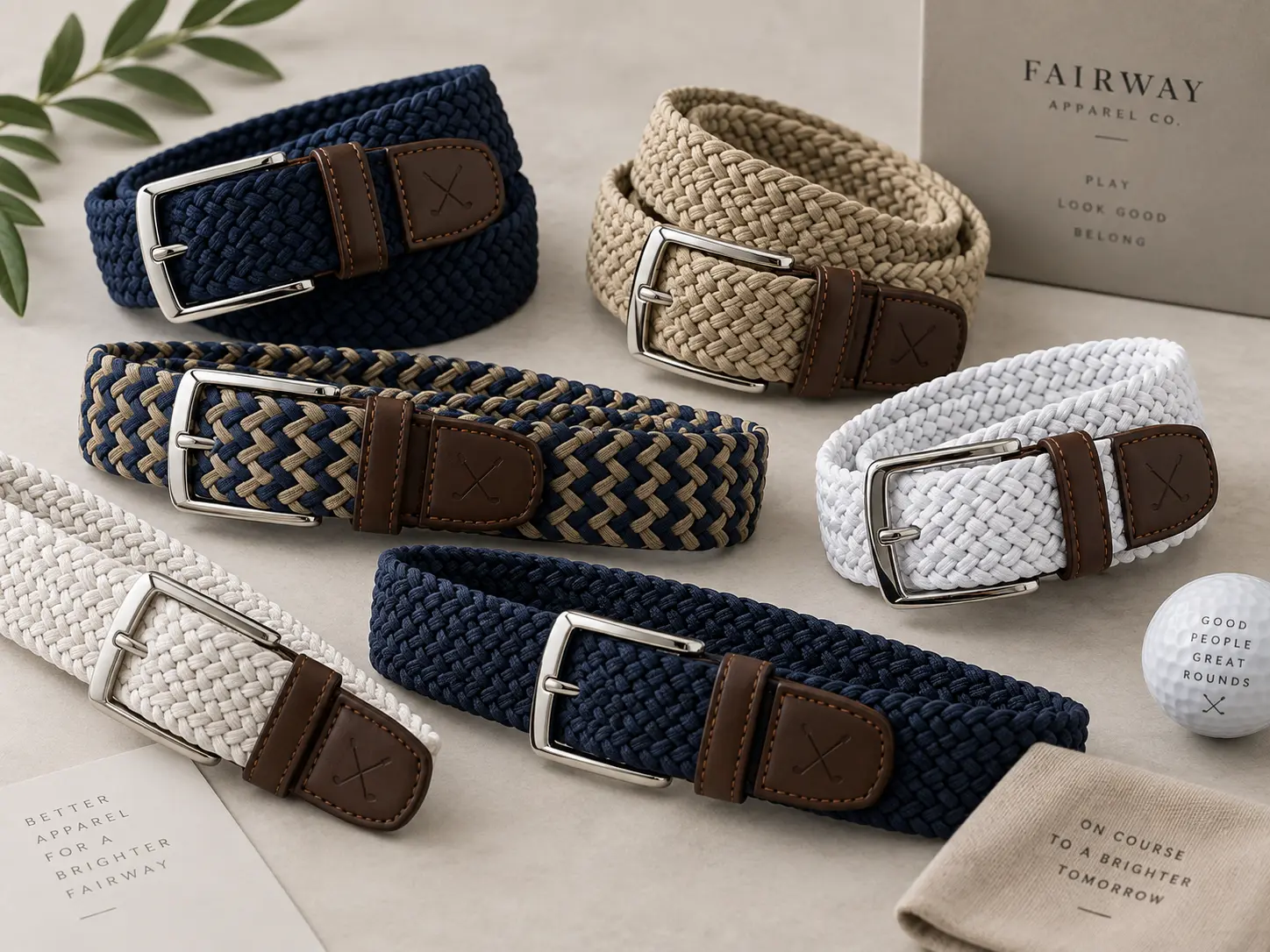
A braided golf belt (the classic "stretch golf belt") is made by interlacing elastic-core or cord yarns in a tubular braid. The strap flexes and recovers, and — critically — has no fixed holes: the buckle prong passes through the braid anywhere along its length. This makes braided belts forgiving across a size range and comfortable through the rotation of a golf swing, which is why they dominate the casual on-course market.
| Attribute | Woven Golf Belt | Braided Stretch Golf Belt |
|---|---|---|
| Construction | Flat loom, warp + weft | Tubular braid, elastic/cord yarns |
| Stretch | None (structured) | High — flexes with the swing |
| Holes | Fixed, ~25 mm spacing | None — prong through braid |
| Sizing | Graded waist sizes | S/M/L or one-size-fits-most |
| Look | Formal, tailored | Casual, classic golf |
| Logo method | Jacquard / print woven in | End-tab deboss / buckle engrave |
| Typical price band | Mid | Low-Mid |
Material Choices That Survive the Course
Golf is played in sun and sweat for four-plus hours, so material choice is about UV resistance, moisture handling, and shape recovery — not just look.
- Braided elastic (rubber or spandex core): The standard for stretch belts. A rubber or spandex core is covered in polyester or cotton yarn. Polyester covering resists UV and sweat better than cotton; cotton feels softer and more premium but fades and absorbs moisture faster.
- Polyester webbing: The workhorse for woven golf belts. Colorfast, UV-stable, low moisture uptake, and holds jacquard logos crisply. See the polyester webbing applications guide for grade selection.
- Waxed cotton: A premium heritage option for woven belts. The waxed finish adds water resistance and a lived-in look that suits classic golf and lifestyle brands, at a higher cost.
- Leather and PU end-tabs: Almost every golf belt — woven or braided — finishes with leather or PU end-tabs and a buckle loop. Full-grain or top-grain leather signals quality at retail; PU is the budget alternative. This is where debossed logos live.
For programs that also carry casual apparel, the same webbing and elastic supply can feed woven belt lines and tactical-style belts — worth consolidating with one manufacturer to hit volume pricing.
Standard Widths and Sizing Logic
Golf belts must fit the belt loops on golf trousers and shorts, which are cut narrower than casual-wear loops.
| Dimension | Standard | Note |
|---|---|---|
| Width | 30-35 mm (1.25-1.5 in) | Fits standard golf belt loops; 35 mm is the most common. |
| Woven length | Waist 30-44 in | Stated length is usually to the middle hole; confirm with retailer. |
| Hole spacing | ~25 mm apart | 5-7 holes typical on woven belts. |
| Braided sizing | S/M/L/XL or OSFM | Braid accepts prong anywhere; one size covers a waist range. |
The single most common sizing dispute is what "length" means. On a woven belt, specify whether the measurement is end-to-end, fold-to-end, or to the middle hole — and align it to your retailer's size chart before production. On a braided belt, specify the relaxed (unstretched) length and the covered waist range.
End-Tabs, Buckles, and Branding
Hardware and trim carry most of the perceived value. A golf belt is judged at the buckle and the end-tab.
- End-tabs: Leather (full-grain, top-grain) or PU. Debossed or embossed logos on the tab are the most durable branding. Tab shape and stitch color are easy customizations.
- Buckles: Pin buckles in zinc alloy are standard; roller buckles suit braided belts. Finishes include brushed nickel, gunmetal, antique brass, and matte black. Laser-engraved or cast logos on the buckle are a premium touch.
- Logo placement: Jacquard-woven into the strap (woven belts), debossed on the leather tab, engraved on the buckle, or on a woven end label. Match the method to how much abrasion and washing the belt will see — the jacquard vs printed webbing guide explains durability trade-offs.
Buckle and tab selection is where a belt program meets the broader hardware supply chain. If your line also uses strap adjusters or side-release buckles elsewhere, the webbing hardware and buckles guide covers material and finish standards.
Custom Program: MOQ and Pricing Reality
Golf belts are a volume accessory. Here are realistic 2026 benchmarks for a private-label program with a manufacturer offering in-house weaving, braiding, and finishing.
| Program Type | Typical MOQ | Indicative Unit Cost |
|---|---|---|
| Braided stretch belt, PU tabs, standard buckle | 500-1,000 pcs / color | $2-5 |
| Braided stretch belt, leather tabs, custom buckle | 1,000 pcs / color | $4-7 |
| Woven belt, jacquard logo, leather tabs | 1,000 pcs / color | $4-9 |
| Premium waxed-cotton woven belt | 500-1,000 pcs | $5-9 |
Custom buckle tooling (a cast or engraved mold) typically adds a one-time $150-600 setup fee amortized across the first order. Custom colors in braided elastic carry a yarn-dye minimum per colorway. Unit price falls meaningfully as a program steps from 1,000 to 5,000+ pieces, mostly from yarn purchasing and buckle volume. For the full cost drivers, see the webbing pricing guide and the MOQ guide.
How to Spec a Golf Belt Line for a Factory
A quote-ready golf belt specification has six fields. Send these and you skip two rounds of back-and-forth:
- Construction: woven or braided; if braided, elastic-core type and target stretch/recovery.
- Width and length: width in mm, and length defined to the middle hole (woven) or relaxed length + waist range (braided).
- Material: strap material (polyester, elastic, waxed cotton) and tab material (leather grade or PU).
- Color: Pantone codes or physical color chips per colorway.
- Hardware: buckle type, finish, and whether the logo is cast, engraved, or plain.
- Branding & quantity: logo method and placement, plus per-colorway quantity and target annual volume.
Send a physical reference belt if you have one — a factory can reverse-engineer construction, materials, and finish from a sample faster than from photos. Approve a pre-production sample before committing to volume, and confirm packaging (individual polybag, belly band, gift box) and labeling in the quotation.
Build Your Golf Belt Line with TMG
TMG Webbing manufactures woven and braided golf belts with in-house weaving, braiding, elastic covering, leather finishing, and buckle sourcing. Send your construction, width, colorways, and target quantity — our team responds with a spec review, sample plan, and honest MOQ within 48 hours. Development samples are free for serious programs.
Request a Golf Belt Quote Talk to an EngineerFrequently Asked Questions
What is the difference between a woven and a braided golf belt?
A woven golf belt is made on a flat loom with interlaced warp and weft yarns, giving a smooth, structured strap that holds a sharp edge and printed or jacquard pattern. A braided golf belt is made by interlacing elastic or cord yarns in a tubular braid, producing a stretchy, flexible strap with no fixed holes — the buckle prong passes through the braid anywhere, so one size fits a range of waists. Woven belts read more formal; braided belts are the classic casual "stretch golf belt."
What material is best for a golf belt?
For stretch braided golf belts, braided elastic (rubber-core yarn covered in polyester or cotton) is the standard because it flexes with the golf swing and recovers its shape. For structured woven golf belts, polyester or cotton webbing with a leather or PU end-tab is most common; waxed cotton gives a premium heritage look. Polyester resists sweat and UV better than cotton on the course. Full-grain or top-grain leather end-tabs and buckle loops signal quality at retail.
What width and size is a standard golf belt?
Most golf belts are 30-35 mm (about 1.25-1.5 inches) wide to fit standard golf trouser and shorts belt loops. Braided stretch belts are typically sold in S/M/L/XL ranges or as one-size-cut-to-fit because the braid accepts the prong anywhere along its length; woven belts use fixed hole spacing (usually 25 mm apart) in waist sizes from about 30 to 44 inches. Always confirm the retailer's sizing chart and whether the stated length is to the middle hole.
How much do custom golf belts cost and what is the MOQ?
Custom private-label golf belts typically start at an MOQ of 500-1,000 pieces per colorway. Unit cost depends on construction and materials: a braided stretch belt with PU end-tabs and a standard zinc-alloy buckle usually lands around $2-5 per belt at volume, while a woven belt with genuine leather tabs and a custom-engraved buckle runs $4-9. Custom colors, jacquard logos, and premium buckles add to the tooling and unit price.
Can I put my logo on a custom golf belt?
Yes. Logos are applied several ways: woven or jacquard directly into the webbing, screen or heat-transfer printed onto the strap, debossed or embossed into the leather end-tab, laser-engraved on a metal buckle, or added as a woven label at the end. Jacquard-woven and leather-debossed logos are the most durable; printed logos are cheapest for multi-color designs but can wear with abrasion.