
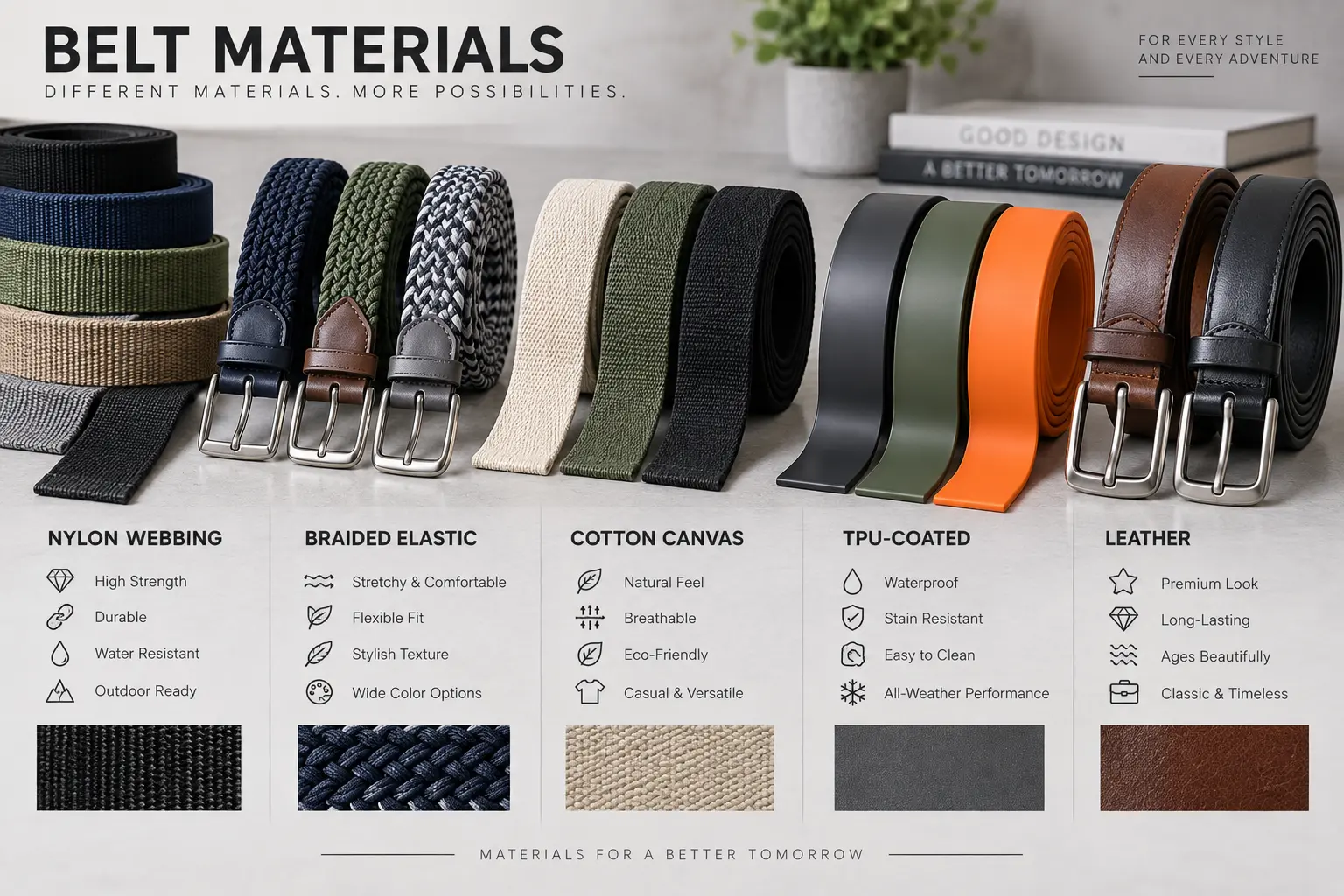
Every belt category on the rack — dress, casual, tactical, workwear, golf, travel — is really a material decision. The strap material determines how the belt wears, how it ages, how it handles water and sun, what it costs, and which customer it sells to. For apparel brands, uniform programs, and private-label developers, choosing the belt material correctly at the specification stage is the difference between a product that gets reordered and one that gets returned.
This guide compares every belt material a manufacturer works with today: the synthetic webbings (nylon, polyester, polypropylene), the naturals (cotton, canvas, leather), the specialty constructions (braided elastic, waxed cotton, TPU-coated), and where each one wins. For belt production specifics, see the woven belts manufacturers guide.
The Belt Material Comparison Table
Here is the full field at a glance, then material by material.
| Material | Strength | Water | Stretch | Cost | Best For |
|---|---|---|---|---|---|
| Nylon webbing | Excellent | Absorbs, weakens slightly | Slight give | Low-Mid | Tactical, workwear, heavy duty |
| Polyester webbing | Very good | Sheds water | Minimal | Low-Mid | Outdoor, fashion, printed |
| Polypropylene (PP) | Moderate | Floats, no uptake | Minimal | Low | Budget belts, water use |
| Cotton / canvas | Moderate | Soaks, slow dry | Soft, breaks in | Mid | Casual, heritage, uniform |
| Waxed cotton | Moderate | Water resistant | Soft, molds | Mid | Premium casual, heritage |
| Braided elastic | Good (recovers) | Varies by cover yarn | High | Low-Mid | Golf, travel, comfort |
| Leather | Excellent | Stains if soaked | Molds over time | High | Dress, premium casual |
| TPU-coated webbing | Very good | Fully waterproof | Minimal | Mid-High | Water sports, outdoor, easy-clean |
Nylon Belt Webbing
Nylon (polyamide) is the strongest common webbing material and the default for tactical, military, and heavy-duty belts. It has excellent abrasion resistance, a soft hand-feel that breaks in comfortably, and slight natural give that makes it comfortable for all-day wear. Its weaknesses: nylon absorbs water (losing around 10-15% strength when wet), stretches a little under sustained load, and fades faster in prolonged UV. For deep detail, see the nylon webbing applications guide — and the extra-thick nylon belt webbing guide for heavy constructions.
Polyester Belt Webbing
Polyester is nylon's mirror image: slightly lower strength and abrasion resistance, but dramatically better UV resistance, nearly zero water uptake, and superior colorfastness. For a belt that lives outdoors — hiking, fishing, uniform work in the sun — polyester holds its color and dimensions where nylon fades and stretches. It is also the best printing surface, so most printed-logo fashion belts are polyester. The polyester applications guide and the nylon vs polyester tensile comparison cover the data.
Polypropylene (PP)
PP is the budget option: cheapest of the synthetics, zero water absorption (it floats), and decent chemical resistance. The trade-offs are lower strength and poor UV tolerance — a PP belt left in the sun degrades noticeably. For price-driven retail programs, water-adjacent use, or short-life promotional belts, PP hits the cost target. The nylon vs PP comparison breaks down when the savings are worth it.
Cotton and Canvas
Cotton belts — usually heavy canvas or flat-woven tape — trade synthetic performance for a natural, soft, "lived-in" character that brands love for casual and heritage lines. Cotton is comfortable from the first wear, takes dye beautifully, and ages with a patina. But it soaks up water, dries slowly, mildews if stored damp, and is weaker wet than dry. The cotton webbing guide and the cotton vs synthetic comparison cover the trade-offs in depth.
Waxed Cotton
Waxed cotton is cotton's premium upgrade: the wax coating adds water resistance, structure, and a distinctive sheen that deepens with age. It is the heritage-belt material of choice for classic menswear and outdoor-lifestyle brands. It costs more than plain cotton and requires care (re-waxing over time), but nothing else looks like it.
Braided Elastic
The stretch belt: a tubular braid over an elastic core. It flexes with the body, has no fixed holes (the prong passes through the braid anywhere), and sells as one-size-fits-most — a genuine comfort and inventory advantage. Polyester-covered elastic is the durable standard; cotton-covered feels more premium. The classic use case is the braided golf belt, and the same construction powers travel and everyday comfort belts.
Leather
The traditional standard. Full-grain and top-grain leather belts are the only accepted materials for formal dress, and they dominate premium casual. Leather is strong, molds to the wearer, and can last decades. The considerations: cost (real leather is the most expensive strap option), water staining, and source/grade honesty — "genuine leather" is a broad term, and bonded leather belts fail quickly. Most textile-belt programs use leather only for end-tabs and trim, where it signals quality without the full-leather price.
TPU-Coated Webbing
TPU (thermoplastic polyurethane) coating over a nylon or polyester core produces a fully waterproof, wipe-clean, odor-resistant strap — the construction behind Biothane-type belts. It is the material of choice for water sports, dog-gear crossovers, food-industry workwear, and any belt that gets soaked or dirty. It costs more than plain webbing but outlasts it in wet service. See the TPU-coated webbing guide for construction detail.
Matching Material to Belt Category
| Belt Category | Recommended Material | Why |
|---|---|---|
| Dress / formal | Full-grain leather | Only accepted formal material; clean edge |
| Casual / heritage | Cotton canvas, waxed cotton | Natural look, soft break-in, ages well |
| Tactical / duty | Heavy nylon webbing | Strength, abrasion, hardware compatibility |
| Outdoor / hiking | Polyester webbing | UV stable, low water uptake, colorfast |
| Golf / travel / comfort | Braided elastic | Stretch, no holes, one-size sizing |
| Workwear / wet service | TPU-coated webbing | Waterproof, wipe-clean, durable wet |
| Budget retail | Polypropylene | Lowest cost, adequate for light use |
For tactical belt programs specifically, the factory-direct tactical belts guide covers nylon grades, hardware, and military-spec options.
Spec Your Belt Line with a Webbing Manufacturer
TMG Webbing manufactures belt webbing in nylon, polyester, PP, cotton, braided elastic, and TPU-coated constructions, with in-house dyeing, weaving, and finishing. Tell us your belt category, target width, and volumes — our team responds with material recommendations, a sample plan, and honest pricing within 48 hours.
Request a Belt Webbing Quote Talk to an EngineerFrequently Asked Questions
What is the most durable belt material?
For webbing belts, nylon and polyester are the most durable synthetics — nylon is tougher and more abrasion-resistant, while polyester resists UV and water better and keeps its color longer. Full-grain leather is the most durable natural belt material, lasting years with care. TPU-coated webbing is the best choice for wet or sweaty environments because the coating blocks moisture entirely. For a workhorse everyday belt, heavy nylon webbing or full-grain leather are the top picks.
Nylon or polyester belt webbing — which is better?
Nylon belt webbing is stronger and more abrasion-resistant with a softer hand-feel, making it the standard for tactical and heavy-duty belts. Polyester webbing has better UV resistance, absorbs almost no water (nylon weakens slightly when wet), and holds color much better — making it the top choice for outdoor and fashion belts that stay vivid. For tensile data, a typical 25mm nylon webbing runs stronger than the same polyester construction, but both far exceed what a belt needs.
What material is best for a dress belt?
Full-grain or top-grain leather remains the standard for dress belts — it looks formal, ages well, and holds a clean edge. Among textile options, a tight flat-woven polyester or cotton belt with leather end-tabs and a minimal buckle is the accepted casual-formal crossover. Nylon tactical-style belts and braided elastic belts are generally too casual for formal wear.
What is a stretch braided belt made of?
A stretch braided belt is made of yarns interlaced in a tubular braid around an elastic core — usually rubber or spandex covered in polyester or cotton. The braid lets the prong of the buckle pass anywhere along the strap (no fixed holes) and the elastic core provides comfortable stretch that moves with the body, which is why it is popular for golf, travel and everyday casual wear.