
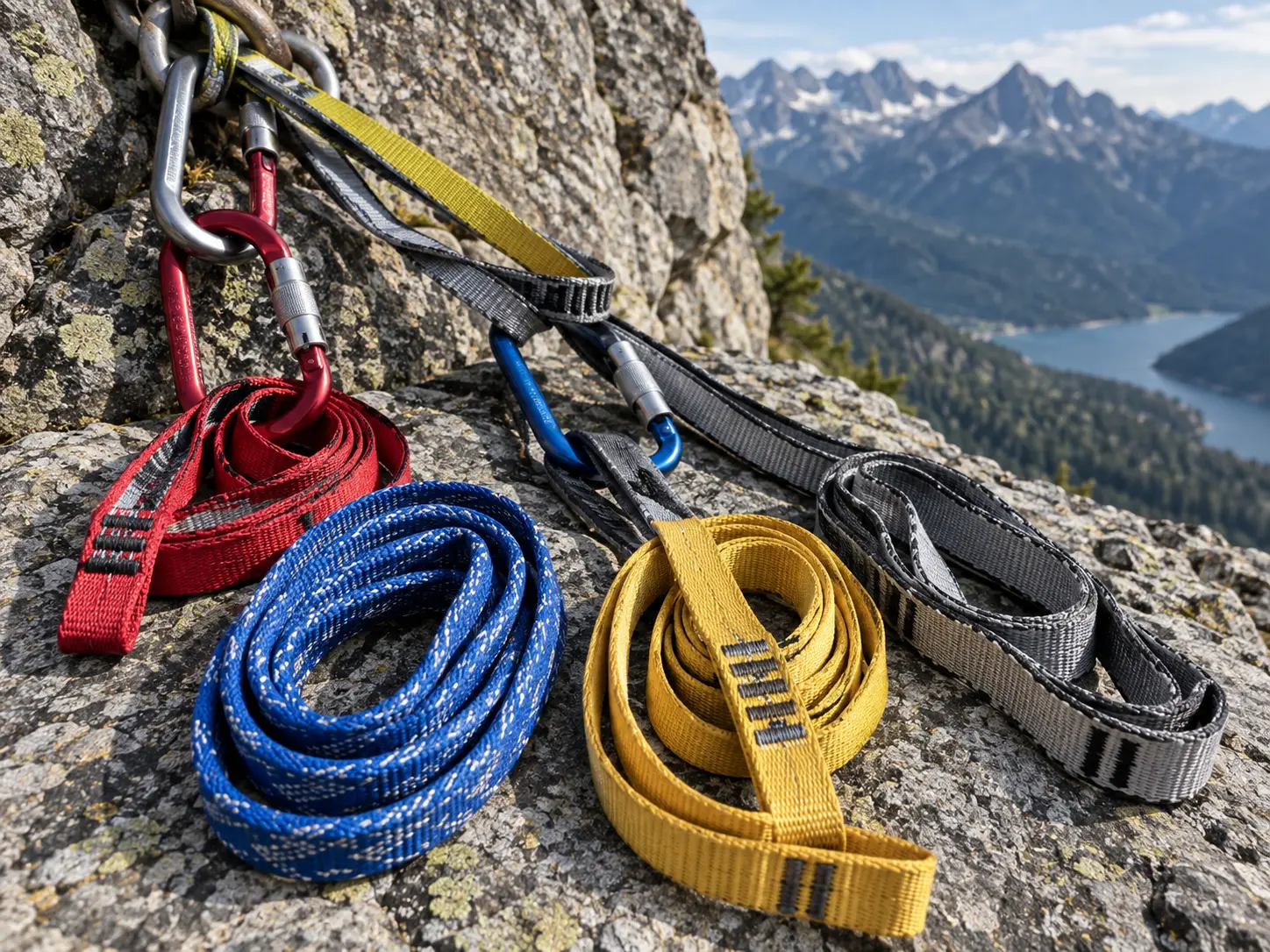
Climbing webbing is a life-safety product. The sling girth-hitched around a chockstone, the runner clipped between two carabiners, and the anchor equalizing three pieces of protection are all narrow fabric under load — and in a leader fall, that fabric is the difference between a routine catch and a catastrophic failure. Choosing the right webbing means understanding construction, material, and the certification standards that govern what is allowed on a rope at all.
This guide is written for climbing gear brands, OEM harness and sling manufacturers, and technical buyers. It covers flat vs tubular construction, the three materials used in climbing webbing (nylon, polyester, Dyneema/UHMWPE), the EN 565 and UIAA strength standards, width and diameter specs, and how to source certified climbing webbing from a manufacturer. Climbing webbing must be certified — never substitute general-purpose industrial webbing in a life-safety system. For general construction background, see the flat vs tubular webbing guide.
Flat vs Tubular: Construction Matters
The first distinction is how the webbing is woven, because it determines knot-holding, suppleness, and durability.
Flat webbing is woven as a single flat band — one layer of interlaced warp and weft. It is thin, relatively stiff, and the cheapest to produce. In climbing it appears mainly in low-profile applications like cam slings, haul-loop reinforcement, and some harness components.
Tubular webbing is woven as a hollow tube and then flattened, so the finished strap has two layers. It is thicker and more supple than flat webbing of the same width, holds knots far better, and is generally stronger and more abrasion-resistant. These properties are why tubular webbing dominates climbing slings, runners, and anchor material — the applications where the strap is knotted, bent over edges, and loaded dynamically.
| Attribute | Flat Webbing | Tubular Webbing |
|---|---|---|
| Structure | Single flat layer | Woven tube, flattened (2 layers) |
| Thickness / feel | Thin, stiff | Thick, supple |
| Knot-holding | Lower | High |
| Abrasion resistance | Moderate | High |
| Cost | Low | Mid |
| Climbing use | Cam slings, reinforcement | Slings, runners, anchors |
Materials: Nylon, Polyester, and Dyneema
Material choice is a trade between energy absorption, weight, water behavior, and heat tolerance. Each has a place on the rack.
- Nylon (polyamide): The traditional climbing webbing material. Its natural elongation (typically 20-30% at breaking) absorbs energy in a fall, lowering the peak impact force transmitted to anchors and the climber. It handles repeated flexing and knotting well and is easy to handle. Downsides: it absorbs water (losing some strength when wet) and degrades under prolonged UV. See the nylon vs polyester tensile strength guide for the data.
- Polyester: Lower stretch and far lower water uptake than nylon, with better UV resistance. Used where low elongation and wet-weather stability matter (via ferrata lanyards, some anchor systems), but its stiffness and lower energy absorption make it less common for general runners.
- Dyneema / UHMWPE: Extremely strong for its weight, allowing thinner, lighter slings, and it absorbs almost no water — ideal for alpine and long routes. But it has a low melting point (around 147°C) and far less dynamic elongation than nylon, so it behaves differently under friction and in a fall. Often blended with nylon to combine grip and strength. See the UHMWPE fiber grades guide for grade differences.
| Property | Nylon | Polyester | Dyneema (UHMWPE) |
|---|---|---|---|
| Energy absorption | High (stretchy) | Low | Low |
| Strength-to-weight | Good | Good | Excellent |
| Water uptake | High | Low | Negligible |
| UV resistance | Moderate | Good | Good |
| Melting point | ~260°C | ~260°C | ~147°C |
| Typical climbing use | General runners, slings | Via ferrata, wet anchors | Alpine, long routes |
Strength Ratings and Certification Standards
In climbing, strength is not a marketing number — it is a certified, tested minimum governed by international standards. This is the section that separates certified climbing webbing from everything else.
- EN 565 is the European standard for mountaineering tape (slings and runners). It requires a minimum breaking strength of 22 kN for climbing tape, tested on the finished product.
- UIAA (International Climbing and Mountaineering Federation) sets equivalent safety standards; UIAA-certified slings also meet the 22 kN benchmark and dynamic requirements.
- 22 kN equals roughly 2,240 kgf (about 4,950 lbf). This is the rating on the sewn sling, not just the raw webbing — the stitching, and any knot, reduce usable strength below the webbing's rated figure.
- Accessory cord and non-anchor webbing carry lower ratings and are not intended as primary protection.
| Standard / Rating | Requirement | Applies To |
|---|---|---|
| EN 565 | ≥ 22 kN tape strength | Mountaineering slings & runners (EU) |
| UIAA | ≥ 22 kN + dynamic tests | Climbing slings (international) |
| 22 kN | ≈ 2,240 kgf / 4,950 lbf | Rated sewn sling minimum |
Verify any supplier's claim against a real test report, not a datasheet. The how to read a webbing test report guide explains how to confirm the numbers mean what you think — and that the certification applies to the finished, sewn product.
Widths, Diameters, and Common Specs
Climbing webbing is specified by width and the resulting sling strength. Common configurations:
- Nylon tubular webbing for slings and runners is commonly around 16-25 mm wide, with 22 kN rated sewn slings the norm.
- Dyneema slings use narrower tape (often 8-13 mm) because the material is so much stronger for its weight, yielding very light, compact runners.
- Sling lengths are sold as sewn loops in standard lengths (e.g. 60, 120, 240 cm) for different anchor and extension uses.
When specifying webbing for a climbing product, define the width, the material and blend, the target breaking strength of the finished sewn article, and the certification required (EN 565 / UIAA). A manufacturer building certified product will weave to the standard and supply batch test data — this is a core part of the custom OEM webbing process.
Why Energy Absorption Matters in a Fall
Climbing safety is about managing force, not just holding weight. When a climber falls, the rope, harness, and slings all stretch to decelerate them. A webbing with high elongation (nylon) spreads that deceleration over more distance, lowering the peak force on the top anchor piece and on the climber's body. A low-stretch material (Dyneema, polyester) stops the fall faster, raising peak force. Neither is "wrong" — but the choice must match the application, and it is a primary reason nylon remains the default for general runners.
This is also why retirement matters. UV, abrasion, and repeated loading all reduce webbing strength over time. The webbing lifespan and UV resistance guide covers how materials degrade and when to retire gear — for climbing, follow the manufacturer's stated service life strictly.
Source Certified Climbing Webbing
TMG Webbing manufactures nylon, polyester, and UHMWPE-blend webbing engineered for outdoor and technical applications, with batch-level strength testing and full material traceability. Tell us your target width, material, finished-sling strength, and certification requirement — our engineering team will review the spec and propose a certified-ready construction. Development samples are free for qualified programs.
Request a Webbing Quote Talk to an EngineerFrequently Asked Questions
What is the difference between flat and tubular climbing webbing?
Flat webbing is woven as a single flat band, while tubular webbing is woven as a hollow tube and then flattened, giving it two layers. Tubular webbing is thicker, more supple, holds knots better, and is generally stronger and more abrasion-resistant for a given width, which is why it dominates climbing slings and runners. Flat webbing is thinner, stiffer, and cheaper, and is used where a low-profile strap is acceptable.
How strong is climbing webbing?
Certified climbing slings and runners are typically rated to a minimum breaking strength of 22 kN (about 2,240 kgf or 4,950 lbf) under the EN 565 and UIAA standards for mountaineering tape. Accessory cord and webbing for non-anchor uses are rated lower. Always use webbing that carries an EN 565 / UIAA certification for life-safety climbing applications — never substitute general-purpose industrial webbing.
Is nylon or Dyneema better for climbing slings?
Nylon (polyamide) is the traditional choice because it absorbs energy in a fall through its natural stretch, reducing peak impact force on anchors and the climber, and it handles repeated flexing well. Dyneema (UHMWPE) is lighter, thinner, stronger for its weight, and absorbs almost no water, making it popular for alpine and long routes — but it has a low melting point (~147°C) and less dynamic elongation, so it behaves differently in a fall and around friction. Many climbers carry both.
Can I use regular webbing for climbing?
No. Climbing is a life-safety application, and only webbing certified to EN 565 / UIAA for mountaineering should be used for slings, runners, and anchors. General industrial or utility webbing is not tested to the dynamic and strength requirements of a climbing fall and can fail. Always buy certified climbing webbing from a reputable manufacturer and retire it according to the maker's lifespan guidance.