
In 2023, a major outdoor brand issued a voluntary recall on 850,000 backpacks. The root cause: a batch of polypropylene shoulder strap webbing that had degraded under UV exposure after 18 months of normal consumer use. No one was seriously injured — but the cost in brand damage, logistics, and customer trust was catastrophic.
Stories like this are far more common than the industry publicly acknowledges. A webbing failure in a climbing sling, a tent guyline snapping in a storm, or a harness strap delaminating mid-descent — these aren't exotic edge cases. They're what happens when buyers specify webbing based on generic category labels instead of actual performance data.
This guide is written for B2B buyers, product developers, and brand sourcing managers who need to make confident, evidence-based decisions on outdoor webbing. We'll give you the numbers, the tradeoffs, and the decision framework that most suppliers won't share — because understanding these differences is what separates a product that lasts from one that fails.
Why "Outdoor" Webbing Is Different From Standard Webbing
Industrial and commercial webbing applications (cargo lashing, safety harnesses in controlled environments, furniture) operate within predictable parameters. Outdoor webbing doesn't. It must simultaneously survive:
- Unprotected UV radiation — direct and reflected (from snow, water) — for months or years at a time
- Temperature swings from -40°C to +80°C, sometimes within a single 24-hour cycle (alpine environments)
- Repeated mechanical stress — flexing, friction, impact loads — with no scheduled maintenance
- Moisture exposure from rain, submersion, humidity, and sweat
- Salt and chemical exposure in marine and coastal environments
The consequence of getting this wrong isn't just a disappointed customer. For climbing gear, safety harnesses, and load-bearing equipment, it can be a life-safety issue. This guide gives you the data to specify webbing that's right for your specific use environment.
The Four Core Materials: Side-by-Side Data Comparison
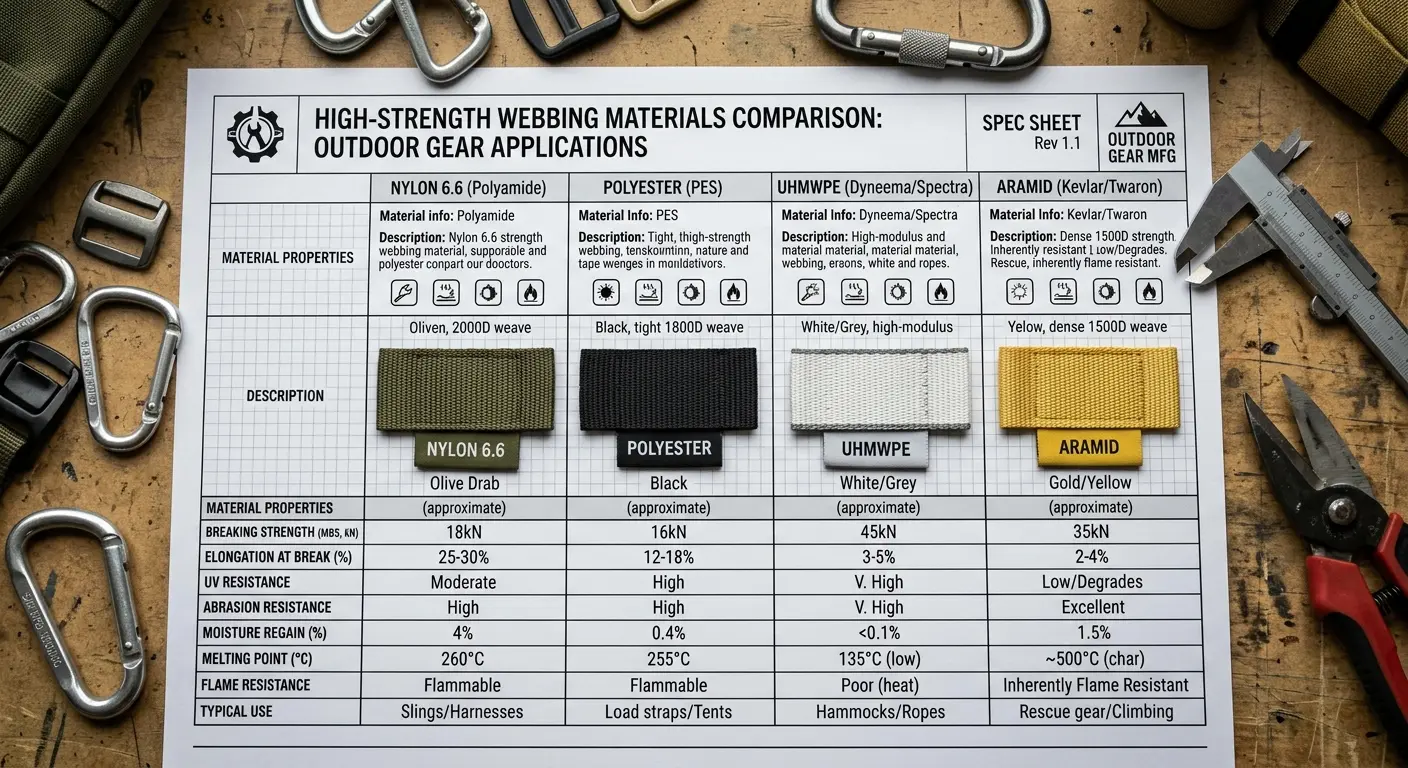
Every outdoor webbing application ultimately comes down to four materials. Here is the objective comparison — not marketing language.
| Property | Nylon 6.6 (HT) | Polyester / PES (HT) | UHMWPE (Dyneema®) | Aramid (Kevlar®) |
|---|---|---|---|---|
| Breaking Strength (25mm flat, typical) |
1,500–2,500 kgf | 1,300–2,200 kgf | 3,000–5,500 kgf | 1,800–3,000 kgf |
| Strength-to-Weight Ratio | Good | Good | Exceptional (15× steel) | Very Good (5× steel) |
| Elongation at Break | 18–25% | 10–15% | 3–5% | 2–4% |
| Elongation at 50% MBS | 6–9% | 2–4% | <1% | <1% |
| Water Absorption | 4.5% (reduces MBS ~10%) | <0.5% | ~0% (floats) | 2–4% |
| UV Resistance | Moderate — degrades without UV treatment | Excellent — inherent UV stability | Good — UV stabilizers recommended | Poor — degrades rapidly in UV without coating |
| Temperature Range | -40°C to +80°C | -40°C to +110°C | -60°C to +80°C | -60°C to +180°C (continuous) |
| Abrasion Resistance | Excellent | Very Good | Very Good | Moderate (compressional damage) |
| Chemical Resistance | Poor vs. acids; Good vs. alkalis | Excellent — broad chemical resistance | Excellent — broad chemical resistance | Good vs. most solvents; poor vs. acids |
| Cost (Relative) | Low | Low–Moderate | High (3–8× PES) | High (3–6× PES) |
What This Table Doesn't Show: The difference between standard-grade and high-tenacity (HT) variants of the same material can be 30–50% in breaking strength. Always ask your supplier whether you're getting standard industrial or HT-grade webbing — they may look identical and cost 20% more, but they behave very differently under load. See our guide to identifying quality webbing for the full checklist.
The Five Key Questions Every Buyer Must Answer
Before specifying any webbing, work through these five questions in order. Your answers will eliminate most of the options and point you toward the right material.
1. How much load will this webbing actually carry in real use?
Calculate the Working Load Limit (WLL) — never the Breaking Strength — as your starting point. The WLL is the Breaking Strength divided by a safety factor (typically 5:1 to 7:1 for safety-critical outdoor applications). If your backpack shoulder strap needs to hold 30kg comfortably under dynamic movement, your webbing must have a WLL of at least 150–210 kgf per strap — which means specifying a webbing with an MBS of at least 750–1,050 kgf.
For climbing slings and load-bearing slings, the relevant standard is EN 1492-1 (EU) or ASME B30.9 (US). These define the minimum breaking strengths, elongation limits, and inspection requirements. Always verify that your supplier's test certificates match the applicable standard.
2. What environment will it be exposed to?
Temperature extremes, UV intensity, moisture, and chemical exposure each rule out different materials:
- High UV + outdoor sun (tents, awnings, marine deck): Polyester first. Nylon degrades significantly without UV-inhibiting treatment; UHMWPE loses strength gradually; Aramid degrades rapidly.
- Cold + wet (alpine, winter, marine): Nylon with UV treatment. Its energy absorption at low temperatures is superior, and the slight strength loss from water absorption is acceptable with HT-grade material. Avoid UHMWPE below -60°C (not a practical concern) but note its near-zero stretch is actually a disadvantage in dynamic cold loads.
- High temperature (engine compartments, desert tactical): Aramid or High-Temp Polyester. Aramid maintains strength to 180°C; standard nylon softens significantly above 120°C.
- Saltwater / marine: UHMWPE or Polyester. Both are inherently resistant to saltwater degradation. Nylon absorbs water and salt accelerates hydrolysis. See our marine webbing guide for a full breakdown.
3. How critical is stretch behavior?
Stretch is not inherently good or bad — it's application-dependent:
- Load-bearing slings and lifting straps: Minimal stretch is desired for energy efficiency and dimensional stability. UHMWPE or Polyester.
- Climbing slings and shock-absorbing systems: Controlled stretch absorbs fall energy. Nylon is preferred for its dynamic elongation.
- Pack straps and compression straps: Moderate, controlled stretch adds comfort under load. Nylon.
- Guy lines and structural webbing: Zero stretch for tautness and structural integrity. UHMWPE or Polyester.
4. What abrasion exposure will it face?
Abrasion resistance ranks: Nylon 6.6 > Polyester > UHMWPE > Aramid. For high-friction applications (shoulder straps, belt loops, contact with rock, sand, or grit), Nylon is the clear choice. Aramid's weakness is compressive abrasion — repeated tight bending around hardware edges causes fibrillation and premature failure.
5. What is your real budget — including failure cost?
The true cost of webbing isn't just the per-meter price. Consider:
- Replacement rate: Cheap PP webbing in a tactical pack may need replacing every 12–18 months of heavy use. HT Polyester may last 5–8 years. UHMWPE may outlast the product it's attached to.
- Warranty and recall exposure: A product recall for a failed backpack strap costs $15–50 in logistics alone per unit, plus brand damage that has no dollar value.
- Certification cost: Using a mil-spec or EN-standard webbing with a batch test certificate costs 10–20% more upfront but eliminates liability questions. See our mil-spec standards guide for what compliance actually requires.
Application-Specific Selection Guide
Hiking Backpacks and Load-Carrying Systems
The dominant material for hiking pack webbing is Nylon 6.6 HT — and for good reason. The combination of high abrasion resistance (shoulder straps rub against clothing and skin constantly), moderate stretch (enhances comfort under dynamic loads), and impact energy absorption makes it the optimal general-purpose choice.
For ultralight backpacks where every gram matters, UHMWPE webbing in narrow widths (10–15mm) is increasingly used for structural support panels. The tradeoff is reduced abrasion resistance and higher cost. The hip belt load-bearing core should remain Nylon — this is non-negotiable for weight distribution comfort.
Tents, Tarps, and Shelter Systems
Tent guyline and stake loop webbing is one of the clearest material choices in the industry: Polyester monofilament or woven webbing. The reasons are physics, not preference:
- Polyester absorbs less than 0.5% water — it doesn't stretch when wet. Nylon can elongate 2–4% when saturated, causing your rainfly to sag mid-storm.
- Polyester's inherent UV stability means the webbing at your tent corners — the most sun-exposed part — won't fail after two seasons of normal use.
- At tent guyline diameters (2–4mm equivalent flat width), Polyester's breaking strength is more than adequate.
For structural ridge lines and tarp ridgelines where zero stretch is required, UHMWPE cord or webbing is the premium choice, particularly for expedition-grade shelter systems used above the treeline.
Climbing and Mountaineering Equipment
This is the most regulated webbing application category. Climbing slings (including endless loops and sewn slings) must comply with EN 892 (dynamic ropes) or EN 1492-1 (flat webbing slings). Any webbing used in this application must come with a batch-specific breaking strength test certificate.
Tubular Nylon webbing remains the standard for climbing slings due to its combination of high breaking strength, controlled elongation, knotability, and superior energy absorption. Dyneema®/UHMWPE slings are available but are niche — their near-zero stretch makes them unsuitable for dynamic energy absorption, and they are priced at 5–8× the cost of equivalent Nylon slings.
Ice axe leash webbing, crampon strap webbing, and belay device runner webbing all follow the same rule: Nylon unless there's a specific reason to specify otherwise.
Marine and Paddlesports
The combination of UV, saltwater, and high dynamic loads makes this a demanding application. Polyester webbing is the baseline standard — it handles all three stressors without degradation. For high-performance marine applications (sailing harness, safety lines, dinghy trapeze webbing), UHMWPE webbing is increasingly preferred due to its near-zero water absorption, resistance to saltwater-induced hydrolysis, and high breaking strength at minimal weight.
For kayak and canoe PFD (life jacket) webbing, compliance with ASTM F1497 or equivalent regional standards is mandatory. Always specify flame-retardant webbing for marine safety equipment.
Tactical and Military-Grade Equipment
Tactical webbing operates in the harshest combined environment: UV exposure, temperature extremes, repeated mechanical stress, and requirement for IR/thermal signature compliance. The correct material is Nylon 6.6 with IRR (Infrared Reflective) treatment and compliance to MIL-W-4088K or equivalent specification. For IRR compliance, both the fiber and any coating must be specially formulated — standard black nylon webbing will "bloom" under IR imaging.
See our comprehensive mil-spec webbing standards guide for the full technical requirements and what to ask your supplier.
The Most Common Mistakes Buyers Make
Mistake 1: Buying on Price Per Meter, Not Cost Per Application Life
A roll of PP webbing at $0.15/m looks compelling against Nylon at $0.40/m. But if the PP strap in a tactical backpack fails and requires a recall after 18 months of use, the math is brutally clear. Always calculate: Price per meter × expected product lifespan / years of service.
Mistake 2: Assuming "Nylon" Means "Strong"
Standard Nylon (6.6 or 6) is a broad category. A webbing made from standard Nylon 6 filament at low density will have dramatically different properties from one made from High-Tenacity Nylon 6.6 drawn fiber. Always ask for the actual breaking strength specification and test certificate — not a sales brochure.
Mistake 3: Ignoring Edge Finish
The strongest webbing in the world fails prematurely if the edges aren't properly sealed. Hot-cut and sealed edges are essential for outdoor applications. Ultrasonically sealed edges provide the highest quality. Raw-cut edges fray immediately under abrasion and begin degrading within the first use cycles. This is covered in detail in our webbing cutting and finishing guide.
Mistake 4: Specifying UHMWPE for High-Abrasion Applications
UHMWPE's compressive abrasion resistance is lower than Nylon's. Using UHMWPE webbing for shoulder straps or hip belts — where the webbing runs over rock edges, ice, or sharp hardware — is a common and costly error. UHMWPE is excellent for structural load-bearing applications, but specify Nylon for any webbing that will experience significant surface abrasion.
Mistake 5: Not Specifying UV Treatment for Outdoor Nylon
Raw Nylon 6.6 webbing loses approximately 30% of its breaking strength after 500 hours of UV exposure in accelerated weathering tests (ASTM G154). For outdoor applications, always specify UV-stabilized Nylon with appropriate UV inhibitor treatment — the cost is minimal and the lifespan extension is significant.
Sourcing Specifications: What to Include in Your RFQ
When requesting webbing samples or placing orders for outdoor applications, your specification should include:
- Material and Grade: "High-Tenacity Nylon 6.6, not standard Nylon 6"
- Breaking Strength: Minimum breaking force (kgf or kN), at standard conditions, with batch test certificate
- Elongation: At 50% and 100% of MBS, as a percentage
- Width and Thickness: Nominal dimensions with tolerance (±0.5mm for industrial widths)
- UV Treatment: "UV-stabilized, minimum 500 hours ASTM G154 without more than 30% MBS loss"
- Edge Finish: "Hot-cut sealed edges" or "ultrasonically sealed"
- Color: Solution-dyed (for marine/outdoor UV resistance) or disperse-dyed, with colorfastness to ISO 105-B02 Grade 4 minimum
- Applicable Standard: EN 1492-1, MIL-W-4088K, or equivalent
- Batch Test Reports: Required for all safety-critical applications
A supplier who cannot provide batch test reports for safety-critical outdoor webbing is a supplier you should not be using.
Summary: Quick Selection Decision Tree
| Your Priority Is... | Recommended Material | Why |
|---|---|---|
| Best overall for general outdoor gear | Nylon 6.6 HT + UV Treatment | Best abrasion, good stretch, proven in all outdoor conditions |
| Maximum UV and weather resistance | Polyester HT | Inherent UV stability, low stretch, no water absorption |
| Minimum weight at maximum strength | UHMWPE / Dyneema® | Highest strength-to-weight ratio, floats, chemically inert |
| High temperature environment | Aramid / High-Temp Polyester | Maintains properties to 180°C+ |
| Saltwater and marine environment | Polyester HT or UHMWPE | No saltwater hydrolysis, high UV resistance |
| Life-safety climbing application | Tubular Nylon (EN 1492-1 certified) | Certified breaking strength, controlled elongation, knot-safe |
| Tactical / military / IR compliant | Nylon 6.6 HT + IRR Treatment + Mil-Spec | UV resistance + IR/thermal signature compliance |
TMG Webbing manufactures all four core webbing materials in both standard industrial and high-tenacity grades. We provide batch-specific breaking strength test reports for all safety-critical applications, and our engineering team can advise on the optimal material, grade, and finish for your specific product. Contact us to discuss your requirements and request samples.
Frequently Asked Questions
What is the strongest webbing material for outdoor use?
By breaking strength, UHMWPE (Dyneema®) is the strongest — a 25mm wide UHMWPE webbing can exceed 5,500 kgf breaking strength while weighing a fraction of equivalent steel. However, "strongest" in isolation is meaningless — you must also consider abrasion resistance, UV performance, stretch behavior, and cost. For most outdoor applications, the best overall choice is High-Tenacity Nylon 6.6 with UV treatment.
Can I use nylon webbing outdoors in direct sunlight?
Yes — but only if it has been UV-stabilized. Standard Nylon webbing degrades rapidly under UV exposure, losing up to 30% of its breaking strength after one season of intensive outdoor use. Always specify UV-inhibitor treated Nylon for any application with prolonged sun exposure. For purely sun-exposed applications, Polyester is a more reliable choice due to its inherent UV stability.
How does water absorption affect nylon webbing performance?
Nylon absorbs approximately 4.5% of its weight in water at standard conditions. This causes two effects: (1) A reduction in breaking strength of approximately 10% compared to dry conditions, and (2) Increased elongation under load. For life-safety applications in wet environments, this must be accounted for in the safety factor calculation. Polyester absorbs less than 0.5% water, making it inherently more dimensionally stable in wet conditions.
What is the expected lifespan of outdoor webbing?
Varies dramatically by material and environment. As a rough guide for normal consumer use (not extreme conditions): Nylon 6.6 (UV-treated): 3–7 years. Polyester: 5–10 years. UHMWPE: 7–15+ years. Aramid (UV-treated): 3–5 years. These estimates assume no mechanical damage. Always inspect webbing visually before each use in safety-critical applications. For a full breakdown by material and environment, see our UV resistance and lifespan guide.
Should I specify tubular or flat webbing for outdoor applications?
Flat webbing is the default for virtually all outdoor gear applications — pack straps, tent guylines, load-bearing lashings. Tubular webbing is specialized: its main advantage is a softer hand feel and slightly higher strength-to-weight ratio in equal width. The primary application for tubular webbing in outdoor gear is climbing slings, where the softer hand allows knots to hold securely and the geometry provides better distribution around anchor points.
What is the minimum breaking strength for backpack shoulder strap webbing?
There is no single universal standard for backpack webbing (climbing gear has EN 1492-1; cargo lashing has EN 12195-2). As a manufacturer's guideline: for adult backpacks rated to 15–25kg, a 25mm wide Nylon 6.6 webbing with 1,500–2,000 kgf MBS is standard. For heavy-duty packs rated to 40kg+, 38–50mm wide webbing with 2,500+ kgf MBS should be specified. Always include a minimum 5:1 safety factor against the maximum rated load.
Is Dyneema® webbing worth the cost for outdoor gear?
It depends entirely on the application. For structural applications where every gram of weight saved translates to meaningful user benefit (alpine climbing, expedition kayaking, ultralight hiking, marine rigging), UHMWPE is often worth the 3–8× cost premium. For general outdoor gear where weight is not the primary concern, the performance gains don't justify the cost. For high-abrasion contact areas (shoulder straps, hip belts), UHMWPE is specifically not recommended regardless of budget — specify Nylon.