
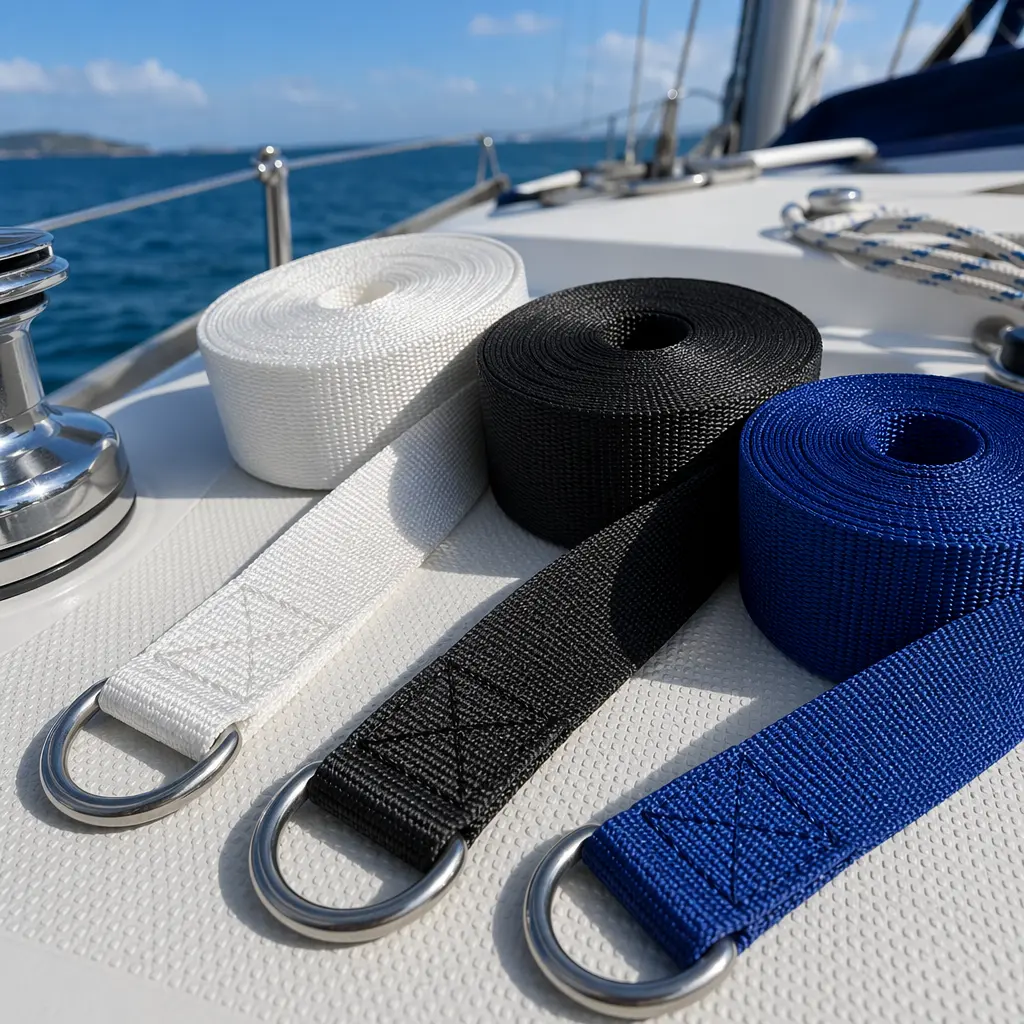
Saltwater is an unforgiving environment for textile webbing. It combines four destructive forces simultaneously: UV radiation from unobstructed sunlight, chemical attack from dissolved NaCl, perpetual humidity promoting mildew growth, and constant mechanical abrasion from deck hardware, rigging, and chafe points. Pick the wrong webbing material and it can fail in a single season — losing 30–40% of its breaking strength before the next haul-out.
This guide covers every material option for marine webbing — polyester, nylon, polypropylene, and UHMWPE/Dyneema® — with specific data on saltwater retention, UV degradation timelines, breaking strength by width, and the certification standards that matter for ocean environments. It also includes application-specific recommendations from sail ties to jackstays to PFD webbing, plus the red flags that separate serious marine webbing suppliers from general-purpose manufacturers.
Material Deep Dive: How 4 Webbing Types Perform in Saltwater
Not all synthetic webbing is built for marine exposure. Here is the data for each material across the five metrics that matter at sea:
| Property | Polyester | Nylon | Polypropylene | UHMWPE / Dyneema® |
|---|---|---|---|---|
| Water absorption | < 1% by weight | 4–8% by weight | 0% (hydrophobic) | 0% (hydrophobic) |
| Strength loss after 90 days saltwater immersion | < 5% | 10–20% | < 5% | < 2% |
| UV resistance (500 hr QUV) | 90%+ retention | 60–70% retention | 80–85% retention (with UV stabilizer) | 85–90% retention |
| Elongation at break | 12–15% (low stretch) | 20–30% (high stretch) | 15–20% | 3–5% (virtually zero stretch) |
| Mildew resistance | Excellent | Poor (absorbs moisture → mildew) | Excellent | Excellent |
| Density (floats?) | 1.38 g/cm³ (sinks) | 1.14 g/cm³ (sinks) | 0.91 g/cm³ (floats) | 0.97 g/cm³ (floats) |
| Typical 25mm breaking strength | 1,500–3,000 kg | 1,200–2,500 kg (wet: -15%) | 400–800 kg | 3,000–6,000 kg |
| Relative cost (25mm, per 100m) | $$ (moderate) | $$$ (higher) | $ (lowest) | $$$$ (3–5× polyester) |
Polyester — The Gold Standard for Marine Webbing
Polyester is the default answer for nearly all marine webbing applications, and the data explains why. It absorbs less than 1% water by weight, so it does not soften, stretch, or lose breaking strength after submersion — unlike nylon which can absorb 4–8% of its weight in water and lose 10–20% of its dry strength. Its UV resistance is naturally high without requiring additives; solution-dyed marine-grade polyester routinely retains more than 90% of its breaking strength after 500 hours of accelerated QUV testing (roughly equivalent to 12–18 months of continuous tropical sunlight exposure).
The low elongation (12–15% at break) is another critical advantage for marine use. When you tension a sail tie or a mooring strap, you want it to stay tensioned — not creep and loosen as nylon would. This dimensional stability under load is why load restraint webbing, jackstays, and sail ties are virtually always specified in polyester, not nylon.
Nylon — Strong on Paper, Problematic at Sea
Nylon's dry breaking strength is competitive (1,200–2,500 kg for 25mm). It also has excellent abrasion resistance and natural elasticity. These properties make nylon an excellent choice for climbing, fall protection, and tactical webbing — but they become liabilities in a marine environment for three specific reasons:
- Water absorption weakens the molecular structure. Nylon's amide groups form hydrogen bonds with water molecules, which physically displace the polymer chains. A nylon strap that measures 2,500 kg breaking strength in the lab drops to roughly 2,100–2,250 kg after a full day of saltwater exposure. If your safety factor was 5:1 on paper, it's now closer to 4.2:1.
- Wet nylon stretches permanently. Nylon can elongate 20–30% under load, and when wet, this stretch increases further. A nylon sail tie tightened in the morning will be loose by afternoon as the webbing absorbs moisture and relaxes.
- Mildew colonizes wet nylon within days. In a tropical marine environment (30°C+, constant humidity), nylon webbing stored in a lazarette or sail locker can develop mildew colonies within 48–72 hours. The mildew itself does not directly attack nylon polymer chains, but the moisture it traps accelerates UV and salt degradation at the fiber surface.
Nylon is not categorically prohibited for marine use — it appears in dock lines and anchor rodes where controlled stretch is desirable. But for any application where constant tension, UV exposure, or dry storage is impractical, polyester is the safer engineering choice.
Polypropylene — Floatable and Budget-Friendly, but Limited
Polypropylene (PP) is the only standard synthetic webbing that floats on water (density 0.91 g/cm³ vs water at 1.0). It is completely hydrophobic, resistant to mildew, and costs significantly less than polyester. These properties make PP an excellent choice for PFD (personal flotation device) straps, fender lines, and temporary mooring ties — applications where buoyancy matters more than ultimate breaking strength.
The limitation is mechanical: 25mm PP webbing typically breaks at 400–800 kg, roughly one-third to one-half of equivalent polyester. PP also has a lower melting point (~165°C) and is more prone to cutting on sharp edges. For any application involving dynamic loads (jackstays, hiking straps, sail ties on a pitching deck), PP's lower strength and lower abrasion resistance rule it out.
UHMWPE / Dyneema® — Maximum Strength, Minimum Weight, Premium Price
UHMWPE (Ultra-High Molecular Weight Polyethylene), marketed as Dyneema®, is the highest-performance option for marine webbing. It floats, has zero water absorption, resists UV, salt, chemicals, and mildew, and delivers 5–7× the strength-to-weight ratio of polyester. A 25mm UHMWPE webbing can exceed 6,000 kg breaking strength — approaching the performance of steel wire rope at a fraction of the weight.
UHMWPE webbing is standard on Grand Prix racing yachts for control lines, high-load lashing, and running backstay tensioning systems. It is also used for anchor rode reinforcement and emergency steering systems where weight, strength, and chafe resistance are non-negotiable.
The trade-offs: cost (3–5× polyester), lower heat tolerance (softens above 100°C, melts at ~150°C — a concern near engine exhaust components), and the fact that UHMWPE's extremely low coefficient of friction makes knotting unreliable (splicing or sewn terminations are required).
Application-by-Application Selection Guide
Different marine webbing applications prioritize different material properties. Here is the recommended specification for each:
| Application | Recommended Material | Width | Min. Breaking Strength | Key Property |
|---|---|---|---|---|
| Sail ties | Solution-dyed polyester | 25 mm | 1,500 kg (14.7 kN) | UV stability + low water absorption |
| Jackstays / jacklines | Polyester, flat weave | 25–30 mm | 2,500 kg (25 kN) | ISO 12401 compliance, UV |
| PFD / life jacket straps | Polypropylene | 20–25 mm | 400 kg (3.9 kN) | Buoyancy (must float) |
| Mooring / dock straps | Polyester | 38–50 mm | 3,000–5,000 kg | Abrasion resistance |
| Dinghy hiking straps | Polyester, firm weave | 38–50 mm | 2,000 kg (20 kN) | Low stretch + comfort width |
| Fender / buoy ties | Polypropylene or polyester | 20–25 mm | 400–800 kg | Floatable (PP) or durable (PES) |
| Boat cover / canopy straps | Polyester | 20–25 mm | 800–1,200 kg | UV resistance + colorfastness |
| Racing control lines (UHMWPE) | UHMWPE / Dyneema® | 10–15 mm | 3,000–5,000 kg | Strength-to-weight ratio |
| Anchor rode reinforcement | UHMWPE or polyester | 25–38 mm | 3,000–6,000 kg | Chafe + UV resistance |
Jackstays: The Safety-Critical Marine Webbing Application
Jackstays (also called jacklines) run fore-and-aft along the deck of a sailboat. A crewmember clips their safety tether to the jackstay, creating a continuous attachment point from cockpit to bow. If the jackstay fails, the crewmember goes overboard — with no secondary attachment. This makes jackstay webbing selection the highest-stakes decision in marine webbing procurement.
The ISO 12401 Standard
ISO 12401:2009 specifies performance, sizing, marking, and test methods for deck safety harnesses and safety lines on recreational craft. The key requirements for webbing used in jackstay construction:
- Dynamic load test: The complete assembly (harness + safety line + jackstay + attachment points) must withstand a dynamic load of 5,000 N (500 kg) without failure of any component.
- Static strength: Each individual component should have a breaking strength significantly above 5,000 N to account for dynamic shock loading, UV degradation over time, and chafe damage.
- Material durability: The standard requires that materials be resistant to UV degradation, saltwater, oil, and mildew relevant to the marine environment.
ORC / World Sailing Offshore Regulations
For offshore racing, the ORC (Offshore Racing Congress) Category 3 Special Regulations add further requirements:
- Attachment strongpoints must have a minimum breaking strength of 2,000 kg (20 kN).
- Jackstays must be replaced every 7 years regardless of visual condition.
- Jackstays must be clearly marked with date of manufacture and breaking strength.
- Stainless steel wire jackstays are permitted but must be tensioned and inspected for strand breakage at each haul-out.
Practical recommendation for B2B buyers: When procuring webbing for jackstay production, specify 25–30mm solution-dyed polyester with a certified breaking strength of at least 2,500 kg (25 kN). Request tensile test reports from the webbing manufacturer that include both dry and wet (24-hour saltwater immersion) breaking strength values. Polyester's wet strength retention (~95%+) is one of its key advantages over nylon in this application.
Marine Webbing Hardware and Accessories
Webbing is only as strong as the hardware it's sewn or attached to. Marine environments demand specific hardware materials and specifications:
| Hardware Type | Recommended Material | Grade / Standard | Notes |
|---|---|---|---|
| D-rings, O-rings | 316 stainless steel | AISI 316 (marine grade) | Avoid 304 SS — pits in saltwater within 12 months |
| Buckles (tension) | 316 SS or marine-grade aluminum | Anodized to MIL-A-8625 | Plastic buckles degrade under UV within 1–2 seasons |
| Sewing thread | PTFE-coated polyester or UHMWPE | V-92 or V-138 bonded | Standard nylon thread deteriorates in saltwater; PTFE coating resists hydrolysis |
| Rivets / fasteners | Monel or 316 SS | Marine-grade only | Galvanic corrosion risk if mixed with aluminum fittings |
| Webbing end terminations | Box-X stitch (minimum 4 passes) or splice | Stitch density 5–6 stitches/cm | Sewn termination should achieve ≥ 80% of webbing breaking strength |
Marine Webbing Testing and Certification: What to Ask For
When sourcing webbing for marine products — especially safety-critical components — request these specific test reports from your supplier:
- Breaking strength (dry): Tested to ASTM D6775 or ISO 13934-1. Should report individual values, mean, standard deviation, and pass/fail against the claimed specification. See our guide to reading webbing test reports.
- Breaking strength (wet, 24-hour saltwater immersion): Same test method, but after conditioning in 3.5% NaCl solution at 23 ± 2°C for 24 hours. The ratio of wet/dry breaking strength should exceed 90% for polyester, 95%+ for UHMWPE.
- UV resistance: ASTM G154 (xenon arc) or ISO 4892-3 (QUV). Request results at 200, 500, and 1,000 hours. For marine-grade polyester, breaking strength retention at 500 hours should be ≥ 90%.
- Colorfastness to light: AATCC 16.3 (Option 3), Grade 4 minimum for marine-grade. Webbing that fades after one season reduces resale value and erodes brand perception for marine equipment manufacturers.
- Mildew resistance: AATCC 30 (Part III) — soil burial test. Most marine buyers skip this because polyester inherently resists mildew, but if your product ships to tropical markets, this test verifies that no mildew-susceptible coating or finish has been applied.
6 Red Flags When Sourcing Marine Webbing
- "Marine grade" without a test report. "Marine grade" is a marketing term, not a standard. If a supplier cannot produce wet-strength and UV-aging test data, the claim is meaningless.
- Offering nylon without a marine warning. A responsible supplier knows that nylon absorbs water and loses strength in marine environments. If they recommend nylon for outdoor marine applications without explaining the trade-offs, they either don't understand marine webbing or don't care about your product's performance.
- Uncoated webbing sold as "UV resistant." UV resistance comes from the polymer chemistry and dye formulation, not from surface coatings. Solution-dyed polyester yarn is intrinsically UV-resistant. A PU coating adds water repellency but does not improve UV resistance — and may crack and peel after one season of saltwater exposure, creating entry points for degradation.
- No wet-strength test data. This is the single most important test for marine webbing. If the factory has never tested their webbing after saltwater immersion, assume it will perform like nylon — losing 10–20% strength when wet.
- No hardware compatibility testing. The best webbing in the world will fail at the D-ring if the hardware specification is wrong. Ask whether the supplier has tested their webbing sewn to the hardware you plan to use, and request the test report for the full assembly — not just the webbing in isolation.
- Stock colors only, no solution-dyed custom colors. Marine equipment brands differentiate on color. If the supplier can only offer stock black or white polyester, they are likely trading finished webbing — not manufacturing it. A direct webbing manufacturer should be able to solution-dye custom colors at an MOQ of 500–1,000 meters.
Quick Decision Matrix: 10-Second Material Selection
| If your priority is... | Choose... | But be aware that... |
|---|---|---|
| Best overall marine performance | Polyester | Heavier than PP, costs more than PP |
| Lightest weight + highest strength | UHMWPE / Dyneema® | 3–5× cost; requires splicing, not knotting |
| Must float (PFDs, fenders) | Polypropylene | Lower breaking strength; lower abrasion resistance |
| Lowest cost | Polypropylene | Not suitable for safety-critical or high-load applications |
| Minimal stretch under load | UHMWPE or polyester | UHMWPE: expensive; Polyester: moderate weight |
| Maximum abrasion resistance | Polyester or Nylon | If marine: polyester. If climbing/indoor: nylon |
Ready to source marine-grade webbing for your next production run? Contact TMG Webbing — we supply solution-dyed polyester marine webbing from 15mm to 50mm widths with certified breaking strengths up to 5,000 kg, full wet-strength and UV test reports, and custom color matching to your brand palette. Small MOQ orders and OEM private labeling available for marine equipment manufacturers.