
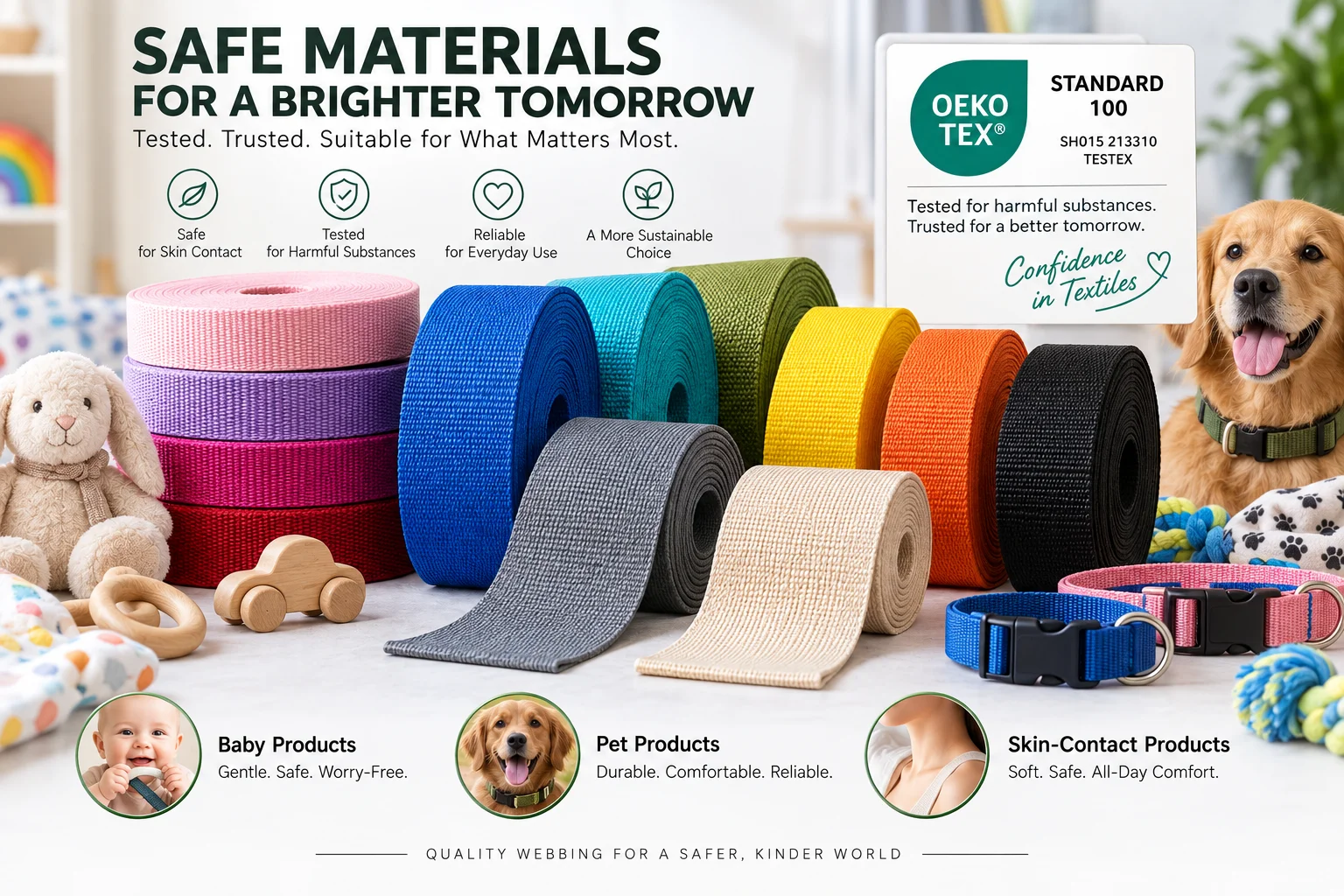
Chemical safety has become a purchasing requirement, not a marketing bonus. Retailers in the EU and North America increasingly demand proof that textile components — including the webbing inside baby carriers, dog collars, medical straps, and everything worn against skin — are free of harmful substances. The most widely recognized proof is OEKO-TEX Standard 100 certification, and understanding what it does and does not cover has become a core sourcing skill.
This guide is written for brand owners, importers, and compliance managers buying webbing at production volume. It covers what OEKO-TEX Standard 100 actually tests, the four product classes and which one your product needs, why the certificate's article scope matters as much as its validity, how it differs from REACH, GRS, and CPSIA, and a practical verification checklist for qualifying a supplier. For material background, see the custom OEM webbing ordering guide.
What OEKO-TEX Standard 100 Tests
OEKO-TEX Standard 100 is an independent third-party certification system for textile products at all stages of processing. A certified article has been laboratory tested against a criteria catalog covering hundreds of regulated and non-regulated substances that are harmful to health, including:
- Restricted azo dyes that can release carcinogenic amines
- Formaldehyde — a residual chemical from dyeing and finishing
- Heavy metals (lead, cadmium, mercury, and others) extractable from the material
- Phthalates — plasticizers found in coatings and prints
- Chlorinated phenols and PFCs used in some finishing treatments
- Residual pesticides carried in from natural fibers
- Colorants classified as allergenic or carcinogenic
- Auxiliary chemicals such as alkylphenols (APEOs) used in wet processing
The limit values are stricter than many legal requirements and are reviewed at least annually. The point for a webbing buyer: the dyes, finishes, and coatings applied during production are exactly where chemical risk lives. Dye method matters too — the dope dyed vs piece dyed webbing guide explains how coloration routes differ in their chemical footprint.
The Four Product Classes
Standard 100 groups products by how much skin contact they have, with limit values tightened accordingly. Ask for the class that matches your end product — not just "a certificate."
| Class | Product Type | Webbing Examples |
|---|---|---|
| Class I | Baby and toddler products (0-3 years) | Baby carrier straps, harnesses, stroller webbing |
| Class II | Direct skin contact | Apparel straps, watch straps, sports gear |
| Class III | No direct skin contact | Bag straps with liners, outer gear layers |
| Class IV | Decoration / furnishing | Furniture webbing, decorative trim |
Class I is the strictest, and a Class I certification satisfies the requirements of the other classes. Note that pet products occupy a special position: there is no dedicated OEKO-TEX pet class, but buyers of dog collar webbing commonly specify Class I or II limits because dogs chew their gear and groom chemicals off their coats.
Why It Matters for Webbing Buyers
Webbing is a component, which makes it the buyer's responsibility in the compliance chain. Three practical scenarios:
- Retail gatekeeping: Major EU and US retailers require Standard 100 (or equivalent) documentation for textile components before listing a product. A missing certificate can block the listing entirely.
- Baby and pet exposure: Products that go in mouths — baby carriers, teethable straps, pet collars — carry the highest chemical-exposure risk and the strictest buyer requirements. Class I certification is frequently a hard requirement.
- Medical and skin-contact products: Webbing in braces, slings, and wearables sits against skin for extended periods; certification reduces both real risk and liability exposure.
The Catch: Certificates Have Article Scope
The most common compliance mistake in sourcing is treating an OEKO-TEX certificate as a company-wide credential. It is not. A certificate applies to specific articles — defined combinations of material, construction, and color range — and to the certificate holder (the mill or trading company), valid for one year at a time.
When a supplier says "we are OEKO-TEX certified," verify three things before relying on it:
- Validity: Certificates renew annually. Check the date, or look the certificate number up on the official OEKO-TEX website's label-check tool.
- Holder identity: The certificate holder must be the entity actually manufacturing (or trading under certification scope) the webbing you buy. A trading company's certificate does not automatically cover its factories.
- Article scope: Your exact webbing — the material, construction, and color — must fall within the article descriptions on the certificate. A certificate covering white polyester tape does not cover a custom-dyed navy jacquard.
If your specification is outside the existing scope, the supplier must have the article tested and certified before your production ships. Build this lead time into your program schedule.
OEKO-TEX vs REACH vs GRS vs CPSIA
These frameworks are frequently confused. They answer different questions:
| Framework | Type | What It Verifies |
|---|---|---|
| OEKO-TEX Standard 100 | Voluntary third-party product certification | Finished article free of listed harmful substances |
| REACH | EU legal regulation | Chemical substances compliance for the EU market |
| GRS | Voluntary certification | Recycled content and chain of custody |
| CPSIA | US legal regulation | Children's product safety (lead, phthalates) in the US |
They are complementary, not interchangeable. A recycled webbing program can be both GRS-certified for recycled content (see the eco-friendly rPET webbing guide) and Standard 100 certified for chemical safety. A children's product for the US market needs CPSIA compliance regardless of any voluntary certification. Map your market and product category first, then specify the right combination to your supplier.
Checklist for Sourcing Certified Webbing
- Determine the product class your end product requires (Class I for baby, II for skin contact).
- Request the supplier's certificate number and verify it on the official OEKO-TEX site.
- Match your exact article (material, construction, color) against the certificate scope.
- Confirm the certificate holder is your actual manufacturer.
- For custom colors or coatings, agree in writing who arranges and pays for scope extension testing, and the lead time.
- Keep the certificate on file with your batch traceability records so each shipment maps to a certified article.
- Re-verify annually — certificates expire, and scopes change with product lines.
Need Certified Webbing for Your Program?
TMG Webbing supplies OEKO-TEX Standard 100 certified webbing constructions for baby, pet, medical, and skin-contact applications, with documented dye and finish processes and batch traceability. Tell us your end product, required class, and specification — our team will confirm the certified article scope for your exact webbing and provide the documentation with your quote.
Request Certified Webbing Quote Talk to an EngineerFrequently Asked Questions
What does OEKO-TEX certified webbing mean?
OEKO-TEX Standard 100 certified webbing has been laboratory tested for a long list of harmful substances — restricted pesticides, formaldehyde, heavy metals, azo dyes that release carcinogenic amines, chlorinated phenols, phthalates, and more — and found below the limit values for its product class. It verifies the webbing is safe for its intended skin-contact level, which is essential for baby products, pet gear, medical straps, and anything worn against the skin.
What are the OEKO-TEX Standard 100 classes?
Standard 100 defines four product classes with different limit values: Class I covers products for babies and toddlers up to 3 years (the strictest limits), Class II covers components with direct skin contact, Class III covers components without direct skin contact, and Class IV covers decoration/furnishing materials. A webbing certified to Class I automatically satisfies the looser requirements of Classes II-IV.
How do I verify a supplier's OEKO-TEX certificate?
Ask for the certificate number and check it on the official OEKO-TEX website (oeko-tex.com) using the label check / certificate finder. Verify that (1) the certificate is currently valid (it must be renewed annually), (2) the certificate holder is your actual supplier, and (3) your specific article — the exact webbing material, construction, and color you are buying — is within the certified article description scope. A valid certificate for a different product does not cover your webbing.
Is OEKO-TEX the same as REACH or GRS?
No. OEKO-TEX Standard 100 is a voluntary third-party product certification that tests the finished article for harmful substances against strict limit values. REACH is the EU's legally binding chemicals regulation that applies to substances placed on the EU market. GRS (Global Recycled Standard) certifies recycled content and chain of custody, not chemical safety. They are complementary — a recycled rPET webbing can be both GRS-certified for content and OEKO-TEX certified for chemical safety.