
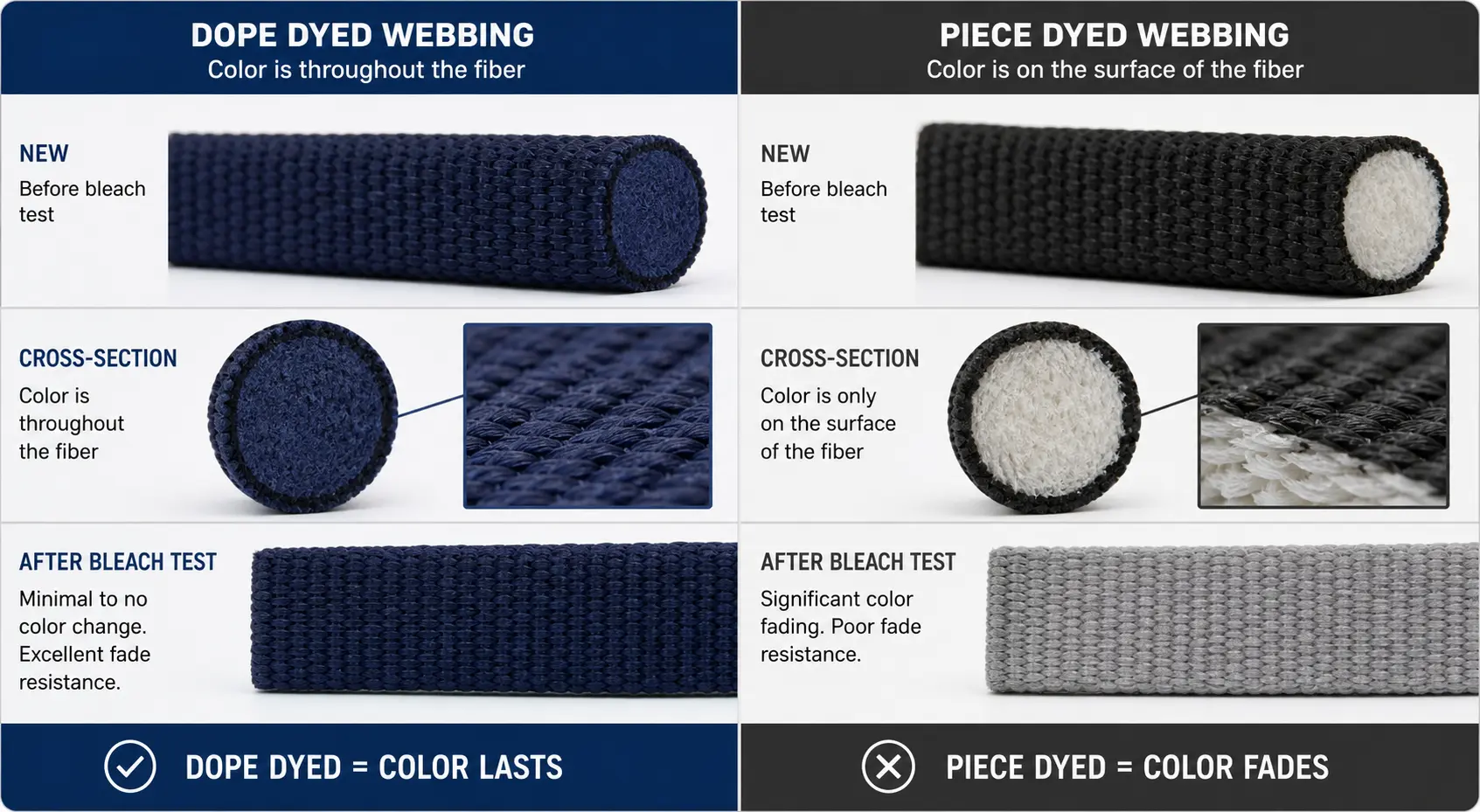
An outdoor furniture brand in Germany receives a customer complaint: 800 patio chairs purchased in March show visible color fading by August—just 5 months of UV exposure. The supplier certified "colorfastness Grade 4-5" on the test report. The spec sheet said "UV-stable polyester webbing." The problem? The webbing was piece dyed, not dope dyed. The buyer didn't know the difference—and the supplier didn't volunteer it. This guide explains why those two production methods deliver a 4× difference in UV service life, a 95% difference in water footprint, and a 6× difference in custom-color MOQ.
If you source polyester or nylon webbing for outdoor furniture, marine, automotive, military, safety, or premium consumer goods, the dyeing method your supplier uses determines whether your product looks new after 3 summers or after 3 months. Dope dyed (also called solution dyed, mass dyed, or spun dyed) locks pigment into the polymer melt before extrusion; piece dyed (also called bath dyed or stock dyed) applies color to the surface of already-woven webbing. The two processes produce webbing that looks identical on day one—but performs very differently after UV, bleach, abrasion, and repeated washing.
This guide consolidates datasheet values from yarn producers (DSM, Honeywell, Avient, Clariant), ISO 105 / AATCC test results, and B2B sourcing data from Chinese yarn and webbing manufacturers. Use it to specify the correct dyeing method in your next RFQ, and to verify supplier claims with objective tests.
The Radish vs Carrot Analogy: Why Dyeing Method Matters
The simplest way to understand the difference is the radish-vs-carrot analogy used by outdoor textile manufacturers:
- Piece dyed webbing is a radish—beautiful red skin, but a white core. Color is applied to the surface of already-formed fiber. When UV rays, abrasion, or bleach wear away the colored "skin," the white core shows through. Fading, streaking, and color migration are inevitable.
- Dope dyed webbing is a carrot—orange all the way through. Color pigment is mixed into the liquid polymer before extrusion, so every filament is colored at the molecular level. You can scratch it, scrub it, bleach it, or leave it in the sun for years—the color cannot wear off because there is no uncolored core underneath.
This single structural difference drives every performance metric that follows: light fastness, wash fastness, bleach resistance, batch consistency, NIR stability, water footprint, and MOQ.
Dope Dyed vs Piece Dyed: 16-Metric Comparison Table
The table below consolidates the technical, commercial, and environmental differences. All values are typical industry ranges; specific values vary by polymer type (PET, PA6, PA66, PP), pigment chemistry, and supplier process control.
| Metric | Dope Dyed (Solution Dyed) | Piece Dyed (Bath Dyed) | Difference |
|---|---|---|---|
| Color location | Throughout fiber cross-section (molecular) | Surface 10-20% of fiber | Fundamental |
| Light fastness (ISO 105-B02) | Grade 7-8 | Grade 4-5 | 3 grades higher |
| Wash fastness (ISO 105-C06) | Grade 5 | Grade 4 | 1 grade higher |
| Rub fastness (ISO 105-X12) | Grade 4-5 (dry/wet) | Grade 3-4 (dry/wet) | 1 grade higher |
| Perspiration fastness | Grade 5 (acid/alkaline) | Grade 4 (acid/alkaline) | 1 grade higher |
| Chlorine resistance | Grade 4-5 (50 ppm Cl) | Grade 2-3 (50 ppm Cl) | 2 grades higher |
| UV service life (Florida, 45°S) | 3,000-5,000 hours | 500-1,200 hours | 3-5× longer |
| Bleach cleanability (5% NaOCl) | No color change in 30 min | Visible fade in 5 min | Critical for hospitality |
| Batch-to-batch consistency | ΔE < 0.5 (masterbatch controlled) | ΔE 1.5-3.0 (dye lot variation) | 3-6× tighter tolerance |
| NIR reflectance consistency | Identical every batch | Varies ±15-25% by dye lot | Military-critical |
| Water consumption | 0 L/kg (no dye bath) | 100-150 L/kg yarn | 95% savings |
| CO₂ footprint | ~50% of piece dyed | Baseline | ~50% reduction |
| Wastewater generated | Zero dye effluent | 1-3 gal/yard fabric | ZDHC-aligned |
| Yarn cost (PET DTY 150D) | $1.38-1.86/kg | $1.10-1.40/kg raw white + dye | 15-30% premium |
| Custom color MOQ | 3,000-5,000 kg per color | 500-1,000 kg per color | 6-10× higher |
| Lead time (custom color) | 20-30 days (masterbatch + extrusion) | 10-15 days (dye bath only) | 2× longer |
Sources: ISO 105-B02/C06/X12 test data from Yaakan, VNPOLYFIBER, Tongxiang Shenao, and HUILONG datasheets; UV exposure data from Art Fabric Vietnam and Coverstore outdoor material testing; B2B pricing from Made-in-China.com verified supplier listings as of Q2 2026.
How Piece Dyeing Works (and Where It Still Wins)
Piece dyeing is the older, simpler, more flexible process—and for many applications it remains the correct choice. The production sequence:
- Polymer extrusion: PET or PA6 chips are melted and extruded into raw white filament yarn (FDY, DTY, or POY).
- Yarn winding: White yarn is wound onto packages or beams, ready for weaving.
- Weaving: White yarn is woven into webbing (plain, twill, herringbone, jacquard) on needle looms.
- Dye bath immersion: The white webbing is loaded into a high-pressure dye bath at 130°C with disperse dyes (polyester) or acid dyes (nylon), plus carriers, leveling agents, and pH adjusters.
- Wash-off and finishing: Multiple rinse cycles remove unfixed dye; heat-setting and softener treatments follow.
The dye molecules penetrate the outer 10-20% of the fiber cross-section and bond to the polymer surface through van der Waals forces and hydrogen bonds. The interior of the fiber remains uncolored.
Where piece dyeing still wins:
- Small custom-color runs: 500 kg MOQ makes it viable for sample programs, pilot runs, and short-season fashion colors.
- Rapid color changes: A piece dyehouse can switch from navy to forest green in 4 hours; a dope dyed extrusion line requires 2-3 days for masterbatch changeover and cleaning.
- Color matching flexibility: Dyehouses can hit any Pantone shade within ΔE 1.0 in 24-48 hours; dope dyed masterbatch matching takes 7-14 days.
- Lower upfront cost: For short-life products (fashion accessories, promotional items, single-season goods), piece dyed is more economical.
- Indoor applications: Where UV exposure is minimal (furniture upholstery, handbags, apparel), the fastness gap is less consequential.
See our color fastness testing guide for the full ISO 105 / AATCC test protocol and acceptance criteria for piece dyed webbing.
How Dope Dyeing Works (and Why It Performs So Differently)
Dope dyeing—also called solution dyeing, mass dyeing, or spun dyeing—reverses the sequence: color is added before the fiber exists. The production sequence:
- Masterbatch preparation: High-concentration pigment masterbatch (typically 30-50% pigment in a PET or PA carrier resin) is compounded and pelletized.
- Polymer melt dosing: Virgin polymer chips and masterbatch pellets are fed into the extruder through gravimetric dosers at ratios typically 2-5% masterbatch by weight.
- Melt mixing and extrusion: The polymer-pigment melt is homogenized in the extruder screw and forced through a spinneret. As the colored melt exits and solidifies, every filament forms with pigment particles distributed uniformly throughout its cross-section.
- Drawing and texturing: The colored yarn is drawn to orient polymer chains and textured (DTY) or left flat (FDY) per application.
- Weaving: The pre-colored yarn is woven into webbing—no subsequent dye bath is needed.
Because pigment particles are encapsulated within the polymer matrix, UV photons must penetrate the polymer to reach them—and the polymer itself absorbs or reflects most UV wavelengths before they can degrade the pigment. This is why dope dyed polyester achieves Grade 7-8 light fastness while piece dyed polyester maxes out at Grade 4-5: the pigment is shielded.
The 5 core advantages of dope dyed webbing:
- Light fastness Grade 7-8: Withstands 3,000-5,000 hours of direct sunlight before perceptible color change. Equivalent to 5-8 years of Florida outdoor exposure.
- Wash fastness Grade 5: Color is integral to the polymer—repeated hot-water wash with detergent cannot remove what is molecularly bound.
- 100% batch consistency: Color is controlled by masterbatch dosing ratio (a weight-based process parameter), not by dyebath chemistry, temperature, and time. ΔE < 0.5 batch-to-batch is routine.
- 95% water savings: No dye bath, no rinse cycles, no wash-off. Eliminates 100-150 L of water per kg of yarn and the corresponding wastewater treatment cost.
- Zero dye effluent: Aligns with ZDHC, bluesign, and brand sustainability programs that restrict dye-house discharge.
The trade-offs:
- Higher MOQ: Custom colors require 3,000-5,000 kg minimum per color (vs 500 kg for piece dyed) because masterbatch production runs are economic only at scale.
- Longer lead time: 20-30 days for custom masterbatch + extrusion vs 10-15 days for piece dyeing.
- Limited color library: Stock colors (Black, Navy, Grey, Beige, White) are widely available; specialty shades require custom masterbatch.
- Restricted to synthetic fibers: Dope dyeing works on PET, PA6, PA66, PP. It does not work on cotton, viscose, or other cellulosics.
- No light pastels: Very pale shades (off-white, light pink, pale yellow) are difficult to achieve because pigment loading below 0.5% produces inconsistent color.
UV Stability: The 3-5× Service Life Difference
UV stability is the single most common reason B2B buyers specify dope dyed webbing. The performance gap is not subtle:
| Exposure condition | Dope dyed PET webbing | Piece dyed PET webbing |
|---|---|---|
| Florida outdoor, 45° south-facing (ASTM G7) | 3,000-5,000 hours to ΔE > 3 | 500-1,200 hours to ΔE > 3 |
| Arizona outdoor (ASTM G7) | 4,000-6,000 hours | 600-1,500 hours |
| QUV accelerated (ISO 4892-3, 340 nm) | 2,000 hours to ΔE > 3 | 400-700 hours |
| Equivalent outdoor years (Florida) | 5-8 years | 1-2 years |
The mechanism: UV photons (290-400 nm) carry enough energy to break azo and anthraquinone dye chromophores. With piece dyed yarn, these chromophores sit on the fiber surface, fully exposed to incident UV. With dope dyed yarn, the pigment is encased in 5-20 μm of polymer that absorbs UV-B (290-320 nm) almost completely and attenuates UV-A (320-400 nm) significantly. The pigment effectively wears "UV sunglasses."
For applications specified by UV service life—outdoor furniture, marine canvas, awnings, shade sails, safety harnesses used outdoors, military gear exposed to desert sun—dope dyed is not an upgrade, it is a requirement. See our webbing UV lifespan guide for the full ASTM G7 / ISO 4892-3 test methodology and polymer-specific degradation curves.
Military NIR: Why Piece Dyeing Is Dangerous
For military webbing that must meet Near-Infrared Reflectance (NIR) specifications—MIL-DTL-32439B, A-A-55126, MIL-DTL-44162D, MIL-PRF-44436C—the choice between dope dyed and piece dyed is not a preference, it is a safety-critical specification.
NIR camouflage works by matching a fabric's reflectance in the 600-1200 nm wavelength range to the reflectance of the surrounding terrain (foliage, soil, sand). Night vision devices (NVDs) amplify reflected NIR, so a soldier wearing webbing whose NIR signature differs from the background becomes visible at 200-400 meters.
The problem with piece dyed webbing for NIR applications:
- Dye lot variation: NIR reflectance depends on dye concentration and penetration depth. Piece dyed batches vary ±15-25% in NIR reflectance at 800 nm across dye lots—even when visible color (Lab values) appears identical.
- Dye migration: Dye molecules migrate within the fiber over time, especially under thermal cycling (-30°C to +50°C in field use). NIR reflectance drifts in service.
- Surface-only dyeing: When the colored surface wears off through abrasion (backpacks, plate carriers), the exposed white core reflects NIR at 80-90%—a bright signature visible to NVDs.
Dope dyed yarn solves all three problems:
- NIR built into the fiber: Reflectance is determined by the masterbatch formulation, controlled to ±2% at 800 nm. Every batch is identical.
- No dye migration: Pigment particles are physically trapped in the polymer matrix—no molecular migration is possible.
- Color throughout: Abrasion exposes more colored fiber, not white core. NIR signature remains stable even after 50,000+ abrasion cycles.
Military procurement specification tip: When sourcing NIR-compliant webbing, require (1) masterbatch origin certificate (Avient, Clariant, or equivalent), (2) per-batch NIR reflectance test report covering 600-1200 nm in 50 nm increments, and (3) abrasion-tested NIR stability (per ISO 12947-2 at 25,000 cycles). If the supplier cannot provide these, the webbing is not NIR-stable regardless of any certificate. See our IRR webbing guide for the full MIL-DTL-32439B compliance protocol.
Color Fastness Testing: The 5-Grade ISO 105 Scale
Color fastness is rated on a 1-5 scale where 5 = no color change/transfer and 1 = severe color change. Buyers should require test reports covering at minimum the four fastness modes relevant to webbing:
| Test | Standard | Dope dyed typical | Piece dyed typical | Specification floor |
|---|---|---|---|---|
| Light fastness | ISO 105-B02 / AATCC 16 | 7-8 | 4-5 | 5 (outdoor), 4 (indoor) |
| Wash fastness | ISO 105-C06 | 5 | 4 | 4 |
| Rub fastness (dry) | ISO 105-X12 | 4-5 | 3-4 | 4 |
| Perspiration fastness | ISO 105-E04 | 5 | 4 | 4 |
| Chlorine fastness | ISO 105-E03 | 4-5 | 2-3 | 3 (poolside), N/A (general) |
Test reports should be batch-specific, not generic "typical values" from a 3-year-old sample. See our test report reading guide for what to verify in a color fastness certificate.
Sustainability: The 95% Water Difference
Textile dyeing is the second-largest polluter of clean water globally, after agriculture. A conventional polyester dye house processing 10,000 tonnes per year consumes 100 million to 1 billion liters of water annually—often in regions already facing water stress. Dope dyeing eliminates this water footprint from the coloring step entirely.
Per kilogram of colored yarn:
| Resource | Dope dyed | Piece dyed | Savings |
|---|---|---|---|
| Water | ~5 L (masterbatch prep only) | 100-150 L (dye bath + rinse) | 95% |
| Energy | ~8 MJ/kg | ~18 MJ/kg (130°C bath heating) | ~55% |
| CO₂ equivalent | ~2.1 kg CO₂/kg | ~4.2 kg CO₂/kg | ~50% |
| Chemical auxiliaries | None (pigment only) | Carriers, leveling agents, pH adjusters, fixatives | 100% eliminated |
| Wastewater treatment | None required | Full effluent treatment plant required | Capital + operating cost eliminated |
For brands pursuing ZDHC (Zero Discharge of Hazardous Chemicals), bluesign, or GOTS certification, dope dyed webbing eliminates the dye-house from the audited supply chain entirely. Combined with recycled PET (rPET) chip feedstock, dope dyed webbing enables a double sustainability claim: verified recycled content (GRS certification) plus verified water and chemical savings. See our rPET webbing guide for the recycled content verification protocol.
Cost Analysis: When Dope Dyed Becomes Cheaper
The per-meter cost premium of dope dyed webbing is typically 12-20%—but total cost of ownership (TCO) tells a different story. Below is a TCO comparison for a B2B buyer specifying 10,000 meters of polyester webbing for outdoor furniture, 50mm width, 1.5mm thickness, custom Pantone 19-4052 "Classic Blue":
| Cost component | Dope dyed | Piece dyed |
|---|---|---|
| Yarn cost (5,000 kg @ $1.60/kg vs $1.25/kg) | $8,000 | $6,250 |
| Weaving + finishing (no dye bath) | $4,200 | $3,800 + $1,200 dye surcharge |
| Masterbatch matching (one-time) | $1,200 | $0 |
| Wastewater surcharge | $0 | $600 |
| Subtotal (10,000 m) | $13,400 | $11,850 |
| Cost per meter | $1.34 | $1.19 |
| UV service life (Florida outdoor) | 6 years | 1.5 years |
| Replacements over 6 years | 1× | 4× |
| 6-year TCO | $13,400 | $47,400 |
| 6-year TCO per meter | $1.34 | $4.74 |
For applications with UV exposure, dope dyed webbing is 3.5× cheaper over a 6-year service life despite the 12% per-meter premium. The math flips for short-life indoor applications: a promotional tote bag used for 6 months sees no UV-driven replacement, so the lower per-meter cost of piece dyed wins.
11-Application Selection Matrix
Below: which dyeing method to specify for each common webbing application. "Dope dyed" recommendations reflect cases where UV, fastness, consistency, or NIR requirements justify the premium; "Piece dyed" reflects cases where flexibility, MOQ, or short service life make it the right call.
| Application | Recommended | Reason |
|---|---|---|
| Outdoor furniture webbing (patio chairs, loungers) | Dope dyed | 5,000 hr UV life vs 1,000 hr; bleach cleanable |
| Marine canvas & jackstay webbing | Dope dyed | Saltwater + UV + bleach cleaning; ISO 12401 compliance |
| Military NIR/IRR webbing (MIL-DTL-32439B) | Dope dyed (mandatory) | NIR consistency batch-to-batch; no dye migration |
| Automotive interior webbing (seat belts, headliner) | Dope dyed | 10-15 year UV life through glass; VOC-free |
| Safety harness webbing (construction, fall arrest) | Dope dyed | UV stability preserves strength indicator color; ANSI Z359 compliance |
| Awning & shade sail webbing | Dope dyed | Continuous UV exposure; 8-year color warranty |
| Pet collars & leashes (outdoor use) | Dope dyed | Wash fastness Grade 5; perspiration fastness; chlorine resistance |
| Premium backpack straps (outdoor/tactical) | Dope dyed | UV + abrasion resistance; batch consistency for brand color matching |
| Indoor fashion bag straps (tote, handbag) | Piece dyed | Custom Pantone matching; low MOQ; short service life |
| Promotional lanyards & event webbing | Piece dyed | Short service life; rapid color changes; low cost |
| Apparel belts (fashion, uniform) | Piece dyed | Seasonal color cycles; small batch flexibility |
8 B2B Sourcing Red Flags
When evaluating suppliers claiming dope dyed webbing capability, these are the most common misrepresentations and verification failures:
- "Solution dyed equivalent" claims: Some suppliers list piece dyed webbing as "solution dyed equivalent" because it achieves Grade 4-5 light fastness (which is not equivalent). Require explicit confirmation of dope dyed yarn in writing, with masterbatch origin.
- No masterbatch origin certificate: Legitimate dope dyed yarn uses masterbatch from Avient (formerly PolyOne), Clariant, Ampacet, or equivalent. If the supplier cannot name the masterbatch supplier, the yarn is likely surface-dyed disguised as dope dyed.
- Test reports older than 12 months: Color fastness reports must be batch-specific and dated within the last 12 months. Generic "typical values" or 3-year-old reports are not acceptable verification.
- No ISO 105-B02 light fastness data: This is the single most important test for dope dyed claims. If the supplier provides wash fastness but not light fastness, suspect piece dyed. Dope dyed should achieve Grade 7+.
- Custom color MOQ below 1,000 kg: Genuine dope dyed custom colors require 3,000-5,000 kg MOQ because masterbatch production runs are economic only at scale. MOQ of 500 kg for a "custom dope dyed" color is a piece dyed product in disguise.
- Lead time under 15 days for custom color: Dope dyed custom colors require masterbatch compounding (5-10 days) + extrusion (10-15 days). Total 20-30 days. A 10-day lead time for a "custom dope dyed" color is technically impossible.
- No cross-section microscopy available: The definitive test for dope dyed vs piece dyed is fiber cross-section microscopy. Dope dyed shows uniform color throughout; piece dyed shows color only on the outer 10-20% of the fiber. If the supplier cannot provide cross-section photos, refuse the order until verified.
- NIR reflectance varies across batches: For military applications, require per-batch NIR reflectance test reports (600-1200 nm in 50 nm increments). If reflectance at 800 nm varies more than ±5% across batches, the yarn is piece dyed—regardless of any other documentation.
5-Step Quick Decision Tree
- Will the webbing see >500 hours/year of direct sunlight? If yes → dope dyed. If no → continue.
- Is this a military NIR/IRR application? If yes → dope dyed (mandatory). If no → continue.
- Will the webbing be cleaned with bleach or chlorine exposure? If yes → dope dyed. If no → continue.
- Is the custom color MOQ acceptable at 3,000+ kg? If yes → dope dyed for best TCO. If no → piece dyed.
- Is service life >3 years? If yes → dope dyed (3-5× UV life). If no → piece dyed acceptable.
This decision tree correctly resolves ~90% of B2B dyeing method selections. For the remaining 10% (specialty applications, hybrid specifications, mixed-yarn constructions), consult the supplier with specific performance requirements and let the engineering team recommend.
Frequently Asked Questions
What is the difference between dope dyed and piece dyed webbing?
Dope dyed (solution dyed) webbing has color pigment mixed into the polymer melt before fiber extrusion, so color is locked into the fiber's molecular structure. Piece dyed webbing is woven from raw white yarn first, then dipped into a dye bath—color sits on the fiber surface. The result: dope dyed achieves light fastness Grade 7-8 vs piece dyed's Grade 4-5, wash fastness Grade 5 vs 4, and 95% water savings, but requires 3,000-5,000 kg MOQ for custom colors vs 500 kg for piece dyed.
Why is dope dyed webbing required for military NIR applications?
Military NIR (Near-Infrared Reflectance) specifications require reflectance values within tight tolerances at 600-1200 nm wavelengths. With dope dyed yarn, NIR properties are built into the fiber during extrusion, delivering identical reflectance every batch. With piece dyed yarn, NIR performance depends on dye penetration and varies dye-lot to dye-lot, creating dangerous detection signatures on the battlefield. MIL-DTL-32439B, A-A-55126, and MIL-DTL-44162D all but require solution-dyed yarn for NIR-compliant webbing.
Is dope dyed webbing more expensive than piece dyed?
Per-meter, dope dyed webbing typically costs 12-20% more than piece dyed equivalents due to higher yarn cost ($1.38-1.86/kg vs $1.10-1.40/kg for raw white) and larger MOQ (3,000-5,000 kg vs 500 kg for custom colors). However, dope dyed eliminates dye-bath processing fees, reduces wastewater treatment costs by ~95%, and delivers 3-5× longer UV service life—making total cost of ownership lower for outdoor or long-life applications.
Can I order dope dyed webbing in any custom color?
Not economically. Standard stock colors (Black, Navy, Grey, Beige, White) have low MOQs (often under 500 kg). Custom Pantone-matched colors require a masterbatch production run with 3,000-5,000 kg minimum per color. For smaller custom-color orders, piece dyed webbing remains the only viable option, accepting the trade-off of Grade 4-5 light fastness instead of Grade 7-8.
How can I verify a supplier's dope dyed claim?
Three verification methods: (1) Cross-section microscopy—dope dyed fiber shows uniform color throughout, piece dyed shows color only on the outer 10-20% of the fiber cross-section. (2) Bleach test—dope dyed webbing immersed in 5% sodium hypochlorite for 30 minutes shows no color change; piece dyed webbing fades or streaks. (3) Supplier documentation—require masterbatch origin certificate (Avient, Clariant, or equivalent) and ISO 105-B02 test report showing Grade 7+ light fastness.
Does dope dyeing work for nylon as well as polyester?
Yes, but with caveats. Dope dyed nylon 6 and nylon 66 are widely available and achieve the same Grade 7-8 light fastness as dope dyed polyester. However, nylon's higher moisture absorption (8% vs polyester's 0.4%) means pigment dispersion can be slightly less uniform, and color matching is more sensitive to humidity during extrusion. See our nylon vs polyester comparison for polymer-specific behavior.
Can dope dyed webbing be recycled?
Yes. Because the pigment is molecularly bound to the polymer, dope dyed PET webbing is fully recyclable through standard mechanical recycling streams—unlike piece dyed webbing, which often requires decolorization steps that degrade recycled polymer quality. Combined with rPET feedstock, dope dyed webbing supports closed-loop recycling. See our webbing recycling guide for the full end-of-life protocol.
Conclusion
Specifying "colored webbing" without specifying the dyeing method is one of the most common—and most expensive—procurement mistakes in B2B textile sourcing. The dyeing method determines UV service life (3-5× difference), color fastness (3 grades difference), batch consistency (6× tighter tolerance), water footprint (95% savings), NIR stability (military-critical), and total cost of ownership (3.5× over a 6-year service life).
For any application that sees sunlight, must match a brand color across multiple production runs, requires NIR compliance, or carries a multi-year warranty—specify dope dyed yarn explicitly in the RFQ, require masterbatch origin documentation, and verify with cross-section microscopy. For short-life, indoor, or rapid color-cycle applications—piece dyed remains the more economical and flexible choice.
The B2B market for dope dyed webbing rewards buyers who specify dyeing method, pigment chemistry, and masterbatch origin in their RFQs—and punishes buyers who accept "colored webbing" or "UV-stable" without verification. Use the 16-metric comparison table, the 11-application matrix, and the 8 red-flag checklist in this guide as your procurement reference, and require batch-level test data from every supplier.
If you need help specifying the correct dyeing method for your webbing application, contact TMG Webbing with your UV exposure, service life, color fastness, and certification requirements. We manufacture dope dyed and piece dyed webbing from PET, PA6, PA66, and PP yarns, with full ISO 105 color fastness testing, NIR reflectance characterization, and masterbatch origin traceability.
Need Dope Dyed Webbing?
TMG Webbing manufactures dope dyed (solution dyed) webbing in standard colors (Black, Navy, Coyote, Ranger Green, White) with low MOQ, plus custom Pantone-matched colors with masterbatch traceability. Light fastness Grade 7-8 certified per ISO 105-B02. NIR-compliant grades available for MIL-DTL-32439B / A-A-55126 applications. Widths from 10 mm to 150 mm.
Request a Quote Factory Inspection Checklist