
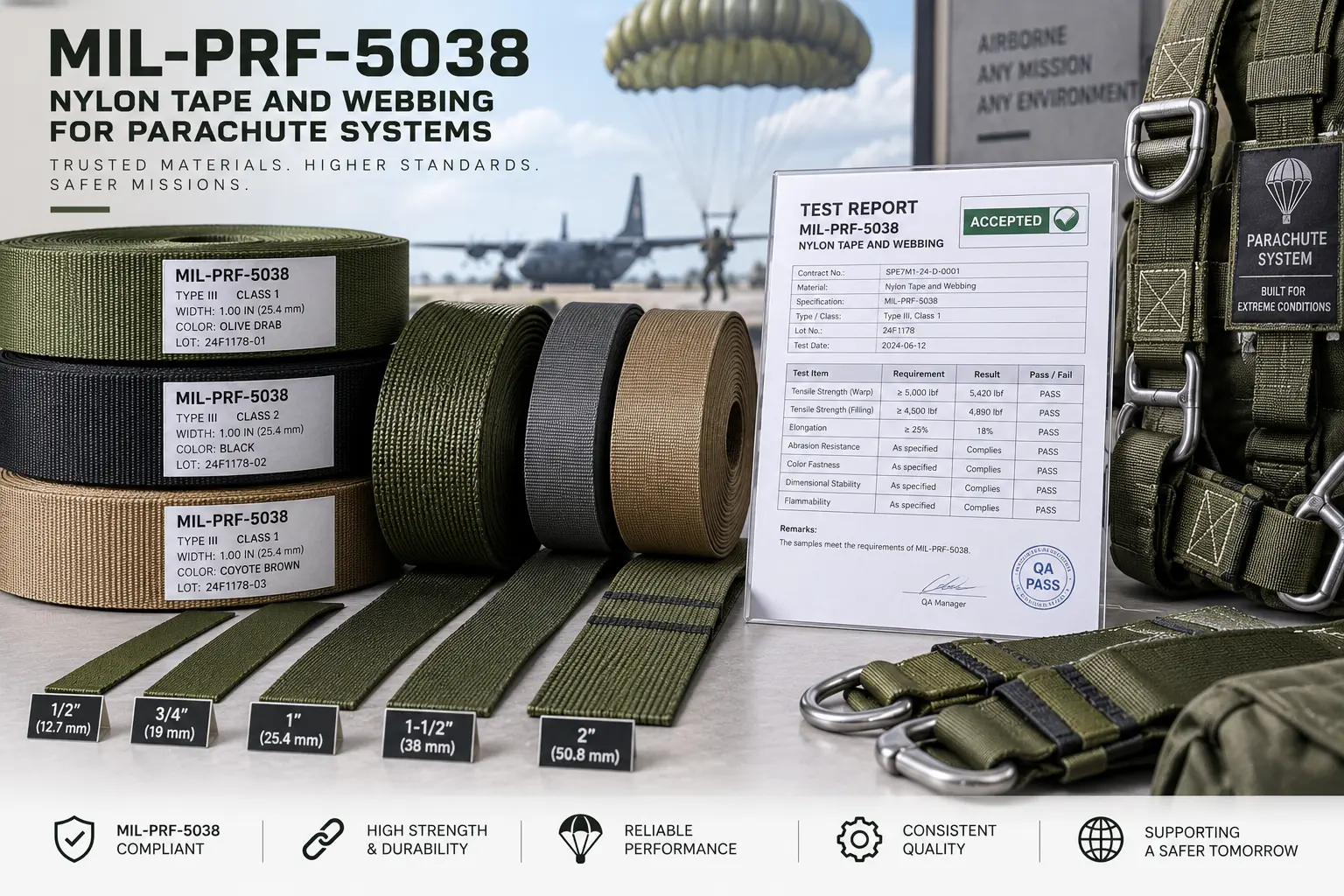
Military narrow fabric is ordered by specification number, and the number is the product. When a parachute program calls for MIL-PRF-5038 nylon tape, it is calling for a precisely defined article — a specific nylon construction with tested tensile strength, controlled elongation, and traceable production — and anything woven "similar to" it is not acceptable for the contract. For buyers new to military procurement, the specification landscape around parachute tape is genuinely confusing, because the documents have been revised, superseded, and reorganized over decades.
This guide explains what MIL-PRF-5038 covers, how it evolved from the older MIL-T-5038, what the type structure defines, how it relates to MIL-W-4088 webbing, and what a credible supplier must provide. It is written for defense procurement staff, parachute system OEMs, and MRO buyers. For the broader standards landscape, see the mil-spec webbing standards guide; for the material science behind parachute webbing, see the parachute webbing specifications guide.
What MIL-PRF-5038 Covers
MIL-PRF-5038 is the U.S. military performance specification for nylon tape and webbing used in parachute and aerial delivery systems. It is one of the family of narrow fabric specifications that together define every strap in a parachute assembly — from suspension and connector tape to reinforcement and pack components.
Like all performance specifications (the "PRF" in the designation), it states required performance results rather than prescribing exactly how the item must be manufactured:
- Tensile strength minimums defined per type and width — the load the tape must withstand in testing.
- Elongation requirements — controlled stretch that governs how the tape behaves under opening shock and sustained load.
- Construction and dimensions — yarn, weave, width, thickness, and weight tolerances that ensure interchangeability.
- Material requirements — nylon fiber type and quality, with dyeing and finishing controlled for consistency.
- Testing and inspection — the conformance testing the supplier must perform and document for each lot.
The specification organizes the product into types and classes that define the exact construction, width, and strength of each article. When ordering, the governing drawing and the exact type/class designation control — never order by specification name alone, and always work to the current revision in force.
From MIL-T-5038 to MIL-PRF-5038
The evolution matters because older drawings still reference the old number. The original MIL-T-5038 was a detail specification — it prescribed the exact construction of the tape. As the U.S. military transitioned to performance-based procurement in the 1990s and 2000s, detail specifications were rewritten as performance specifications: MIL-PRF-5038 replaced MIL-T-5038, stating required results and letting qualified manufacturers prove conformance.
Practical implications for buyers:
- Legacy drawings citing MIL-T-5038 are typically satisfied by the corresponding MIL-PRF-5038 article — but confirm with the contracting activity, because the interpretation depends on the contract and revision.
- "PRF" changes the burden of proof: the supplier demonstrates performance through testing rather than following a prescribed recipe. This makes the supplier's test documentation even more important.
- Always verify the current revision before quoting — specifications are amended, and older stock quoted to a cancelled revision can be rejected at receiving inspection.
How It Relates to MIL-W-4088
Buyers frequently confuse the two because both cover nylon narrow fabric for parachutes. The distinction is the product family:
| Specification | Covers | Typical Use in a Parachute |
|---|---|---|
| MIL-PRF-5038 | Nylon tape & webbing (its own type structure) | Suspension and connector tape, pack and component tape |
| MIL-W-4088 | Woven nylon webbing | Harness and riser structural straps |
A single parachute assembly uses both, plus cords and threads from their own specifications. For the detailed comparison of the webbing families, see the MIL-W-4088 vs MIL-W-17337 comparison. When in doubt, the governing drawing for the assembly identifies which article goes where — source to the drawing.
Why Nylon, and Why the Testing Matters
Military parachute tape is nylon for the same energy-management reasons covered in the nylon webbing applications and parachute guides: nylon's elongation absorbs opening shock, and its toughness survives the flexing, folding, and abrasion of deployment and repacking. The specification's elongation requirements are not incidental — a tape that is strong enough but stretches too little transmits a sharper shock than the system was designed for.
This is why lot-level test reports matter more in this product family than almost anywhere else in narrow fabric. A supplier's certificate means little if it cannot produce:
- Batch tensile and elongation results for the specific lot shipped, tested to the specification's method.
- Traceability from yarn lot and dye lot through weaving to the finished roll.
- Dimensional conformance — width, thickness, weight per unit length within tolerance.
- A pre-production or first-article sample when the contract requires it.
The how to read a webbing test report guide explains how to verify that the numbers on the report actually correspond to your lot and the specification's test methods.
Qualifying a Supplier
For defense and aerospace programs, supplier qualification goes beyond the webbing itself. Confirm before ordering:
- Conformance claim precision: The supplier quotes the exact type, class, and current revision — not "equivalent to." A supplier who blurs the designation will blur the conformance.
- Program requirements: Whether your contract requires a qualified products list (QPL) or qualified suppliers list (QSL) listing, first-article inspection, or specific packaging and marking (including unit, roll lengths, and traceability marking on each roll).
- Distribution chain honesty: If buying through a distributor, confirm the manufacturing source and that the test documentation flows from the mill, not a re-typed summary.
- Inspection readiness: The factory can support a factory inspection — process controls, calibration, and records.
For background on how military parachute components fit together, see the military parachute components guide and the UHMWPE parachute components guide.
Source Specification-Grade Nylon Tape
TMG Webbing manufactures high-strength nylon 66 tape and webbing with batch-level tensile and elongation testing, dimensional control, and full lot traceability. Tell us your governing specification, type, class, width, and quantity — our engineering team will review the requirement and respond with a conforming proposal within 48 hours.
Request a Specification Quote Talk to an EngineerFrequently Asked Questions
What is MIL-PRF-5038 nylon tape?
MIL-PRF-5038 is the U.S. military performance specification covering nylon tape and webbing used in parachute and aerial delivery systems — the narrow fabric straps for suspension lines, harnesses, risers, and pack components. It defines the required performance (tensile strength, elongation, construction, dimensions) by type and class, and it superseded the older detail specification MIL-T-5038 when the military moved to performance-based procurement.
What is the difference between MIL-PRF-5038 and MIL-T-5038?
MIL-T-5038 was the original detail specification that prescribed exactly how the nylon tape was made. MIL-PRF-5038 is its performance-based successor: instead of prescribing the manufacturing method, it states the required performance results (strength, elongation, dimensional tolerances) and lets qualified suppliers demonstrate conformance through testing. Product marked to the older MIL-T-5038 has been transitioning to the PRF version; always buy to the current revision in force.
How does MIL-PRF-5038 relate to MIL-W-4088 webbing?
They cover related but distinct families of parachute narrow fabric. MIL-W-4088 covers woven nylon webbing (the wider, heavier structural straps in harnesses and risers), while MIL-PRF-5038 covers nylon tape and webbing used in parachute components with its own type structure defining width, strength, and elongation. A parachute assembly typically uses both. Always specify by the governing drawing and the exact type/class rather than by specification name alone.
What should a MIL-PRF-5038 supplier provide?
A credible supplier provides: (1) weaving to the exact type, class, and current revision of the specification, (2) batch-level test reports showing conformance of tensile strength and elongation for the lot you receive, (3) material traceability from yarn lot through dye lot to finished roll, and (4) a pre-production sample validated before volume. For military programs, confirm whether the contract also requires qualification or QSL listing, and whether first-article inspection applies.