
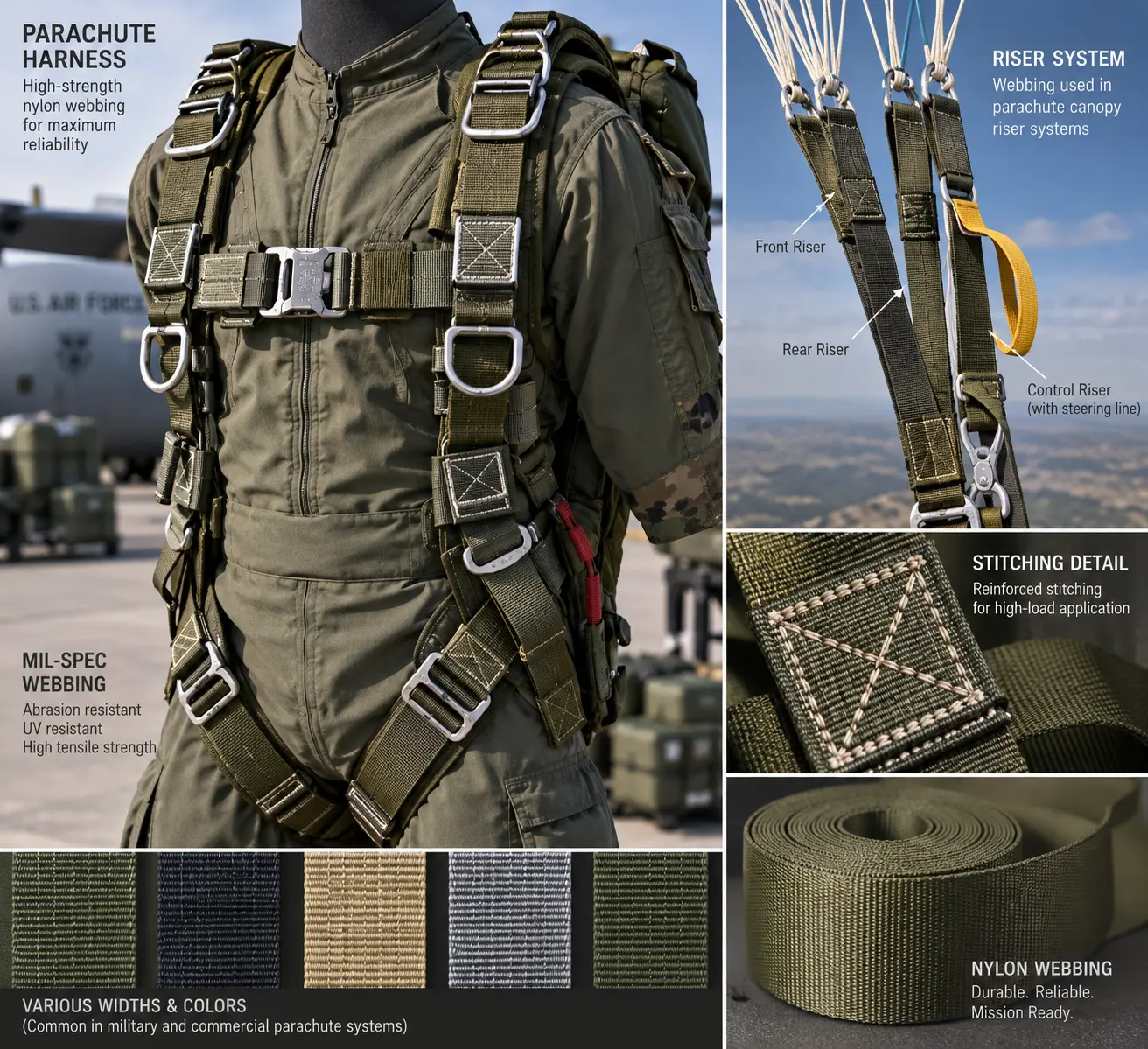
Parachute webbing operates in one of the most unforgiving environments any narrow fabric will ever see. In the fraction of a second a canopy inflates, the harness and riser webbing goes from slack to arresting a falling human or a multi-ton payload — an opening shock that can reach several times the static weight. The webbing has to survive that shock, every single time, with zero tolerance for failure. That requirement shapes everything about how parachute webbing is specified and made.
This guide is written for parachute system designers, military procurement, aerial delivery and drone-recovery engineers, and technical buyers. It covers why nylon 66 dominates parachute webbing, the military specifications that govern it (MIL-W-4088), tensile and elongation requirements, construction choices, and how to qualify a supplier with real batch test data. For the component-level and UHMWPE angle, see the parachute UHMWPE webbing components guide and the military parachute components guide.
Why Nylon 66 Dominates Parachute Webbing
Parachute design is energy management. When the canopy opens, the system must decelerate the load without exceeding the force the human body or the airframe can tolerate. The webbing plays a direct role in that deceleration.
Nylon 66 (polyamide) is the default material because it elongates under load — typically 20-30% at breaking strength. That stretch acts like a spring, spreading the opening shock over more time and distance and thereby lowering the peak force transmitted to the jumper. Nylon also has excellent abrasion resistance, good knot- and stitch-holding, and a long service history in military parachutes.
Alternatives are used where the design calls for different behavior. Polyester has much lower elongation and better UV and water resistance, so it appears where low stretch and weather stability matter more than energy absorption. UHMWPE (Dyneema) offers exceptional strength-to-weight for weight-critical systems, but its very low elongation and low melting point require careful system design — covered in detail in the UHMWPE fiber grades guide. The nylon vs polyester tensile strength guide quantifies the difference.
MIL-W-4088 and Military Specifications
Military parachute webbing is not a generic product — it is woven to a specification so that components are interchangeable and reliability is verifiable. The key U.S. specification is MIL-W-4088, which covers woven nylon webbing for parachutes and related personnel and cargo systems.
- MIL-W-4088 defines webbing by type, with each type specifying construction (flat or tubular), width, tensile strength, elongation, and finish. Specifying the type ensures the webbing meets the system's strength and energy-absorption design.
- Controlled elongation is as important as tensile strength — a webbing that is strong but stretches too little (or too much) can fail the system's opening-shock design even if its breaking strength looks adequate on paper.
- Finish and treatment may include coatings for abrasion, mildew resistance, or low-visibility/IR requirements depending on the application.
For a broader view of how mil-spec webbing types relate, see the MIL-W-4088 vs MIL-W-17337 comparison and the mil-spec webbing standards guide.
Tensile Strength and Elongation Requirements
Two numbers define parachute webbing performance, and both must be specified and tested:
| Property | Why It Matters | How It's Verified |
|---|---|---|
| Tensile (breaking) strength | Must exceed the maximum load the system can impose, with safety factor, including opening shock. | Specified by type in the governing spec; confirmed by batch tensile testing. |
| Elongation at break | Determines how much opening-shock energy the webbing absorbs; too low spikes peak force. | Specified as a range; verified alongside tensile in the test report. |
| Width & thickness | Sets strength and fits the harness/riser hardware and stitching pattern. | Dimensional inspection per the spec. |
| Construction | Flat vs tubular affects strength, suppleness, and how it stitches and folds. | Woven to the type's defined construction. |
Always verify these on an actual test report, not a marketing datasheet. The how to read a webbing test report guide explains how to confirm tensile and elongation figures and that the report corresponds to the lot you are buying.
Flat vs Tubular Construction
Like climbing webbing, parachute webbing comes in flat and tubular constructions, and the choice affects strength, suppleness, and how the webbing folds and stitches into a harness.
- Flat webbing is a single woven layer — thinner and used where a low profile and specific stitch patterns are needed, such as some riser and reinforcement applications.
- Tubular webbing is woven as a tube and flattened to two layers — thicker, more supple, and stronger for its width, common in load-bearing harness straps.
The governing military specification dictates which construction each type uses, so the system designer selects by spec type rather than choosing construction freely. The flat vs tubular webbing guide covers the structural trade-offs in general terms.
Qualifying a Parachute Webbing Supplier
Parachute webbing is a no-failure-tolerance product, so supplier qualification is rigorous. A credible supplier should provide:
- Conformance to the governing specification — woven to the exact MIL-W-4088 type, not "equivalent to."
- Batch-level test data — tensile and elongation results traceable to the production lot you receive.
- Material traceability — yarn lot and dye lot records for each batch.
- Process control — documented weaving, dyeing, and finishing controls, ideally verified by an inspection.
- Sample validation — a pre-production sample tested against the spec before volume commitment.
The custom OEM webbing ordering guide walks the full specification-to-production process, and the factory inspection checklist helps verify a supplier's quality systems before a long-term program.
Source Specification-Grade Parachute Webbing
TMG Webbing manufactures high-strength nylon 66, polyester, and UHMWPE webbing for demanding technical applications, with batch-level tensile and elongation testing and full material traceability. Tell us your governing specification, type, width, and quantity — our engineering team will review the requirement and propose a conforming construction with test data. Development samples are available for qualified programs.
Request a Specification Quote Talk to an EngineerFrequently Asked Questions
What webbing is used in parachutes?
Parachute harnesses, risers, and suspension systems use high-strength nylon 66 (polyamide) webbing because its natural elongation absorbs the shock of canopy opening, reducing peak force on the jumper and the airframe. Military parachute webbing is woven to specifications such as MIL-W-4088, which defines construction, tensile strength, and elongation. Some modern systems use polyester or UHMWPE where low stretch, low water uptake, or very high strength-to-weight is required.
How strong does parachute webbing need to be?
Parachute webbing must withstand both the static weight of the jumper or payload and, more importantly, the dynamic opening shock when the canopy inflates — forces several times body weight. Military specification webbings such as MIL-W-4088 define minimum tensile strengths that run into the thousands of pounds-force depending on the type and width, plus controlled elongation. The exact requirement is set by the system designer and the governing specification for the parachute model.
What is MIL-W-4088 webbing?
MIL-W-4088 is a U.S. military specification covering woven nylon webbing used in parachutes and related personnel and cargo systems. It defines webbing types by construction (flat or tubular), width, tensile strength, elongation, and finish so that components are interchangeable and reliable. Suppliers of mil-spec parachute webbing must weave to the specified type and provide test data demonstrating conformance.
Why is nylon used for parachute webbing instead of polyester?
Nylon 66 is preferred for most parachute harness and suspension webbing because it elongates under load — typically 20-30% at breaking — and that stretch absorbs the energy of canopy opening shock, lowering the peak deceleration force on the jumper. Polyester has much lower elongation, so it transmits a sharper opening shock, though it offers better UV and water resistance and is used where low stretch is specifically required. The choice is set by the system's energy-management design.