
A B2B buyer asks for "UHMWPE webbing" and receives three quotes: $24/meter, $38/meter, and $52/meter. All three claim "Dyneema-equivalent." One uses SK75, one uses SK78, one uses generic Chinese HMPE. The tensile reports look similar on paper—but the creep lifetime differs by 8x, the abrasion resistance differs by 4x, and only one of the three will still meet OCIMF MEG4 after 5 years in service. This guide gives you the data to tell them apart.
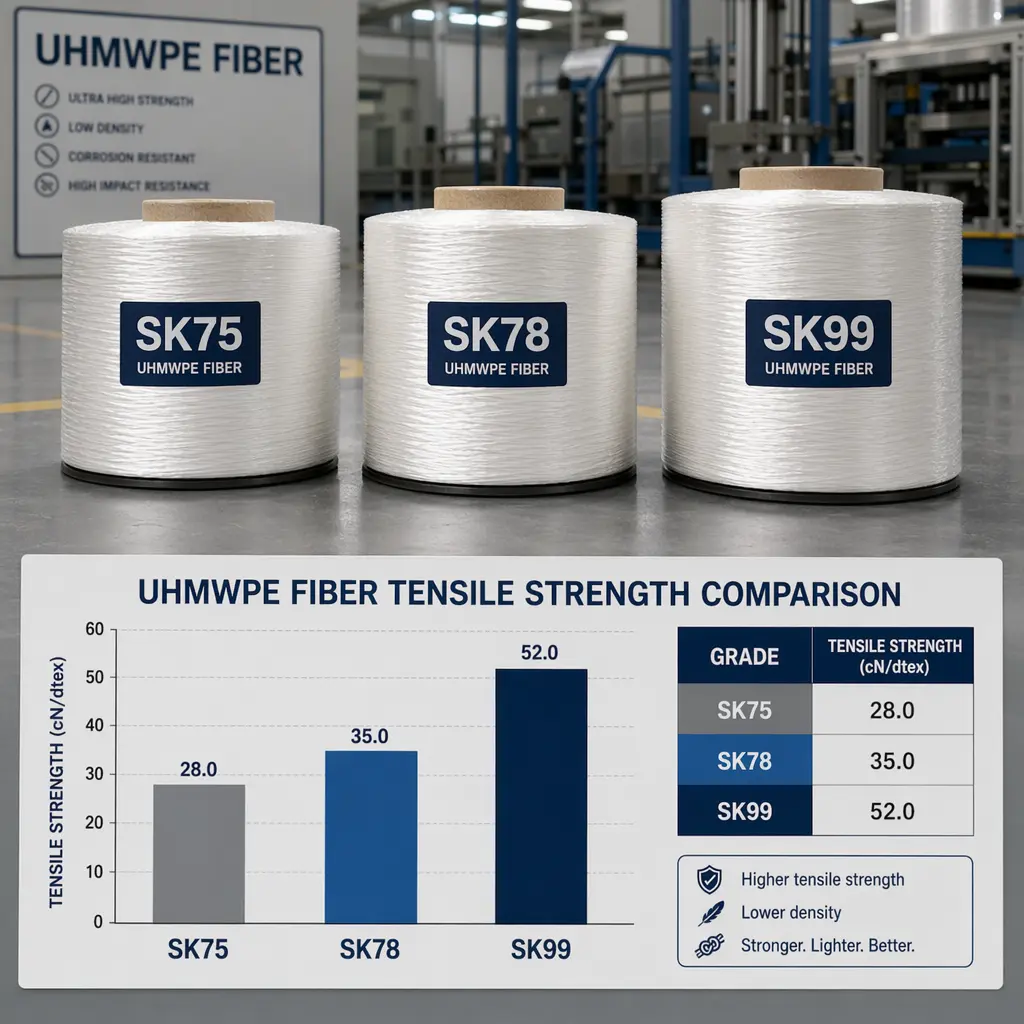
If you source UHMWPE webbing, slings, or ropes for marine, lifting, ballistic, or industrial applications, the fiber grade you specify directly determines safety margin, service life, and total cost of ownership. The three mainstream Dyneema grades—SK75, SK78, and SK99—differ in tenacity (35.1 vs 42.5 cN/dtex), creep rate (0.02% vs 0.006%/day), modulus (113 vs 155 GPa), and price (15–30% premium per step). Specifying the wrong grade can either waste budget on over-engineered fiber or cause field failure from creep rupture.
This guide consolidates datasheet values from DSM/Avient, Honeywell Spectra, and independent testing labs, then maps each grade to 11 real-world applications with specific breaking strength, diameter, and certification requirements. Use it as a procurement reference before your next RFQ.
The 3-Grade Comparison Table
The table below consolidates the published datasheet values for the three mainstream Dyneema grades at their most common dtex (1760 for SK75/SK78, 880 for SK99). All values are fiber-level; rope and webbing breaking strength will be 65–80% of theoretical due to braiding geometry, friction, and splice losses.
| Property | SK75 | SK78 | SK99 | DM20 (Reference) |
|---|---|---|---|---|
| Tenacity (cN/dtex) | 35.1 | 35.1 | 42.5 | 32.0 |
| Tenacity (g/den) | 39.8 | 39.8 | 48.1 | 36.3 |
| Tensile modulus (GPa) | 113 | 113 | 155 | 89 |
| Modulus (cN/dtex) | 1160 | 1160 | 1590 | 960 |
| Elongation at break (%) | 3.4 | 3.4 | 3.5 | 3.6 |
| Density (g/cm³) | 0.97 | 0.97 | 0.97 | 0.97 |
| Creep rate (%/day, 30°C, 300 MPa) | 0.020 | 0.006 | 0.006 | 0.00007 |
| Creep reduction vs SK75 | Baseline | −78% | −99% (preliminary) | −99.65% |
| Crystallinity | >85% | >85% | >85% | >85% |
| Polymer chain alignment | >95% | >95% | >95% | >95% |
| Molecular architecture | Standard gel-spun | Side-chain anchored | Heat-stretched SK78 | DM20 cross-linked |
| Typical dtex | 110–2640 | 1760–2640 | 880 | 1760 |
| Melting point (°C) | 144–152 | 144–152 | 144–152 | 144–152 |
| Relative price index | 1.00 (baseline) | 1.15–1.25 | 1.40–1.60 | 1.80–2.20 |
| MEG4 compliance (fiber level) | No | Yes | Yes | Yes |
| DNV-GL / ClassNK certificate | No | Yes | Yes (limited) | Yes |
Reading the table: SK75 and SK78 are identical in strength and modulus—the only difference is creep. SK99 is 20% stronger and 18% stiffer than SK78, with identical creep behavior. DM20 sacrifices ~9% strength versus SK78 but reduces creep by 99.9%, making it the only grade suitable for permanent mooring.
SK75: The Proven Standard
SK75 has been the workhorse UHMWPE grade since the 1990s. It is produced by Avient's gel-spinning process, which aligns polymer chains to >95% with >85% crystallinity. At 1760 dtex, SK75 delivers 35.1 cN/dtex tenacity and 113 GPa modulus—roughly 15× the specific strength of steel and 40% stronger than aramid on a weight-for-weight basis.
Where SK75 Excels
SK75 is the correct specification for dynamic applications with short cycle times, where sustained static tension is not a design condition. In these applications, SK78's 78% creep improvement carries no operational benefit because the load is released before creep accumulates:
- Kitesurfing and paragliding lines — Load cycles of minutes, not months
- Aquaculture netting and ropes — Dynamic wave loading, replaced every 2–3 seasons
- Commercial fishing ropes and netting — High replacement cycle, cost-sensitive
- Winch cables for off-road vehicles — Intermittent loads, easy field inspection
- Dinghy control lines — Constant handling, replaced seasonally
Where SK75 Fails
SK75's weakness is creep under sustained load: 0.02%/day at 30°C and 300 MPa. Over a 5-year service life at 20% breaking load, that accumulates to roughly 36% permanent elongation—enough to take a halyard out of clutch engagement or shift a mooring line out of design geometry. For any application where the line stays tensioned for weeks or months, SK75 is the wrong specification.
SK75 is also not MEG4-compliant at fiber level. The OCIMF MEG4 standard for mooring lines requires creep testing and certification that SK75 cannot pass. If your customer is a tanker operator or LNG carrier, specifying SK75 will disqualify your product from approval.
SK78: The High-Cycle Standard
SK78 was engineered to solve SK75's creep problem. Avient introduced side-chain molecular anchors into the polymer backbone—engineered branches that prevent long-chain sliding under static and fatigue loading. The result is a 78% reduction in creep rate (0.006%/day vs 0.02%/day) with zero sacrifice in tenacity, modulus, or elongation.
The Creep Lifetime Math
Under continuous 20% breaking load at 20°C, a 1000 kN BS rope made with:
- SK78: 650 g/m, creep lifetime ≈ 8 years
- Generic HMPE: <3 years creep lifetime
That 4× creep lifetime advantage is why SK78 has become the default specification for performance sailing, offshore mooring, and industrial lifting. SK78 is the only grade with full DNV-GL Approval of Manufacturing Certificate and ClassNK Notification of Approval of Filament, and it passes all OCIMF MEG4 test requirements at fiber level.
Where SK78 Is Mandatory
- Permanent and semi-permanent mooring lines (tankers, FPSOs, offshore platforms)
- Racing yacht halyards and sheets (high-cycle fatigue, MEG4 indirectly via classification)
- Lifting slings for crane and rigging (EN 1492-2, long-term static loads)
- Tow lines for commercial vessels
- Synthetic standing rigging (forestays, backstays)
- Industrial winch lines (continuous drum loading)
For most B2B buyers, SK78 is the safe default. If your application is not weight-critical or diameter-constrained, SK78 delivers the best balance of strength, creep resistance, certification, and cost.
SK99: Maximum Tenacity
SK99 was launched by DSM in 2013 as the highest-tenacity Dyneema grade ever produced. It achieves 42.5 cN/dtex tenacity and 155 GPa modulus—a 20% strength increase and 18% modulus increase over SK78—through an additional heat-stretching step in the fiber manufacturing process. Critically, SK99 retains SK78's creep characteristics (0.006%/day), so the strength upgrade comes with no creep penalty.
Where SK99 Justifies Its 40–60% Price Premium
SK99 is not "better" than SK78—it is different. The 20% strength increase only matters when you can convert it into a system-level advantage: smaller diameter, lighter weight, or higher breaking load at fixed diameter. Specify SK99 when:
- Diameter is constrained by hardware — A 10mm SK99 rope achieves the breaking load of a 12mm SK78 rope, fitting smaller clutches and blocks
- Weight aloft matters — Grand prix racing yachts save 15–20% on halyard weight, improving righting moment
- Offshore guys and afterguys — High-load running rigging where diameter reduction improves sheet winch efficiency
- Aerospace and defense — Ballistic protection where areal density (g/m²) is the dominant metric
- High-load wire replacement — Steel wire conversions where reducing diameter saves drum capacity
Where SK99 Is the Wrong Choice
SK99's higher modulus makes it stiffer than SK78, which creates three problems:
- Reduced grip in rope clutches — SK99's stiffer fibers slip more under jaw pressure, requiring higher clutch engagement forces or larger clutch contact area
- Greater sensitivity to tight bend radii — SK99's higher modulus accelerates fatigue at sheaves and fairleads; minimum D/d ratios must increase by 10–15%
- Specifying SK99 to reduce rope diameter accelerates creep — A smaller-diameter SK99 rope carries a higher percentage of its breaking load in service, which can negate the strength advantage and actually shorten creep lifetime
Common B2B trap: Some buyers specify SK99 "for the strongest fiber" without realizing that SK99's strength advantage only materializes when the rope or webbing is downsized. If you keep the same diameter as an SK78 design and just swap fiber grade, you've paid 40–60% more for breaking strength headroom you don't use. See our test report guide for how to verify the strength upgrade is actually being delivered.
Creep Deep Dive: Why SK78 Was Engineered
Creep is the irreversible elongation of UHMWPE fiber under sustained load. Unlike elastic stretch (which recovers when load is removed), creep is permanent—it accumulates over the fiber's service life and ultimately causes rupture when the fiber can no longer hold design tension.
The molecular mechanism is long-chain sliding: UHMWPE's polymer chains are not chemically cross-linked, so under sustained tension they slowly slide past each other. SK75's standard gel-spun architecture has no mechanism to prevent this. SK78's innovation was introducing side-chain molecular anchors—engineered branches that physically block chain sliding without sacrificing the fiber's flexibility or strength.
Creep Rate Comparison at 30°C, 300 MPa
| Grade | Creep Rate (%/day) | 5-Year Accumulated Elongation* | Service Implication |
|---|---|---|---|
| SK75 | 0.020 | ~36% | Catastrophic — line out of design geometry |
| SK78 | 0.006 | ~11% | Manageable — periodic re-tensioning required |
| SK99 | 0.006 | ~11% | Manageable — same as SK78 |
| DM20 | 0.00007 | <0.13% | Negligible — meets 25-year mooring spec |
| Generic HMPE | 0.025–0.040 | 45–72% | Catastrophic — creep rupture in <3 years |
*Calculated at continuous 300 MPa load, 30°C. Real-world service conditions (lower load, lower temperature, intermittent rest periods) yield lower accumulated elongation. Use these values for comparative specification, not absolute lifetime prediction.
Temperature Sensitivity
Creep rate is highly temperature-dependent. The 0.006%/day figure for SK78 is measured at 30°C; at 10°C (deep-water mooring conditions), the rate drops to approximately 0.0015%/day. At 50°C (tropical surface waters, dark-colored rope in direct sun), it can rise to 0.020%/day—erasing SK78's advantage over SK75. Always specify creep testing at the application's actual service temperature, not the datasheet default.
Dyneema vs Generic HMPE: The 4× Gap
The B2B UHMWPE market has a persistent transparency problem: many Chinese and Korean manufacturers produce "UHMWPE" or "HMPE" fiber via standard extrusion rather than gel-spinning, and the resulting fiber is sold at 30–50% lower prices than branded Dyneema. All Dyneema is UHMWPE, but not all UHMWPE is Dyneema. The performance gap is not subtle:
| Property | Dyneema SK78 | Generic HMPE | Gap |
|---|---|---|---|
| Batch-to-batch strength variation | <10% | Up to 22% below claimed | 2.2× more consistent |
| Abrasion lifetime (fairlead test) | Baseline | 4× faster wear | 4× longer service life |
| Creep lifetime (8 years @ 20% BS, 20°C) | 8 years | <3 years | 2.7× longer |
| Filament diameter variation | <10% | 15–30% | Cascade failure risk |
| Polymer chain alignment | >95% | 70–85% | Lower tenacity ceiling |
| MEG4 fiber-level certification | Yes | No | Disqualifies marine use |
| DNV-GL / ClassNK approval | Yes | No | Disqualifies offshore use |
| Carbon footprint (per unit strength) | Baseline | 90% higher | Sustainability reporting |
| Price per kg | Baseline | −30 to −50% | False economy |
The 22% strength variation in generic HMPE is the most dangerous failure mode. When a manufacturer claims "40 kN breaking strength" but the actual batch delivers 31 kN, the safety factor you designed at 5:1 becomes 3.9:1—below the 4:1 minimum for lifting applications under EN 1492-2. Independent batch testing is non-negotiable when sourcing generic HMPE.
For applications where human safety, regulatory compliance, or 10+ year service life is required, the 15–30% Dyneema premium is recovered through lower replacement frequency, fewer inspection cycles, and elimination of creep-rupture liability. For short-life consumer products (kite lines, fishing nets replaced every season), generic HMPE is a legitimate cost optimization.
11-Application Selection Matrix
Use this matrix as a starting specification. Verify all values against your application's design code, customer specification, and certification requirements.
| Application | Recommended Grade | Typical Width / Diameter | Minimum Breaking Strength | Critical Certification |
|---|---|---|---|---|
| Offshore permanent mooring (FPSO, platform) | DM20 | 90–120 mm rope | 1500–3000 kN | OCIMF MEG4, DNV-GL |
| Offshore semi-permanent mooring (tanker) | SK78 | 72–96 mm rope | 1000–2000 kN | OCIMF MEG4, ClassNK |
| Yacht halyards and sheets (cruising) | SK78 | 8–14 mm rope | 15–80 kN | None required |
| Grand prix racing halyards | SK99 | 6–10 mm rope | 15–50 kN | None required |
| Crane lifting slings (EN 1492-2) | SK78 | 30–300 mm webbing | 500–50,000 kg | EN 1492-2, Lloyd's Register |
| Recovery straps (off-road vehicles) | SK75 (kinetic) / SK78 (static) | 50–100 mm webbing | 8,000–20,000 kg | None required |
| Ballistic vest panels | SK99 (or Spectra 1000) | Woven fabric, 100–200 g/m² | NIJ Level IIIA spec | NIJ-STD-0101.06 |
| Cut-resistant gloves (HPPE) | SK65 / SK75 yarn | 13-gauge knit | EN 388 Level B–F | EN 388:2016 |
| Aquaculture netting | SK75 (cost-optimized) | 3–8 mm twine | 200–1500 kg per twine | None required |
| Synthetic standing rigging (forestay) | DM20 (zero-creep) or SK78 | 5–13 mm rope | 30–200 kN | None required (vendor spec) |
| Industrial winch lines (continuous drum) | SK78 | 8–24 mm rope | 40–400 kN | ASME B30.9 (US) |
For webbing applications specifically (lifting slings, recovery straps, tie-downs), the grade selection logic is the same as for rope, but with two additional considerations: webbing construction (plain weave, double-layer, jacketed) and coating compatibility (PU, plasma treatment) affect breaking strength more than fiber grade does. A poorly woven SK99 webbing can deliver lower actual strength than a well-woven SK75 webbing. See our flat vs tubular webbing guide for construction details.
Price vs Total Cost of Ownership
UHMWPE fiber is sold by weight, but B2B buyers pay for breaking strength and service life. The relevant metric is not $/kg but $/kN-year of service. Here's a 15-year TCO comparison for a 1000 kN BS offshore mooring line:
| Option | Initial Cost | Service Life | Replacements over 15 yr | Inspection Cost | 15-Year TCO |
|---|---|---|---|---|---|
| Generic HMPE | $8,000 | 3 years | 5 replacements | High (annual) | $48,000+ |
| Dyneema SK78 | $12,000 | 8 years | 2 replacements | Standard | $30,000 |
| Dyneema DM20 | $20,000 | 25+ years | 0 replacements | Low (monitoring) | $22,000 |
Despite DM20's 67% price premium over SK78 and 150% premium over generic HMPE, it delivers the lowest 15-year TCO because it eliminates replacement labor, downtime, and inspection overhead. For a fleet of 50 mooring lines, the TCO difference between generic HMPE and DM20 over 15 years exceeds $1.3 million.
Procurement trap: Many B2B tenders evaluate only initial cost, penalizing SK78 and DM20 in favor of generic HMPE. If you are a supplier responding to such tenders, include a TCO worksheet with your quote. If you are a buyer, require all bidders to provide 10-year TCO projections, not just unit price. See our MOQ guide for how volume interacts with grade selection.
8 B2B Sourcing Red Flags
When evaluating UHMWPE webbing or rope suppliers, the following claims should trigger immediate technical due diligence:
- "Dyneema-equivalent" without grade specification. Dyneema is a brand, not a grade. A supplier claiming "Dyneema-equivalent" without specifying SK75, SK78, or SK99 is almost certainly shipping generic HMPE. Require the actual fiber grade and DSM/Avient license number if Dyneema is claimed.
- "UHMWPE" or "HMPE" without manufacturer name. Reputable suppliers will state the fiber source: Dyneema (Avient), Spectra (Honeywell), or a named Chinese brand (e.g., ZTT, Mendiratta, IZANAS). An unnamed "UHMWPE" is generic HMPE with all its quality variability.
- No creep test data. If the supplier cannot provide a creep curve at your application's service temperature and design load, they have not tested it. See our factory inspection checklist for required test documents.
- Tensile test only at room temperature, dry conditions. UHMWPE's strength drops 10–15% at 60°C. For tropical or hot-environment applications, require test data at the application's worst-case temperature.
- No batch-to-batch strength variation data. A supplier that cannot show 10-batch statistical variation (CV%) is not controlling quality. Dyneema licenses manufacturers to publish this; generic HMPE suppliers typically cannot.
- "SK78 spec" without MEG4 or DNV-GL certificate. SK78's value proposition is certification. If the supplier claims SK78 but cannot show DNV-GL Approval of Manufacturing or ClassNK Notification of Approval, the fiber is either counterfeit or gray-market.
- Price 30–50% below Dyneema market rate. Dyneema has transparent market pricing. If a quote is dramatically below market, the supplier is shipping generic HMPE labeled as Dyneema—a common fraud pattern in Chinese B2B marketplaces.
- No certificate of origin from Avient. Avient issues Certificates of Origin for licensed Dyneema shipments. Require this document for every batch. A supplier that cannot produce it is not a licensed Dyneema manufacturer.
Quick Decision Guide
Use this 5-question flowchart to specify the correct grade in 60 seconds:
Grade Selection Decision Tree
- Is the load static or sustained for weeks/months?
- Yes → Go to Q2
- No (dynamic, intermittent) → SK75 (or generic HMPE for cost-optimized consumer products)
- Is the application permanent (25+ year design life)?
- Yes → DM20 (zero-creep, MEG4-compliant)
- No (replaceable, 5–10 year life) → Go to Q3
- Is diameter or weight a binding constraint?
- Yes (hardware-limited, weight-critical) → SK99 (20% strength headroom for downsizing)
- No → Go to Q4
- Is MEG4, DNV-GL, or ClassNK certification required?
- Yes → SK78
- No → Go to Q5
- Is the customer a marine, offshore, or safety-critical operator?
- Yes → SK78 (default safe specification)
- No (consumer, industrial) → SK78 if budget allows, SK75 if cost-optimized
Default Recommendations by Industry
- Marine & Offshore (mooring, towing, lifting) — SK78 minimum, DM20 for permanent installations
- Sailing (cruising) — SK78 for halyards and sheets, SK75 for dinghy control lines
- Sailing (grand prix racing) — SK99 for halyards, SK78 for sheets (grip priority)
- Industrial lifting (cranes, slings) — SK78 with EN 1492-2 certification
- Defense & ballistic — SK99 or Spectra 1000/2000 for areal density optimization
- PPE (cut-resistant gloves) — SK65 or SK75 yarn, cost-optimized
- Aquaculture & fishing — SK75 or generic HMPE (replacement-cycle economics)
- Off-road recovery — SK75 (kinetic straps) or SK78 (static winch lines)
FAQ
What is the difference between SK75 and SK78?
SK75 and SK78 have identical tenacity (35.1 cN/dtex at 1760 dtex) and modulus (113 GPa). The difference is creep rate: SK78's engineered side chains reduce creep to 0.006%/day at 30°C and 300 MPa, a 78% reduction versus SK75's 0.02%/day. For dynamic applications with short cycle times, SK75 is the correct specification; for static or high-cycle loads, SK78 is mandatory.
Is SK99 stronger than SK78?
Yes. SK99 achieves 42.5 cN/dtex tenacity and 155 GPa modulus, a 20% strength increase and 18% modulus increase over SK78's 35.1 cN/dtex and 113 GPa. SK99 retains SK78's creep characteristics (0.006%/day). However, SK99's higher modulus makes it stiffer, with reduced grip in rope clutches and greater sensitivity to tight bend radii.
Is generic HMPE the same as Dyneema?
No. All Dyneema is UHMWPE, but not all UHMWPE is Dyneema. Generic HMPE produced by standard extrusion shows up to 22% strength variation batch-to-batch, abrades 4× faster, and has less than 25% of the creep lifetime of Dyneema SK78 under equivalent load. Dyneema's gel-spinning process achieves >95% polymer chain alignment, delivering <10% strength variation and DNV-GL/ClassNK-certified consistency.
Which UHMWPE grade is best for permanent mooring?
For permanent mooring, neither SK75 nor SK78 is sufficient—specify DM20, which achieves a creep rate of 0.00007%/day at 30°C and 300 MPa, with a calculated creep lifetime exceeding 250 years under permanent mooring conditions. DM20 meets the OCIMF MEG4 requirement of less than 0.5% elongation over 25 years in service.
How can I verify a supplier's Dyneema claim?
Require three documents: (1) Avient Certificate of Origin for the specific batch, (2) DNV-GL or ClassNK approval certificate showing the manufacturer as a licensed Dyneema partner, and (3) batch-specific tensile test report showing <10% strength variation across at least 10 samples. If any of these are missing or refused, treat the product as generic HMPE regardless of labeling. See our Dyneema UHMWPE guide for the full verification protocol.
Does UHMWPE grade affect webbing construction?
Yes, but less than fiber alignment does. SK99's higher modulus makes the fiber stiffer, which can cause weaving difficulties in tight plain-weave patterns; most SK99 webbings use a looser weave or jacketed construction. SK75 and SK78 weave identically. Coating adhesion (PU, plasma-treated) is grade-independent. Compare with nylon and polyester tensile data for hybrid constructions.
What about Honeywell Spectra vs Dyneema?
Spectra is Honeywell's UHMWPE brand, produced in the USA. Spectra S-1000 (43 g/den, 133 GPa) is comparable to SK78; Spectra HT (41 g/den, 135–165 GPa) is comparable to SK99. Spectra is more common in North American defense and aerospace supply chains; Dyneema dominates Europe and Asia. Performance is functionally equivalent at matching grades. Specify either brand in RFQs to enable competitive bidding.
Conclusion
Specifying UHMWPE fiber grade is not a "stronger is better" decision—it is a system-level optimization across strength, creep, certification, diameter, weight, and total cost of ownership. SK75 remains the right choice for dynamic, cost-sensitive applications. SK78 is the safe default for any safety-critical or high-cycle application, with full MEG4/DNV-GL compliance. SK99 justifies its premium only when diameter or weight constraints make the 20% strength headroom structurally meaningful. DM20 is the only grade that solves permanent-mooring creep.
The B2B UHMWPE market rewards buyers who specify grade, manufacturer, and certification in their RFQs—and punishes buyers who accept "UHMWPE" or "Dyneema-equivalent" without verification. Use the decision tree, the application matrix, and the red-flag checklist in this guide as your procurement reference, and require batch-level test data from every supplier.
If you need help specifying the correct UHMWPE grade for your webbing, rope, or sling application, contact TMG Webbing with your design load, service temperature, certification requirements, and target service life. We manufacture webbing in SK75, SK78, and SK99 from licensed Dyneema and Spectra fiber, with full batch traceability and DNV-GL-compliant test reporting.
Need SK78 or SK99 Webbing?
TMG Webbing manufactures UHMWPE webbing from licensed Dyneema® and Spectra® fiber, with batch-level tensile testing, creep characterization, and UV aging. Widths from 10 mm to 300 mm, breaking strengths from 500 kg to 50,000 kg. DNV-GL and Lloyd's Register type approval available.
Request a Quote Factory Inspection Checklist