
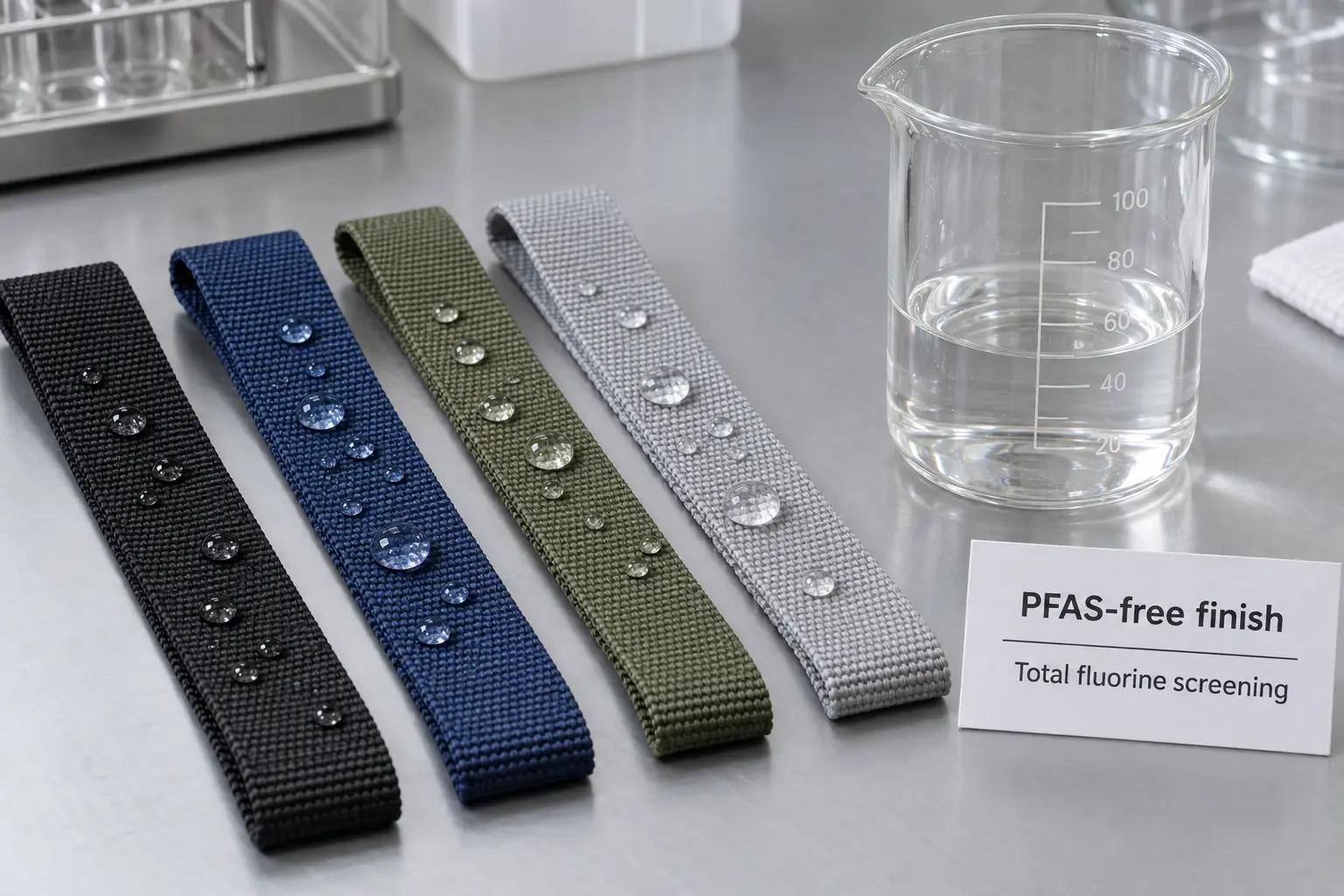
On 10 October 2026, the EU restriction on PFHxA, its salts and PFHxA-related substances began applying to consumer clothing, clothing accessories and footwear. It is one entry in REACH Annex XVII, adopted as Regulation (EU) 2024/2462, and it takes effect directly across all member states without needing national implementation. A second phase follows in October 2027 for all remaining textiles.
The restriction lands on narrow fabric more heavily than its wording suggests, because webbing is rarely sold as bulk chemistry risk — it is sold as a component. A water-repellent woven belt, a treated strap on an apparel item, a footwear closure tape or a DWR-finished trim for outdoor gear all sit inside the scope, and the compliance question arrives from the brand as a supplier declaration request long before any regulator knocks.
This guide is written for procurement, product development and quality teams on both sides of the transaction: which webbing is genuinely exposed, where PFAS actually sits in a narrow fabric construction, how the numbers are measured, what a PFAS-free finish can and cannot deliver, and what to write into a purchase specification so the evidence holds up. If your starting question is simply how finishes are applied in the first place, read the webbing finishing and treatments guide first.
The Rules Buyers Are Actually Being Asked to Meet
Several separate instruments are converging, and they do not share thresholds, scope or testing expectations. That patchwork is the main difficulty — a strap that clears one jurisdiction can fail another.
| Instrument | Status | Scope & Key Thresholds |
|---|---|---|
| EU PFHxA restriction Reg. (EU) 2024/2462, amending REACH Annex XVII |
In force | From 10 Oct 2026: textiles, leather, fur and hides in clothing and related accessories, plus all footwear, sold to the general public. PFHxA and its salts < 25 ppb; PFHxA-related substances < 1,000 ppb, measured per homogeneous material. Extends to all other textiles from 10 Oct 2027. |
| EU-wide PFAS class restriction | Proposed | Not yet law. Risk Assessment Committee opinion adopted March 2026 with targeted derogations; Socio-Economic Analysis Committee final opinion expected before the end of 2026. Adoption assumed during 2027, generally applying after an ~18-month transition. |
| France | In force | Since 1 Jan 2026: manufacture, import, export and sale of consumer clothing and footwear containing PFAS prohibited, with defined exemptions. Thresholds finalised Dec 2025: 25 ppb for named PFAS via targeted analysis excluding polymers; 250 ppb for the sum; 50 ppm where polymers are included. |
| Denmark | In force | National restriction in force during 2026, operating on a total-fluorine basis rather than a named-substance list — commonly cited at 50 mg F/kg. |
| United States | State by state | California's textile articles law phases in from 2025 for intentionally added PFAS and adds a total-organic-fluorine threshold from 2027. Illinois requires notification and phases in a firefighting protective clothing sales ban from 2027. New Jersey's apparel law excludes protective equipment and military clothing. |
| China | In force | National test-method standards for PFAS in textiles, with the latest part effective 1 May 2026 covering a broad list of substances. A testing route rather than a ban — useful as evidence, not as a market-access gate. |
Two structural points matter more than the individual numbers. First, the EU PFHxA restriction is directly applicable — it amends a regulation, not a directive, so enforcement does not wait for member-state legislation, even though penalties and controls remain national. Second, it sets limits but prescribes no test method, which pushes the burden of proof onto documentation and supply-chain evidence rather than onto a single laboratory result.
Where PFAS Actually Sits in a Narrow Fabric
This is the question that decides whether an article is exposed at all, and it is where most supplier conversations go wrong. PFAS is not a fiber. Nylon, polyester, polypropylene, aramid and UHMWPE are non-fluorinated polymers, and greige or conventionally dyed webbing with no functional finish contains no intentionally added fluorinated chemistry.
PFAS arrives through the finishing stage:
- Durable water-repellent (DWR) finishes. The classic C6 and C8 fluorocarbon repellents are the primary risk. Any webbing described as water-repellent, rain-resistant or quick-dry should be treated as a PFAS candidate until declared otherwise.
- Stain-release and soil-release agents. Oleophobic performance is the giveaway — fluorine is what repels oil, so a strap that resists grease and coffee is far more likely to be fluorocarbon-treated than one that only beads water.
- Fluorinated anti-wicking agents. Used to stop moisture travelling along a tape by capillary action, common in footwear and technical trims.
- Fluoropolymer and fluoroelastomer coatings. PTFE-type top coats and fluoroelastomer systems are PFAS by definition, even where they are applied for abrasion resistance rather than repellency.
- Fluorinated processing aids. Occasionally used as wetting or levelling agents in padding and coating baths to control surface tension. These are easy to overlook because they are not part of the intended product function.
The practical screen is therefore functional, not material. If the webbing is asked to repel water, repel oil, release soil or resist wicking, your risk is real. If it is a plain or piece-dyed tape with no functional finish, you are dealing with trace-contamination risk at most — but you still cannot assert that without evidence from the finish supply chain.
Coated webbing deserves its own note. PVC and TPU coatings are not themselves fluorinated polymers, so a coated strap is not automatically non-compliant — but coatings frequently carry additives: slip agents, release agents, processing aids, and sometimes a fluorinated top finish for soil release. Where the coating sits on a consumer clothing accessory or footwear item, each of those becomes a separate homogeneous material to declare. The comparison in PVC vs TPU coated webbing covers the base chemistries; PFAS exposure is a separate, additive question on top of them.
Homogeneous Material: The Unit That Actually Gets Tested
Both the EU PFHxA limits and the French thresholds are assessed per homogeneous material — a single, uniform material that cannot be mechanically separated into further materials. A finished strap is not one sample. A typical assembly can break down into:
- the woven tape, including any dope-dyed or piece-dyed colorant
- the DWR or stain-release finish, assessed as part of the material it is applied to
- the coating, where present
- the sewing thread
- any adhesive, hot-melt or laminated film
- printed or transfer-applied graphics
This is why "the webbing passed" is not an answer. A brand asking for compliance data on a finished product needs the declaration to travel down to each material, and that usually means the strap manufacturer has to pull declarations from its own finish supplier, coating supplier and thread supplier. Building that documentation chain is slower than running a test, and it is the part that most often stalls an order.
How Compliance Is Actually Demonstrated
Two analytical routes dominate, and they answer different questions:
| Approach | What It Tells You | Where It Falls Short |
|---|---|---|
| Total organic fluorine screening | Whether fluorinated chemistry is present at all, at very low detection levels, across the whole sample rather than a named list. | Cannot distinguish a restricted substance from a permitted fluoropolymer, and reports no substance-level value against the 25 ppb threshold. |
| Targeted analysis by LC-MS/MS | Quantifies named PFAS, including PFHxA and its salts, against the legal thresholds. | Only finds what the method looks for; PFHxA-related substances are defined structurally and their detection methods are still developing. |
| Upstream chemical documentation | Evidence that no fluorinated chemistry entered the process, plus full material disclosure from the finish and coating suppliers. | Depends entirely on supplier honesty and change control — worthless without a contractual obligation to notify reformulations. |
The working answer is all three, layered. Screening catches surprises cheaply; targeted analysis proves the legal number; supplier documentation explains why the number is what it is and gives you early warning when a finish is reformulated. A supplier who hands over a certificate with no method, no article reference and no batch link has given you nothing you can defend to a brand. The documentation discipline in how to read a webbing test report applies directly here.
What PFAS-Free Finishes Can and Cannot Do
The substitution problem is real: fluorine lowers surface tension more effectively than any commercially available alternative. That single fact defines the trade-off, and buyers should understand it before promising a brand performance parity.
| Finish route | Water repellency | Oil / stain repellency | Durability | Typical fit |
|---|---|---|---|---|
| Hydrocarbon / wax (C0) | Good on first contact | Poor | Moderate; needs heat reactivation | General outdoor trims, bag straps, cost-sensitive programs |
| Silicone-based | Very good | Poor to limited | Good, with a softer handle | Apparel straps, soft-touch belts, premium outdoor trims |
| Dendrimer / hybrid polymer | Very good | Limited | Good; higher cost | Performance programs where durability matters more than price |
| Polyurethane-based | Good, often alongside a coating | Poor | Good; can double as an abrasion layer | Coated straps needing both repellency and wear resistance |
| No finish at all | None | None | Not applicable | Washable items, dry-use straps, where repellency is not a requirement |
Three practical consequences follow. Water repellency is achievable, oil repellency broadly is not — so any product promise built on grease and stain resistance needs re-scoping, not just re-formulating. PFAS-free finishes lose performance faster in washing and abrasion and depend on heat to reactivate, which changes care labelling and after-sales expectations. And a soiled strap wets out sooner than a fluorocarbon-treated one, so field complaints about "no longer waterproof" often trace back to contamination rather than to finish failure.
None of this is a reason to avoid the transition. It is a reason to specify performance by test method and threshold rather than by chemistry name, and to validate on production material before committing a program.
7-Point PFAS Specification Checklist
- Finish declaration. State whether the webbing has a functional finish at all, and if so, its chemistry family — PFAS-free, or fluorinated.
- Intentionally added vs residual. Require a declaration that no PFAS are intentionally added, plus disclosure of any known residuals or process-aid carryover.
- Threshold and basis. Quote the limit being declared against (for example PFHxA < 25 ppb and related substances < 1,000 ppb) and confirm it is assessed per homogeneous material.
- Test method and laboratory. Name the screening and targeted methods used, and the accredited laboratory that ran them — with results linked to a specific article and lot.
- Full material disclosure. Declarations for tape, finish, coating, thread, adhesive and any print, so the chain is complete rather than sampled.
- Change notification. A contractual obligation to notify and re-qualify if the finish, coating or any input changes — with retesting at the supplier's cost.
- Performance and durability targets. Repellency after a defined number of wash or abrasion cycles, plus the reactivation instructions that keep the finish performing. Where the end product faces regulatory scrutiny beyond chemicals, the same discipline applies as in a factory inspection.
Five Mistakes That Cost Orders
- Assuming "textile" excludes webbing. A clothing accessory or footwear strap is inside the first phase; component status is not an exemption.
- Testing the finished strap as one sample. Limits are per homogeneous material, so a pooled result hides the one component that fails.
- Accepting a one-line PFAS-free certificate. No article, no method, no batch and no validity date is not evidence.
- Ignoring residual exposure on unfinished tape. Plain webbing is low-risk, not automatically zero-risk — the finish and coating supply chain still has to be declared.
- Promising oil and stain repellency on a PFAS-free finish. Water repellency can be matched closely; grease resistance cannot. Re-scope the claim before the brand does it for you.
Where This Is Heading
The PFHxA restriction is the first phase of a group-based approach rather than an endpoint. If the proposed EU-wide class restriction is adopted during 2027 with an approximately 18-month transition, the substance-by-substance question disappears and the material question takes over: which of your straps genuinely need fluorinated chemistry, and which can be reformulated or simply left unfinished. Programs that start building the documentation chain now — article by article, finish supplier by finish supplier — will be able to answer that from records. Programs that wait will be answering it from a sampling schedule, under deadline.
Need PFAS-Free or Non-Fluorinated Webbing?
TMG Webbing supplies woven and coated narrow fabric in PFAS-free finish options — hydrocarbon, silicone and polyurethane-hybrid systems — alongside unfinished and conventionally dyed constructions. We provide finish chemistry declarations, per-homogeneous-material breakdowns of each strap construction, supported test documentation, and batch-level traceability, and we will work with your brand's compliance team on the exact threshold and method they require. Send your article, finish requirement, target market and annual volume for a proposal within 48 hours.
Request PFAS-Free Webbing Quote Talk to an EngineerFrequently Asked Questions
Does ordinary nylon or polyester webbing contain PFAS?
The yarn does not — nylon, polyester, polypropylene, aramid and UHMWPE are all non-fluorinated polymers, so plain webbing with no functional finish is a very low-risk article. PFAS enters narrow fabric through what is applied afterwards: DWR treatments, stain-release agents, fluorinated anti-wicking agents, fluoropolymer or fluoroelastomer coatings, and occasionally fluorinated process aids. If your strap is not asked to repel water, repel oil, release soil or resist wicking, your exposure is usually limited to trace contamination rather than intentional addition.
Which webbing products fall inside the EU PFHxA restriction from 10 October 2026?
The first phase covers textiles, leather, fur and hides used in clothing and related accessories, plus all footwear, when sold to the general public. Narrow fabric is not exempt for being a component: a water-repellent woven belt, a treated apparel strap, a footwear closure tape or a DWR-finished trim sits inside that scope. From 10 October 2027 the same limits extend to all remaining textiles. Certain personal protective equipment and construction textiles are excluded, and goods already on the EU market before each date fall under the transition provision.
What are the actual PFHxA concentration limits?
Under Regulation (EU) 2024/2462, which amended REACH Annex XVII, products may not contain PFHxA and its salts at 25 parts per billion or above, nor PFHxA-related substances at 1,000 parts per billion or above. Compliance is assessed per homogeneous material, so each distinct material in the assembly is evaluated on its own rather than averaged across the finished product. That matters because tape, coating, thread and adhesive can each count as a separate homogeneous material.
Does the EU restriction prescribe a test method for PFAS in webbing?
No. The regulation sets numerical limits but prescribes no single analytical method, and techniques for detecting PFHxA-related substances are still maturing. Buyers typically combine total organic fluorine screening, which shows whether fluorinated chemistry is present at all, with targeted LC-MS/MS analysis that quantifies named substances against the thresholds. Because screening cannot separate a restricted substance from a permitted fluoropolymer, ask for both plus upstream chemical documentation.
Can PFAS-free finishes match the water repellency of a fluorocarbon DWR?
For water repellency, close is achievable — C0 chemistries based on hydrocarbon wax, silicone, dendrimer or polyurethane hybrids shed rain effectively on first contact. For oil and stain repellency, no: fluorine lowers surface tension far more than any alternative, so a PFAS-free finish still absorbs oil and grease. Durability is also lower, with heat reactivation needed to restore performance, and a soiled strap wets out faster than a fluorocarbon-treated one. Specify the performance you need by test method, not by chemistry name.
Will there be an EU-wide PFAS ban, and when?
A proposal to restrict PFAS as an entire class is progressing under REACH but is not yet law. ECHA's Risk Assessment Committee adopted an opinion supporting a restriction with targeted derogations in March 2026, and the Socio-Economic Analysis Committee issued its draft opinion the same month, with consultation closing in May. A final committee opinion was expected before the end of 2026, after which the European Commission would draft the Annex XVII amendment. Adoption during 2027 is the working assumption, generally applying after an approximately 18-month transition period.
What should a PFAS declaration from a webbing supplier actually say?
It should name the legal entity and factory, identify the exact article and its homogeneous materials, declare whether PFAS were intentionally added and whether any remain as impurities or residues, quote the thresholds declared against, name the test method and laboratory for any supporting data, cite the batch or lot, and carry a signature, date and validity period. A one-line certificate reading "PFAS-free" with no article reference, no method and no batch link is marketing, not evidence.