
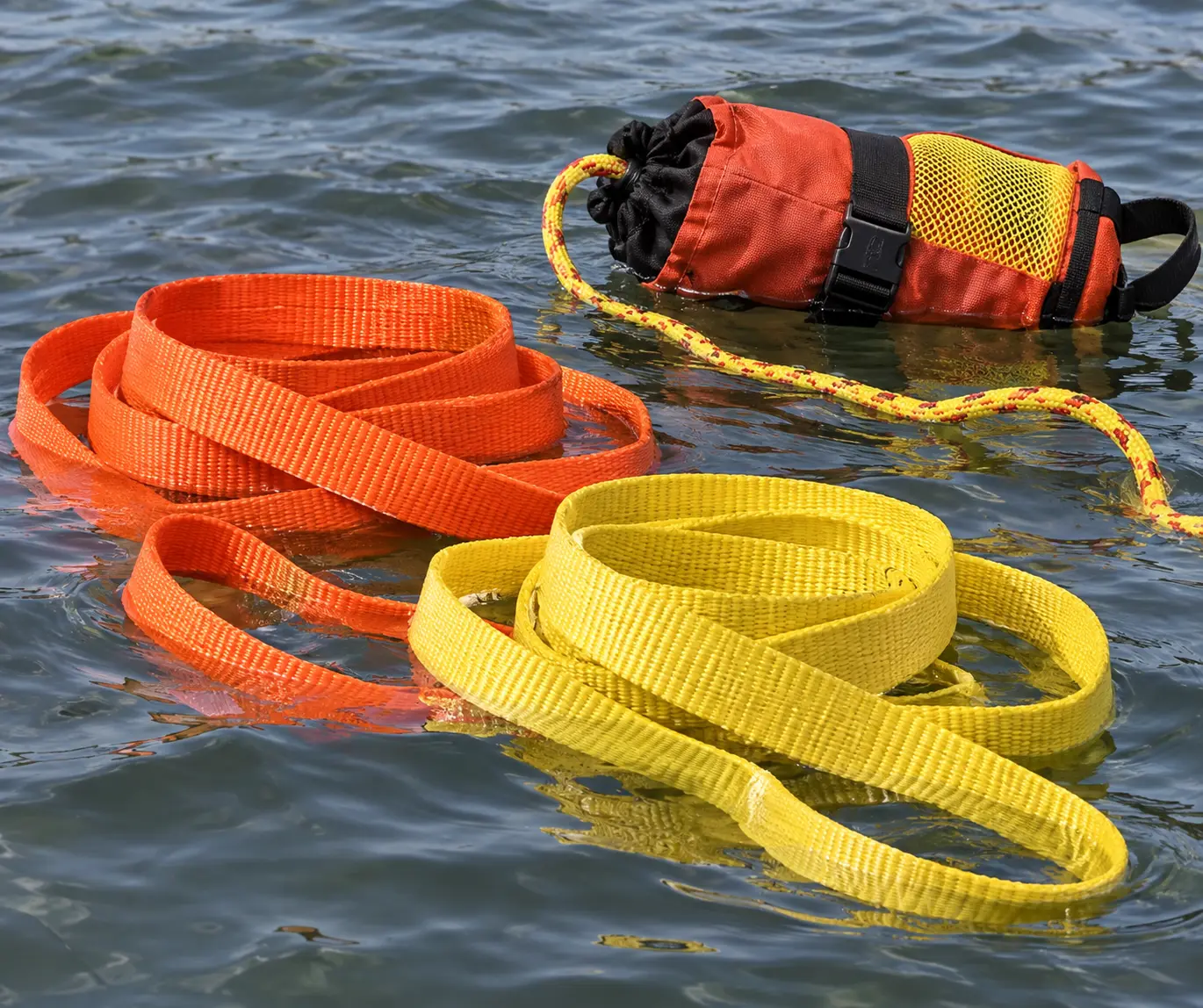
In water rescue, a strap that sinks is a strap nobody can grab. When a throw line pays out over the stern, when a PFD strap trails in the current, or when a life raft painter line floats free, the difference between gear that stays on the surface and gear that disappears is written into the fiber itself. Floating webbing is not a coating or a marketing term — it is a density property, and it only exists in two fiber families.
This guide covers the physics behind buoyant webbing, which materials genuinely float and which only pretend to, where floating webbing is actually used in marine and water rescue equipment, the specifications that separate real rescue-grade product from commodity strap, and how to verify a supplier's float claim before you commit to production. For the broader marine context, see the marine webbing guide.
The Physics: Only Two Fibers Float
A webbing floats when its average density is below water's 1.0 g/cm3. Since weave structure can only trap a limited amount of air — and that air escapes as the strap becomes waterlogged — long-term flotation comes from the fiber, not the construction:
| Fiber | Specific Gravity (g/cm3) | Floats? | Water Absorption |
|---|---|---|---|
| Polypropylene (PP) | 0.91 | Yes — floats reliably | < 0.1% |
| UHMWPE (Dyneema) | 0.97 | Yes — floats, barely | < 0.1% |
| Nylon 6.6 | 1.14 | No — sinks | ~ 4% |
| Polyester | 1.38 | No — sinks | ~ 0.4% |
| Aramid (Kevlar) | 1.44 | No — sinks | ~ 2-3% |
| Cotton | 1.54 | No — sinks fast | ~ 8% |
Two important nuances. First, UHMWPE at 0.97 g/cm3 barely floats — a heavy weave, a metal fitting, or salt-water saturation can tip it under, so it is specified for strength-first applications that also happen to float, not for pure flotation. Second, hardware changes the math: a floating strap with a steel buckle or a heavy carabiner will still sink at one end. Rescue gear is designed around the whole assembly, not the webbing alone.
Material Comparison for Water Rescue Webbing
For straps that must float, the realistic choice is between commodity PP and premium UHMWPE. A third route — foam or coated constructions — has a niche but real limitations:
| Property | PP Webbing | UHMWPE Webbing | Foam-Core / Coated |
|---|---|---|---|
| Floats reliably | Yes, long-term | Yes, marginally | While the foam layer is intact |
| 25 mm breaking strength (typical) | 0.6-1.2 kN | 2.5-10+ kN | Carrier-fiber dependent |
| Wet strength retention | ~100% | ~100% | Varies with delamination |
| UV resistance | Low-Moderate (stabilised versions exist) | High | Surface cracks with age |
| Abrasion resistance | Moderate | Very high (cut-resistant) | Low — coating abrades off |
| Melting point | ~ 160 C (limits heat finishing) | ~ 145 C | Coating-dependent |
| Cost position | Low | Premium | Mid |
The practical rule: if the strap's job is flotation (throw lines, tethers, PFD straps), PP is the default because it is cheap, tough enough, and absorbs nothing. If the strap's job is strength and flotation is a bonus (rescue slings, winch extensions, tow bridles), UHMWPE is the material — see the UHMWPE vs steel cable comparison for where that pays off. And if a supplier quotes nylon or polyester as "floating webbing", the claim only survives until the first rainstorm.
Where Floating Webbing Is Actually Used
The applications below are where specifiers genuinely need the strap to stay on the surface — with the failure consequence if it does not:
| Application | Why It Must Float | Typical Material |
|---|---|---|
| Throw-bag rescue lines & tapes | A sinking line tangles under the casualty; the throw must remain visible and grab-able | PP (occasionally UHMWPE core) |
| PFD / life jacket adjustment straps | Trailing straps must not snag underwater; strap remains accessible to the wearer | PP |
| Swiftwater rescue tethers & cow tails | Rescuer releases the tether in an emergency — it must float clear, not drag | PP |
| Life raft grab lines & painter lines | Boarding a raft requires grabbing a floating line; sunken painter lines foul propellers | PP |
| Kayak / canoe deck lines | Handhold for the swimmer during self-rescue | PP or PP/elastic hybrid |
| Rescue slings & lift bridles | Strength-critical; flotation simplifies recovery of dropped gear | UHMWPE |
| Marine K9 gear | Dog working from water: a sinking leash wraps around submerged obstacles | PP — see the dog collar guide |
| Marina & water park safety barriers | Visual demarcation must stay on the surface to be seen | PP, high-vis colors |
Specifications That Matter for Rescue-Grade Webbing
Buying "floating webbing" by name is how you get commodity PP delivered for a life-safety product. A real specification has five measurable fields:
- Wet-state breaking strength. Not the dry number. PP and UHMWPE keep nearly all of their strength when saturated; nylon does not. State the wet figure on the drawing and demand it on the test report — see how to read a webbing test report.
- Flotation after 24-hour immersion. The strap must return to the surface after being fully submerged for a day, not merely float when dry. Wet weight gain should stay under 5% for PP/UHMWPE.
- UV hours to strength retention. Water rescue gear lives outdoors. Ask for the remaining breaking strength after a defined UV exposure (for example 80% retention after 500 hours) and match it to the service life you promise customers. Stabilised dope-dyed PP holds up far better than piece-dyed — see the dope-dyed vs piece-dyed comparison.
- Colorfastness in saltwater and chlorine. High-visibility orange and yellow are not decorative: they are how a rescuer finds the strap. Dope-dyed color (pigment in the melt) resists both; surface prints wash out.
- Certification fit. If your product is a certified PFD, the webbing enters a conformity assessment chain (ISO 12402 family in most markets, USCG in the United States). The webbing supplier's role is consistent materials, batch test data, and traceability — confirm current standard requirements with your notified body rather than assuming a webbing "is certified".
Verifying a Float Claim: The 24-Hour Test
Before you approve a sample for production, run this simple acceptance test — it takes a bucket and a day:
- Cut a 1-metre sample from the actual production batch (not a showroom piece).
- Weigh it dry, fully submerge it under a weight for 24 hours at room temperature.
- Release it below the surface. It must rise and remain floating.
- Weigh it wet. Weight gain above ~5% means water is entering the fiber or the weave is holding water — either way, long-term flotation is at risk.
- Repeat after a UV exposure cycle if the strap will live outdoors; some surface-dyed PP loses its stabilisers with sunlight.
Batch-test data backing this test is the difference between a real OEM program and a sample that performed once in a showroom.
6 Mistakes When Specifying Floating Webbing
- Assuming all marine webbing floats. Polyester marine webbing is specified for UV and strength — it sinks. See the marine webbing guide for the floating vs non-floating split.
- Specifying dry strength only, then shipping a strap that loses 10-15% when wet.
- Ignoring hardware density — the strap floats, the steel buckle drags it under.
- Choosing piece-dyed PP for high-visibility colors; surface dye fades in salt and sun, and the strap becomes invisible exactly when it matters.
- Over-specifying UHMWPE where cheap PP does the flotation job — you pay 10x the price for strength nobody needs.
- Skipping the wet-hand test: some PP webbing becomes slick when saturated. Grip matters when a casualty's hands are cold and exhausted.
Need Buoyant Webbing for a Rescue or Marine Product?
TMG Webbing manufactures high-visibility PP floating webbing in 10-75 mm widths, UV-stabilised dope-dyed colors, and UHMWPE hybrid constructions for strength-critical rescue gear — with batch-level wet-strength and immersion test data. Send your target breaking strength, width, color, and certification context; our engineering team responds with a spec review and physical samples within 48 hours.
Request Floating Webbing Quote Talk to an EngineerFrequently Asked Questions
What materials float in webbing?
Only fibers with a specific gravity below 1.0 g/cm3 float in water — in practice that is polypropylene (PP, ~0.91) and UHMWPE/Dyneema (~0.97). Nylon (1.14), polyester (1.38), aramid (1.44), and cotton (1.54) all sink. A loosely woven webbing can trap air and float briefly, but only low-density fibers keep a strap on the surface once it is waterlogged.
Is polypropylene webbing better than nylon for marine use?
For flotation, yes: PP is the only common commodity fiber that floats, absorbs almost no water, and resists saltwater and mildew. Its weaknesses are lower UV and abrasion tolerance than nylon or polyester, and a ~160 C melting point that limits heat finishing. For straps that must float, PP is the standard; for load-bearing marine straps that do not need to float, polyester usually wins — see the nylon vs polyester tensile data.
Does floating webbing lose strength when wet?
It depends on the fiber. PP and UHMWPE absorb almost no water, so their dry and wet breaking strengths are essentially identical. Nylon can lose 10-15% when saturated because water acts as a plasticiser in the polymer. For rescue equipment, always specify the wet-state figure on the test report.
How do you test that a webbing actually floats?
Use a 24-hour immersion test: fully submerge a 1-metre production sample for 24 hours, release it below the surface, and confirm it returns to the surface and stays there. Also record wet weight gain — under 5% for PP/UHMWPE — and repeat after a UV exposure cycle if the strap will live outdoors.
What is floating webbing used for in water rescue?
Main uses include throw-bag rescue lines, swiftwater tethers and cow tails, PFD adjustment straps, life raft grab lines and painter lines, kayak deck lines, rescue slings, marine K9 gear, and marina safety barriers. In every case the strap must stay visible and accessible on the surface, and often must remain grippable when hands are cold and tired.
How much does floating webbing cost?
Commodity PP floating webbing in 20-50 mm widths typically costs $0.02-0.08 per metre at container volumes — the cheapest way to add flotation. UHMWPE floating webbing runs roughly $0.50-5.00+ per metre depending on width and strength. MOQ for stock PP widths starts around 3,000-5,000 m; UHMWPE programs typically start at 500-2,000 m. See the pricing guide and MOQ guide for volume tiers.
Can any webbing be made to float with foam or coating?
Foam-core laminates and PVC/TPU coated webbing can float even over a sinking carrier fiber, because the trapped air or low-density layer dominates the average density. The trade-offs are bulk, stiffness, and delamination risk with abrasion and UV. For rescue gear that must survive years of saltwater, an inherently buoyant fiber is the more durable route; coated constructions suit short-service consumer products.