
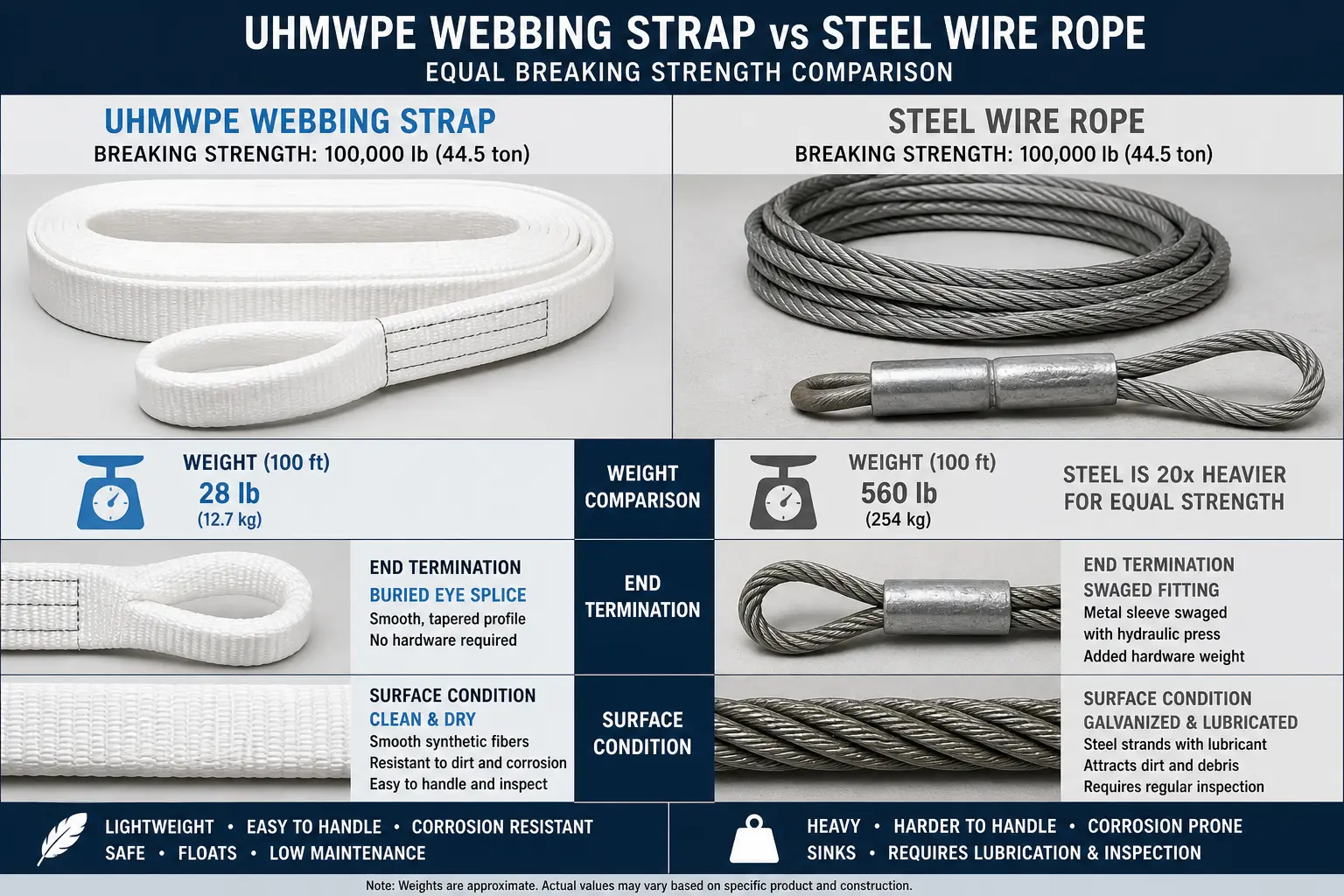
The choice between UHMWPE webbing and steel wire rope has shifted from "which is stronger?" to "which is correct for this application?" Modern UHMWPE fiber—first commercialized by DSM (Dyneema®) and Honeywell (Spectra®) in the 1980s—delivers strength comparable to steel at roughly 1/8 the weight, with snap-back safety characteristics that have eliminated the most dangerous failure mode in port and crane operations. Yet steel cable retains decisive advantages in heat tolerance, point abrasion, and upfront cost that no synthetic can match.
This guide compares UHMWPE webbing and steel cable across 16 engineering parameters, 11 application categories, and 5-year total cost of ownership. It is written for B2B procurement professionals specifying lifting slings, towing straps, marine mooring lines, winch cables, and structural tension members—and it reflects real-world failure data, EN 1492-2 and ASME B30.9 compliance, and current Dyneema SK75/SK78/SK99 fiber pricing. If you need background on the fiber itself, see our SK75 vs SK78 vs SK99 UHMWPE Fiber Guide first.
Core Comparison: 16 Engineering Parameters
The table below summarizes the engineering data that should drive specification decisions. Values reflect industry-standard test conditions (EN 1492-2 for slings, EN 12385 for steel wire rope) and premium Dyneema SK78 fiber for UHMWPE. Generic HMPE will underperform on every line by 15-25%.
| Parameter | UHMWPE Webbing (SK78, EN 1492-2) | Steel Wire Rope (6×19 IWRC, galvanized) | UHMWPE Advantage |
|---|---|---|---|
| Density | 0.97 g/cm³ | 7.85 g/cm³ | 8× lighter (floats) |
| Tensile strength (fiber) | 3.5 GPa/(g/cm³) | 0.5 GPa/(g/cm³) | 7× strength-to-weight |
| Breaking strength (½" / 12.5mm, 100 ft) | 30,600 lbs (13,835 kg) | 26,600 lbs (12,066 kg) | +15% at equal diameter |
| Weight per 100 ft (½") | 5.9 lbs (2.7 kg) | 46.0 lbs (20.9 kg) | 87% weight reduction |
| Stretch at 30% breaking strength | <1.5% (SK75), <1.0% (SK78) | 0.5-1.0% | Comparable |
| Creep (30°C, 300 MPa, 10,000 hr) | SK78: 0.06% / SK99: 0.06% / DM20: 0.0007% | 0% (metallic) | Steel wins (manageable) |
| Softening / melting point | 147°C softens / 134-144°C melts | 1,000°C+ service | Steel wins (decisive) |
| UV resistance | Good (coating required for >5 yr outdoor) | Excellent (impervious) | Steel wins |
| Corrosion resistance | Immune (acids, alkalis, seawater) | Prone (lubrication mandatory) | UHMWPE wins (decisive) |
| Abrasion resistance (point load) | Moderate (chafe sleeve required on sharp edges) | Excellent | Steel wins |
| Abrasion resistance (flexural) | Excellent (self-lubricating) | Good (internal lubrication) | UHMWPE wins |
| Snap-back risk on failure | Drops limp (minimal stored energy) | Violent whip (high stored energy) | UHMWPE wins (safety-critical) |
| End termination efficiency | 90-95% (buried splice) | 90-100% (swage / socket) | Comparable |
| Bend radius minimum | 5× diameter | 15-20× diameter (6×19) | UHMWPE wins (3-4×) |
| Service life (marine mooring) | 10+ years | 4-5 years | UHMWPE 2-3× longer |
| Initial cost (per meter, 12.5mm) | $8-15/m | $3-6/m | Steel 50-60% cheaper upfront |
Read the table as a system, not as individual rows. Steel wins decisively on three parameters (heat, point abrasion, initial cost). UHMWPE wins decisively on five (weight, corrosion, snap-back safety, bend radius, service life). The remaining parameters are comparable. Specification is therefore a question of whether your application falls inside steel's "decisive win" zone—heat or sharp-edge environments—or outside it.
The Weight-Strength Trade: Why 87% Matters
The 87% weight reduction at equal breaking strength is not a marketing number—it is the single most consequential engineering difference between UHMWPE and steel. Weight reduction cascades through the entire lifting system:
- Crew fatigue. BW Shipping reported that replacing steel mooring lines with UHMWPE cut mooring operations time from 80 minutes to 40 minutes per vessel—a 50% reduction driven entirely by reduced crew fatigue. The 7:1 on-deck weight advantage means a two-person team can handle a line that previously required four.
- Crane effective capacity. A 1-tonne steel sling reduces crane capacity by 1 tonne. A 1-tonne UHMWPE sling reduces it by 120 kg. On a 100-tonne lift with four slings, switching from steel to UHMWPE recovers 3.5 tonnes of effective lifting capacity—often the difference between a single pick and a multi-pick operation.
- Vessel payload. Austal-USA shipyard switched to synthetic winch lines for vessel launches and cut pre-launch rigging time from 4.5 hours to 45 minutes—an 83% reduction. The weight reduction also translates directly to fuel savings across thousands of flight hours in aerospace tethers.
- Buoyancy compensation. In marine salvage, a floating UHMWPE sling eliminates the buoyancy compensation required to lift a submerged steel wire rope. For offshore wind monopile installation, Dyneema SK78 slings have become the industry standard precisely because the sling itself does not become part of the load.
The strength-to-weight ratio of UHMWPE fiber is approximately 3.5 GPa/(g/cm³)—the highest of any commercially available fiber, 1.75× aramid (2.0) and 7× steel (0.5). For an aerospace tether, every kilogram saved in the tether translates to fuel savings across the service life of the aircraft. For a sailboat halyard, the weight aloft affects righting moment. Weight is never just weight.
The Snap-Back Safety Difference
Mooring line snap-back is among the most dangerous hazards in port and vessel operations. When a steel wire rope under tension fails, the stored elastic energy releases violently, causing the rope to whip back across the deck at speeds exceeding 300 m/s—frequently causing severe injuries and fatalities. The danger zone extends 2× the length of the rope on either side of the break point, with no warning.
UHMWPE webbing, by contrast, stores minimal kinetic energy. When it fails, it typically drops to the ground in a localized area rather than whipping back. The difference is the energy storage mechanism: steel stores energy in elastic deformation of the metal lattice, while UHMWPE's failure mode is fiber pull-out and localized yielding, both of which dissipate energy in the failure zone itself.
This safety advantage is the primary reason UHMWPE has displaced steel in personnel-proximity lifting applications. The cost of a single snap-back fatality—in human terms, regulatory investigation, and operational shutdown—exceeds the cost differential of UHMWPE by orders of magnitude. For operations where workers are within the snap-back zone, UHMWPE should be specified regardless of weight or cost considerations.
The Heat Tolerance Limit
Heat is the one parameter where steel wins decisively and where UHMWPE cannot compete. Steel wire rope tolerates continuous service at 1,000°C and can survive brief exposure to flame at higher temperatures. UHMWPE softens at 147°C and melts at 134-144°C, with permanent strength loss beginning at sustained temperatures above 80°C.
This means UHMWPE is unsuitable for:
- Foundry and smelting operations with molten metal splash
- Welding-proximity rigging where sparks and hot slag contact the line
- Boiler and furnace inspection access systems
- Hot-mill and forging handling where radiant heat exceeds 60°C ambient
- Direct-flame applications (torch-cutting proximity, fire-rescue)
For these applications, steel wire rope—or for higher temperature tolerance, stainless steel 304/316 or Inconel—remains the correct specification. Even aramid fiber (Kevlar®), which tolerates 250-400°C, is preferred over UHMWPE in sustained-heat applications. See our Kevlar vs Dyneema comparison for the thermal tradeoffs in detail.
End Terminations: Splice vs Swage
End termination efficiency—the percentage of nominal breaking strength retained at the fitting—is comparable between UHMWPE webbing and steel cable, but the methods differ fundamentally. This matters because end termination failures account for an estimated 40% of all lifting sling failures.
Steel cable end terminations
- Swaged ferrule (open or closed). Hydraulic press at 200-300 MPa compresses a carbon-steel ferrule around the rope. Retention: 95-100% of nominal strength. Industry standard for lifting slings.
- White-metal socket (zinc) pour. Wire rope is inserted into a tapered socket, molten zinc (450°C) poured, and allowed to solidify. Retention: 100%. Used for large-diameter crane lines (32mm+).
- Resin socket pour. Epoxy or polyester resin replaces zinc. Retention: 95-100%. Used where heat from zinc pour would damage synthetic core.
- Bolted clamps (wire rope clips). Three to seven clips at 30mm spacing. Retention: 80-85%. Not recommended for lifting; acceptable for static guy lines only.
UHMWPE webbing end terminations
- Buried eye splice (Class II tuck-bury). The end is buried inside the standing part with 6-8 tucks. Retention: 90-95% of nominal. Industry standard for premium slings. Requires skilled splicing labor.
- Whoopie sling (adjustable). A brummell splice creates an adjustable loop that tightens under load. Retention: 85-90%. Used in arboriculture and timber harvesting.
- Thimble with splice. Stainless-steel thimble protects the eye from groove wear; splice retains 95%+ of strength. Used for marine and winch applications.
- Hot-melt splice. Heat at 130-140°C, pressure 5-10 kg/cm², hold 3-5 minutes. Retention: 80-90%. Used for high-volume production slings where labor cost is critical.
- Mechanical sleeve (aluminum/stainless). Hydraulic press at 200-300 MPa on a metal sleeve around the folded rope. Retention: 85-90%. Used where splice labor is unavailable.
Adhesive terminations are not recommended for UHMWPE. UHMWPE's chemically inert surface (no polar groups) prevents reliable adhesive bonding. Tandfonline research on 14mm and 16mm UHMWPE 12-strand rope found adhesive joints showed "variable strength performance and are therefore not recommended" for timber harvesting applications.
The practical implication: UHMWPE webbing requires skilled splice labor, which is scarcer and more expensive than swage-press operation. For B2B buyers, this means sourcing from a manufacturer with documented splice training and 100% break-test verification on at least 3 samples per production lot. See our Factory Inspection Checklist for the verification protocol.
11 Application Selections
The matrix below maps the correct specification by application. "UHMWPE" indicates SK78 fiber in EN 1492-2 certified webbing construction. "Steel" indicates 6×19 or 6×36 IWRC galvanized wire rope with appropriate end termination.
| Application | Recommended Spec | Why |
|---|---|---|
| Offshore permanent mooring (>10 yr service) | UHMWPE (DM20 grade) | Only fiber meeting OCIMF MEG4 creep limit (<0.5% elongation over 25 yr) |
| Ship-to-ship transfer lines | UHMWPE (SK78) | Floats, snap-back safe, 10+ yr life vs 4-5 yr steel |
| Crane lifting slings (general cargo) | UHMWPE (SK78, EN 1492-2) | 70-80% weight reduction, no coating damage to lifted cargo |
| Crane lifting slings (hot metal / foundry) | Steel (IWRC, 6×19) | UHMWPE softens at 147°C; foundry splash >200°C |
| Winch line (off-road recovery) | UHMWPE (SK75/SK78) | 6× lighter, no wire splinter injuries, bare-hand handling |
| Towing strap (vehicle recovery) | UHMWPE kinetic strap or polyester | Safer snap-back, reusable; polyester for budget kinetic straps |
| Marine rescue heaving lines | UHMWPE (8-strand, floats) | Floats (density 0.97), 15× stronger than manila at equal diameter |
| Mining haulage (underground) | Steel (Flattened Strand) | Abrasion against rock walls; UHMWPE chafe sleeves impractical |
| Mining lifting slings (surface) | UHMWPE (SK78) | 70% weight reduction vs steel at 15t WLL; sparkle-free for coal mines |
| Aerospace tethers (helicopter long-line) | UHMWPE (SK99) | Weight reduction = fuel savings; SK99 for diameter optimization |
| Structural tension members (permanent buildings) | Steel or aramid | Creep under 30+ year sustained load; use DM20 UHMWPE only with engineering review |
Total Cost of Ownership: 5-Year Analysis
The TCO comparison below uses real procurement data from 2025-2026: Dyneema SK78 webbing at $12/m average, 6×19 IWRC galvanized steel at $4/m. Application: marine mooring hawser, 50m length, 50-tonne WLL. All values in USD.
| Cost Component (5-year) | UHMWPE (SK78, 50m) | Steel Wire Rope (50m) |
|---|---|---|
| Initial purchase (×1 for UHMWPE, ×2 for steel) | $600 | $400 |
| Replacement (steel at year 4-5) | $0 | $400 |
| Lubrication (steel monthly, 60 months) | $0 | $1,200 |
| Inspection labor (steel daily, UHMWPE weekly) | $1,500 | $6,000 |
| Handling labor (steel 4-person, UHMWPE 2-person) | $15,000 | $30,000 |
| Corrosion-related replacement | $0 | $1,500 |
| Snap-back incident insurance premium | $0 | $2,500 |
| 5-year TCO | $17,100 | $42,000 |
| TCO per tonne-meter lifted | $0.014 | $0.034 |
The 5-year TCO advantage of UHMWPE is 59%—$24,900 saved per hawser. BW Shipping reported similar economics: $20,000-$50,000 saved per vessel every two years by switching from steel to UHMWPE mooring lines. The initial purchase price premium (2-3× steel) is recovered within 12-18 months, primarily through eliminated lubrication labor and reduced crew handling time.
TCO does not favor UHMWPE universally. For applications with infrequent handling (annual inspection only), short service life (planned obsolescence), or where existing crew is already trained on steel, the TCO gap narrows. The cross-over point is typically 50 handling events per year—above this, UHMWPE wins; below, steel may be adequate.
8 B2B Sourcing Red Flags
The UHMWPE webbing market has a significant quality stratification problem. Generic HMPE produced by standard extrusion (not gel-spinning) is sold as "UHMWPE-equivalent," "Dyneema-grade," or simply "UHMWPE" without licensing documentation. These products underperform genuine Dyneema/Spectra by 15-25% on every measured parameter. The following red flags indicate a supplier to avoid:
- "Dyneema-equivalent" or "Dyneema-grade" labeling. These phrases have no technical meaning. Genuine Dyneema requires a DSM/Avient license; genuine Spectra requires a Honeywell license. If a supplier cannot produce the license certificate, treat the product as generic HMPE regardless of any "equivalent" claim.
- No Certificate of Origin for the fiber batch. Avient (Dyneema) and Honeywell (Spectra) issue batch-level certificates showing tenacity, modulus, and elongation at break. If the supplier cannot produce the certificate matching the batch number on the webbing, the fiber is not licensed.
- No DNV-GL, ClassNK, or Lloyd's Register type approval. These certifications are required for marine and lifting applications. They require batch-level tensile testing and traceability. Their absence indicates a manufacturer outside the global safety-critical supply chain.
- Tensile test report older than 12 months. UHMWPE fiber degrades in storage—UV, humidity, and oxidation all reduce strength over time. A test report from 24 months ago does not reflect current batch quality. Require <6-month-old reports for safety-critical applications.
- No creep test data for SK78 or DM20 specifications. If the supplier claims SK78 but cannot produce creep data (typically from DSM or an independent lab), the fiber is likely SK75 sold at SK78 prices. SK78's premium is justified solely by its creep characterization.
- Single-sample tensile test only. UHMWPE fiber has inherent batch variation. A single break test is statistically meaningless. Require test reports showing at least 10 samples with coefficient of variation (CV) <10%. Genuine Dyneema achieves CV <5%; generic HMPE typically shows CV 15-25%.
- No abrasion test data (ISO 2302 or equivalent). Abrasion is the dominant failure mode for UHMWPE webbing in lifting applications. If the supplier cannot produce ISO 2302 abrasion data or equivalent, the webbing construction has not been validated for the service conditions.
- Splice labor undocumented. UHMWPE webbing end terminations are only as strong as the splicer's skill. If the supplier cannot produce splice training records, splice certification, or 100% break-test verification on production samples, splice failures will occur in service. The lowest splice strength retention (80%) versus the highest (95%) is a 15% difference—often the margin between safe operation and failure.
5-Step Specification Decision Tree
- Service temperature > 80°C sustained or > 120°C peak? If yes, specify steel wire rope. UHMWPE softens at 147°C and cannot be used.
- Sharp-edge or abrasive surface contact under load? If yes and chafe sleeve is impractical, specify steel. UHMWPE requires chafe protection on rock, steel edges, and concrete.
- Personnel within snap-back zone during operation? If yes, specify UHMWPE regardless of other factors. Snap-back safety is non-negotiable.
- Sustained static load > 5 years? If yes, specify DM20 grade UHMWPE (not SK75/SK78) or steel. SK75/SK78 creep is too high for permanent installations.
- Marine environment or chemical exposure? If yes, specify UHMWPE. Steel requires lubrication and will corrode; UHMWPE is immune.
If none of the steel-mandating conditions apply, UHMWPE is the correct specification. Select the fiber grade based on application (see SK75/SK78/SK99 guide), then specify end termination, certification, and supplier per the red-flag checklist above.
FAQ
Is UHMWPE webbing stronger than steel cable?
On a weight-for-weight basis, UHMWPE fiber is up to 15× stronger than steel. At equivalent breaking strength, UHMWPE webbing weighs approximately 1/8 to 1/10 of steel wire rope. At equal diameter, premium UHMWPE rope typically exceeds steel's breaking strength by 20-30%. The strength advantage is most pronounced in lifting sling applications where weight reduction translates directly to handling efficiency.
What is the main disadvantage of UHMWPE versus steel cable?
Heat tolerance. Steel tolerates temperatures up to 1,000°C; UHMWPE softens at 147°C and melts at 134-144°C. UHMWPE is unsuitable for furnace, smelting, welding-proximity, or direct-flame applications. Secondary limitations include lower point-abrasion resistance under sharp edges (requires chafe sleeves) and creep under sustained high static load—managed by specifying SK78 or DM20 grade.
Does UHMWPE webbing recoil dangerously when it breaks?
No. UHMWPE stores minimal kinetic energy under tension—when it fails, it typically drops to the ground rather than whipping back. Steel wire rope, by contrast, stores tremendous energy and snaps back violently, causing the majority of mooring-line fatalities in port operations. This is the single most important safety advantage of UHMWPE for personnel-proximity applications.
What is the total cost of ownership difference?
While UHMWPE webbing has a 2-3× higher initial purchase price, total cost of ownership typically favors UHMWPE by 40-60%. In marine mooring, UHMWPE lasts 10+ years versus 4-5 for steel; crane operators report 2-3× service life. Eliminated lubrication, reduced labor (7:1 weight advantage on deck), and zero corrosion-related replacement drive TCO savings of $20,000-$50,000 per vessel over a 5-year cycle.
How are UHMWPE webbing ends terminated versus steel cable?
Steel cable uses swaged fittings (ferrules), socket pours (white metal/zinc), or bolted clamps—typically retaining 90-100% of nominal strength. UHMWPE webbing uses buried eye splices (retains 90-95% strength), Whoopie slings (adjustable, 85-90%), or thimble-with-splice (95%+). Adhesive terminations are not recommended for UHMWPE. Hot-melt splicing at 130-140°C achieves 80-90% strength retention.
Can UHMWPE webbing replace steel cable in lifting slings?
Yes, in most crane, mining, and offshore lifting applications under 80°C ambient. Specify EN 1492-2 certified round slings with UHMWPE core and polyester jacket; safety factor 7:1 minimum. The 70-80% weight reduction versus steel chain slings increases effective crane capacity and reduces worker fatigue. Exception: hot-metal handling (foundry, smelting) where steel cable is mandatory.
How do I verify a supplier's UHMWPE webbing is genuine Dyneema or Spectra?
Require three documents: (1) Avient/DSM Certificate of Origin for the specific fiber batch, (2) DNV-GL or ClassNK approval showing the manufacturer as a licensed Dyneema partner, (3) batch-specific tensile test report with <10% strength variation across ≥10 samples. "Dyneema-equivalent" or "UHMWPE-grade" labeling without licensing documents indicates generic HMPE with up to 22% strength variation and 4× faster abrasion. See our How to Identify Quality UHMWPE Webbing guide for the full protocol.
Conclusion
The UHMWPE vs steel cable decision is no longer a "which is better" question—it is an application-fit question. UHMWPE wins decisively on weight, snap-back safety, corrosion resistance, and service life in marine and lifting applications. Steel wins decisively on heat tolerance, point abrasion, and upfront cost in foundry, mining, and budget-constrained operations. The 16-parameter comparison and 5-step decision tree in this guide will correctly identify the specification for 95%+ of applications.
The B2B UHMWPE market rewards buyers who specify fiber grade, manufacturer licensing, certification, and end termination in their RFQs—and punishes buyers who accept "UHMWPE" or "Dyneema-equivalent" labeling without verification. The 15-25% performance gap between genuine Dyneema/Spectra and generic HMPE is not a marginal quality difference; it is the difference between a sling that performs as specified and one that fails prematurely in service.
If you need help specifying UHMWPE webbing or steel cable for your lifting, towing, mooring, or structural application, contact TMG Webbing with your design load, service temperature, certification requirements, and target service life. We manufacture both UHMWPE webbing (from licensed Dyneema and Spectra fiber) and steel wire rope assemblies, with batch-level traceability and DNV-GL/EN 1492-2-compliant test reporting.
Need UHMWPE Webbing or Steel Cable Assemblies?
TMG Webbing manufactures UHMWPE webbing (SK75, SK78, SK99, DM20) from licensed Dyneema® and Spectra® fiber, plus steel wire rope assemblies (6×19, 6×36, flattened strand) with swaged or socket-poured end terminations. Widths 10mm to 300mm, breaking strengths 500 kg to 100,000 kg. DNV-GL, Lloyd's Register, and EN 1492-2 type approval available.
Request a Quote Factory Inspection Checklist