
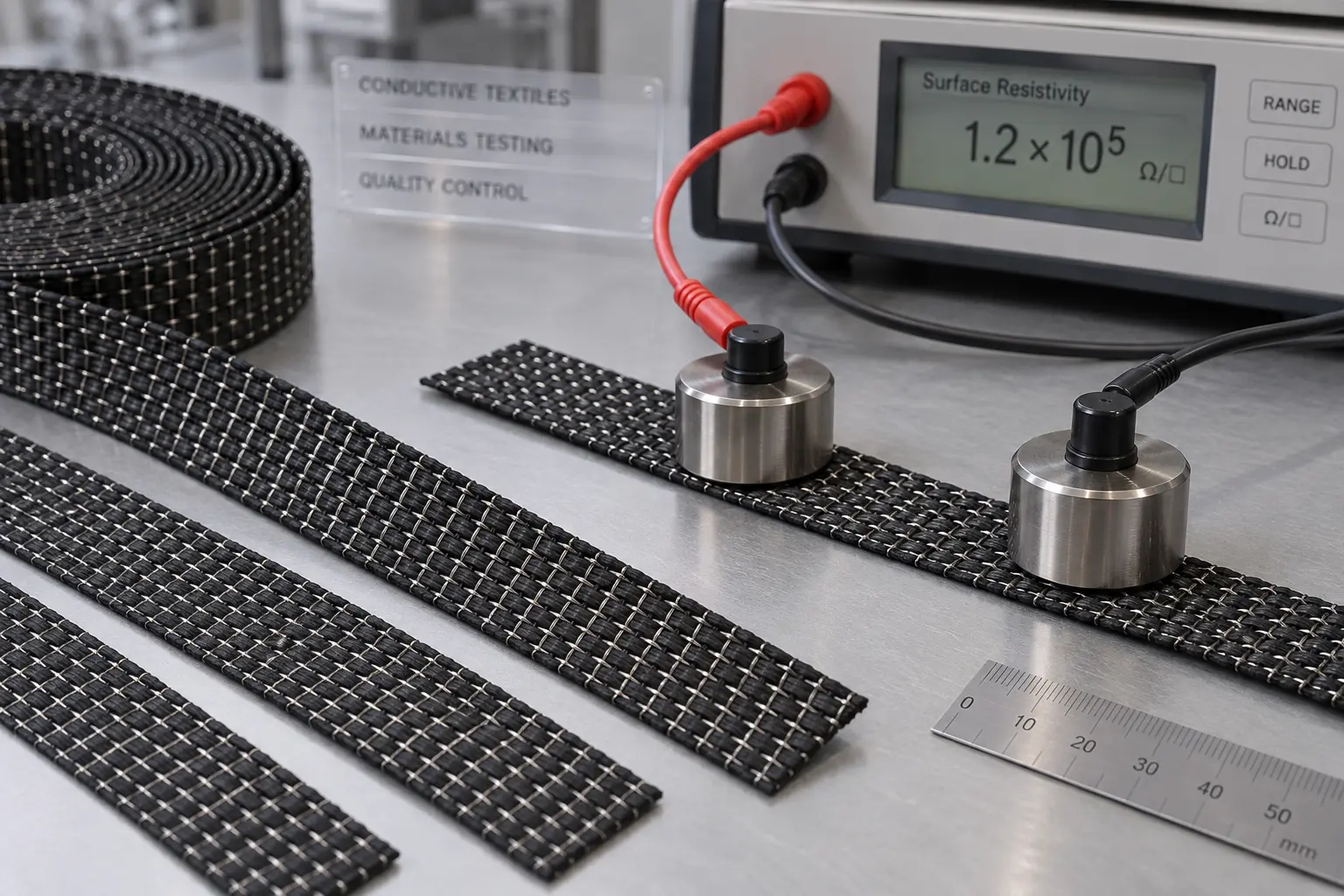
A standard nylon or polyester strap is an electrical insulator. Put it next to a printed circuit board, inside a fuel-handling enclosure, or on a garment worn in an explosive atmosphere, and it becomes a component that accumulates charge and has nowhere to put it. Conductive and anti-static webbings solve that — but they solve very different versions of the problem, and buying the wrong one produces a strap that measures fine on day one and fails in service.
This guide explains the resistivity spectrum that separates insulative, anti-static, and conductive webbing, the four ways conductivity is physically built into narrow fabric, which test methods actually govern procurement, why so many "anti-static" straps stop working after washing, and the five fields your specification must contain. For background on why base-material choice still dominates mechanical behaviour, see the nylon vs polyester tensile comparison.
The Resistivity Spectrum: Three Categories, Not Two
Everything comes down to how freely charge moves across the surface of the fabric. Surface resistivity, in ohms per square (Ω/sq), is the number that decides which category a webbing belongs to:
| Category | Surface Resistivity | What It Does | Typical Use |
|---|---|---|---|
| Insulative | > 1012 Ω/sq | Holds charge; cannot dissipate | Standard nylon, polyester, PP webbing |
| Anti-static / dissipative | 106 - 1011 Ω/sq | Bleeds charge away slowly and safely | ESD straps, cleanroom garment closures |
| Conductive | < 105 Ω/sq | Provides a defined electrical path | Grounding straps, signal paths, heating elements |
The distinction matters practically: antistatic behaviour prevents a spark, while conductive behaviour creates a path. If a strap must be bonded to ground and carry current, dissipative webbing at 109 Ω/sq is far too resistive. If a strap must simply not shock a handler, conductive webbing at 103 Ω/sq is over-engineering — and usually costs several times more.
Four Ways to Make Webbing Conductive
How the conductivity is achieved determines whether it lasts. Only two of the following four survive real service:
| Construction | How It Works | Durability | Typical Result |
|---|---|---|---|
| Carbon-loaded sheath-core yarn | Carbon black dispersed in the polymer sheath of a filament yarn, woven into the webbing at set intervals | Permanent — survives washing and abrasion | Dissipative range |
| Stainless steel staple blend | Fine stainless fibres blended into the spun yarn so conductive-to-conductive contact occurs throughout | Permanent; heavier and stiffer | Dissipative to conductive |
| Metal-plated filament (silver/nickel) | Continuous metal coating on a base filament, giving a low-resistance yarn | Permanent but coating can abrade at sharp bends | Conductive range |
| Topical anti-static finish | Surfactant or conductive polymer applied to the finished webbing surface | Temporary — degrades in roughly 5-20 washes | Dissipative range, short-term |
Buyers get caught by the last row constantly. A supplier quotes "anti-static webbing" at commodity price; the sample measures 108 Ω/sq and passes initial inspection; after ten industrial washes the finish is gone and the strap reads like plain polyester. The test is simple: ask for resistivity data after 5, 10, and 25 wash cycles. A permanent conductive-fiber construction produces all three without drift.
Testing and Standards That Govern Procurement
Resistivity is meaningless without the method and conditioning behind it. Nylon and polyester conductivity shift with humidity, so a measurement taken on a humid afternoon will not match one taken in a dry lab:
| Reference | What It Covers | When Buyers Use It |
|---|---|---|
| EN 1149-1 | Surface resistivity measurement (ring electrode method) | Primary acceptance metric for dissipative materials |
| EN 1149-3 | Charge decay — how fast a deposited charge dissipates | When spark risk, not absolute resistance, is the concern |
| EN 1149-5 | Performance requirements for electrostatic dissipative protective clothing | When the webbing is a component of certified PPE |
| EN 61340-5-1 | ESD control programme requirements | Electronics manufacturing environment compliance |
| ANSI/ESD S20.20 | North American ESD control programme standard | US electronics assembly lines and their suppliers |
| ASTM D257 | General DC resistance / conductance of insulating materials | Laboratory cross-check when no sector standard applies |
One caveat worth stating plainly: a webbing component is not "certified" on its own. When the finished assembly falls under PPE regulation or ATEX, conformity is assessed at product level, and the webbing's role is to deliver consistent, documented material performance. Confirm scope and current version with your notified body — and demand the resistivity report per batch, as described in how to read a webbing test report.
Where Conductive and Anti-Static Webbing Are Used
| Application | Requirement Type | Typical Construction |
|---|---|---|
| ESD wrist / heel straps | Dissipative, skin-contact safe | Carbon-loaded yarn, often with conductive fibre on the contact face |
| Grounding straps in enclosures | Conductive path, low resistance | Stainless blend or metal-plated yarn |
| Electronics transport & conveyor belts | Dissipative across a wide surface | Carbon grid or dissipative coating |
| Protective clothing for ATEX zones | Dissipative, documented and durable | Carbon sheath-core yarn — verify at product level |
| Cleanroom garment closures | Dissipative, low linting | Continuous filament polyester with carbon yarn |
| Military / energetic-material handling | Dissipative plus other performance specs | Often combined with IRR or flame-retardant requirements |
| Wearable electronics & heated gear | Conductive path / resistive heating element | Metal-plated filament in defined yarn paths |
The Trade-Off: Conductivity vs Mechanical Performance
Adding conductivity costs you something mechanical, and the trade is not always obvious:
- Stiffness and weight. Stainless-steel-blend and metal-plated yarns are heavier and stiffer than the polyester they replace; straps become less supple and may abrade mating surfaces.
- Strength. Raising conductive yarn content improves conductivity but lowers breaking strength, because the conductive yarn is rarely as strong as the structural yarn it displaces. Request tensile data on the conductive construction itself, not on the base webbing.
- Color range. Carbon and metal yarns are dark. Dissipative webbing in a light brand color is a real development challenge — discuss it before you promise marketing a shade.
- Bend fatigue. Metal-plated coatings can lose continuity at tight, repeated bends; a strap that folds sharply in service needs a blend-based construction instead.
Specification Checklist: 5 Fields
- Target resistivity range in Ω/sq, with the measurement standard named (usually EN 1149-1). A single value without a range and a method is unenforceable.
- Conditioning and test environment — temperature and relative humidity at measurement, so your incoming inspection can reproduce the supplier's number.
- Durability requirement: number of wash or abrasion cycles the strap must survive while staying in range. This is the field that separates permanent constructions from topical finishes.
- Mechanical specification: width, thickness, breaking strength of the conductive construction, plus hardware compatibility — see the hardware guide and the width selection guide.
- Regulatory context: which programme standard the finished product must satisfy (EN 61340-5-1, ANSI/ESD S20.20, ATEX assessment), and the batch-level documentation you need from the factory.
6 Mistakes When Buying ESD Webbing
- Confusing anti-static with conductive — and then finding the strap is 1,000 times too resistive to bond to ground.
- Accepting a one-time measurement with no wash-cycle data; topical finishes pass initial inspection and fail in service.
- Ignoring conditioning, so your QC lab reads 1011 while the supplier's certificate says 108.
- Specifying conductivity but not strength, then receiving a strap that meets ESD and snaps under load.
- Assuming the webbing is "certified" for PPE or ATEX use; conformity belongs to the finished assembly.
- Over-specifying metal-plated yarn where a carbon-loaded construction would do — you pay several times more for conductivity you do not need.
Need Dissipative or Conductive Webbing?
TMG Webbing develops carbon-loaded, stainless-blend, and metal-plated conductive webbings in 10-50 mm widths, with surface resistivity reports per batch, wash-durability data, and combined constructions (flame-retardant, IRR, aramid-reinforced). Send your target resistivity range, wash-cycle requirement, mechanical spec, and annual volume — our engineering team responds with a construction proposal and sample plan within 48 hours.
Request ESD Webbing Quote Talk to an EngineerFrequently Asked Questions
What is the difference between anti-static and conductive webbing?
Anti-static (static-dissipative) webbing bleeds charge away gradually, typically around 106 to 1011 Ω/sq. Conductive webbing carries current freely, generally below 105 Ω/sq, and is used when a defined electrical path or grounding continuity is required. Standard nylon and polyester are insulative — above about 1012 Ω/sq — and cannot dissipate charge at all.
How is conductivity measured in webbing?
Surface resistivity in ohms per square, measured with ring electrodes — EN 1149-1 for protective-clothing materials, ASTM D257 as the general laboratory method. Some programmes add charge decay time (EN 1149-3) or point-to-point resistance. Samples must be conditioned (commonly 23 C and 25% RH) because humidity shifts the result significantly.
Is anti-static webbing permanent or does it wash out?
It depends on the construction. Conductive fiber woven in — carbon-loaded sheath-core, stainless staple blends, metal-plated filaments — is permanent and survives dozens of industrial washes. A topical anti-static finish is temporary and typically degrades after 5-20 washes. Always ask which one you are buying, and request resistivity data after the wash cycles your product will actually see.
Which standards apply to ESD-safe webbing?
Common references are EN 1149-1 (surface resistivity), EN 1149-3 (charge decay), EN 1149-5 (dissipative protective clothing performance), EN 61340-5-1 (ESD control programmes), and ANSI/ESD S20.20 in North American electronics. Equipment for potentially explosive atmospheres brings ATEX-related requirements at the finished-assembly level. Confirm scope and version with your notified body.
What is conductive webbing used for?
ESD wrist and heel straps, grounding straps inside enclosures and vehicles, anti-static conveyor and transport belts, straps on protective clothing for classified atmospheres, cleanroom garment closures, military systems handling sensitive materials, and smart textile applications where a conductive yarn path carries low-current signals or acts as a heating element.
Can conductive yarn change the mechanical properties of webbing?
Yes. Metal-plated and stainless blends are stiffer and heavier, reduce flexibility, and can abrade adjacent surfaces; they are also dark in color. Carbon-loaded yarns are lighter and softer but more resistive. Raising conductive content improves conductivity but lowers breaking strength — so request mechanical data on the actual conductive construction, not the base webbing.
How much does conductive or anti-static webbing cost?
Carbon-loaded anti-static webbing typically adds roughly $0.05-0.30 per metre over comparable standard webbing depending on width and blend ratio. Stainless-blend and silver-plated conductive constructions often run $0.30-2.00+ per metre. Development sampling usually costs a few hundred dollars because conductive yarn is expensive in small lots; MOQ typically starts at 1,000-3,000 m — see the pricing guide and MOQ guide.
Custom Webbing Orders
Custom webbing MOQ: 3,000 meters. Standard production lead time: 15 days after specification and sample approval. Confirm the delivery schedule for your exact order. Stock availability and finished-product quantities are quoted separately.
TMG Webbing holds GRS and OEKO-TEX STANDARD 100 certificates. Ask us to confirm the current certificate, holder and article scope for your material, color and finish. Recycled-content claims and transaction documentation depend on the order.