
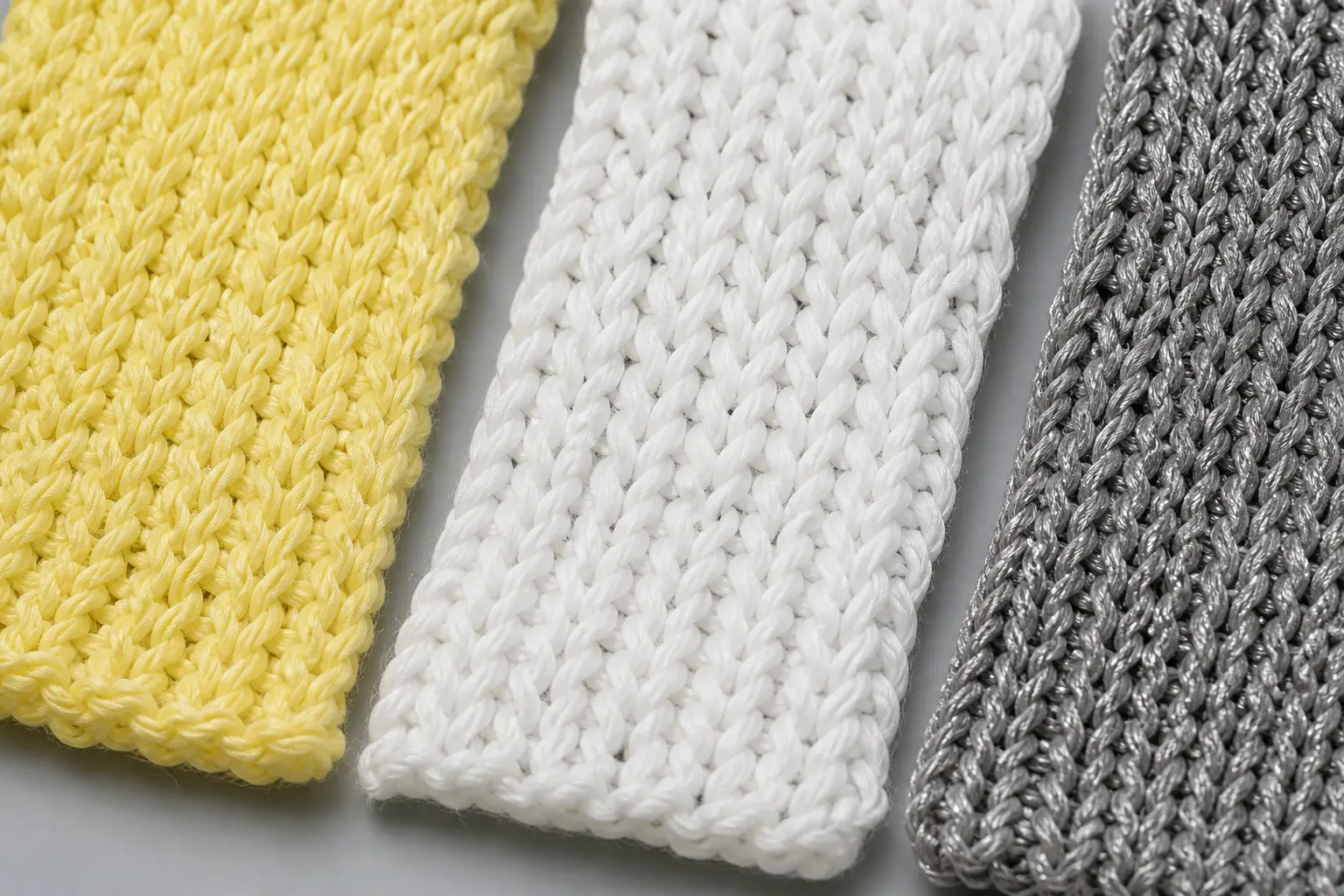
The global cut resistant gloves market reached $3.2 billion in 2026, driven by tightening OSHA enforcement, expanding food processing regulations, and a manufacturing sector that increasingly demands multi-hazard hand protection. Behind every cut-resistant glove is a engineered yarn or webbing — and the fiber you choose directly determines whether your product passes EN 388 certification or fails a liability claim after a workplace injury.
This guide covers everything a PPE manufacturer, safety distributor, or industrial buyer needs to know about selecting cut resistant webbing for gloves: fiber material comparison (aramid vs HPPE vs steel vs glass), EN 388 and ANSI/ISEA 105 rating systems, application-specific selection, composite yarn engineering, thermal and moisture performance, total cost of ownership, and factory sourcing red flags.
Cut Resistance Standards: EN 388 vs ANSI/ISEA 105
Two standards govern cut resistant glove ratings worldwide. Understanding both — and their critical differences — is essential for B2B buyers sourcing internationally.
EN 388:2016 (European Standard)
EN 388 evaluates four mechanical risks (abrasion, cut, tear, puncture) plus an optional impact protection test. The 2016 revision added the ISO 13997 TDM-100 test alongside the legacy Coupe test because modern high-strength fibers like HPPE and aramid dull the rotary Coupe blade, producing falsely high ratings.
- Coupe Test (legacy): Levels 1-5. A circular blade rotates against the sample. Higher = more rotations to cut through. Level 5 requires an index of 20.0+.
- ISO 13997 TDM Test (current): Levels A-F. A straight blade applies increasing force. Measures Newtons required to cut through. Level F requires 30N+.
A typical EN 388 label reads 4X43F — abrasion 4, Coupe cut X (not tested/invalid), tear 4, puncture 3, ISO cut F (highest). The final letter (A-F) is the most critical value for cut protection.
ANSI/ISEA 105 (North American Standard)
ANSI/ISEA 105-2016 uses only the TDM-100 test, measuring grams of force required to cut through the material. Nine levels from A1 (200g minimum) to A9 (6,000g+). This is the standard referenced by OSHA and most North American safety programs.
| ANSI Level | Cut Force (grams) | EN 388 ISO Level | Force (Newtons) | Typical Hazard |
|---|---|---|---|---|
| A1 | 200-499 | A | 2N | Light assembly, packaging |
| A2 | 500-999 | B | 5N | Cardboard, minor edge contact |
| A3 | 1,000-1,499 | C | 10N | Light sheet metal, general fabrication |
| A4 | 1,500-2,199 | D | 15N | Automotive parts, food processing |
| A5 | 2,200-2,999 | E | 22N | Glass handling, heavy sheet metal |
| A6 | 3,000-3,999 | F | 30N | Meat cutting, metal stamping |
| A7 | 4,000-5,999 | F+ | 40-50N | Heavy butchery, recycling |
| A8-A9 | 6,000+ | F++ | 60N+ | Razor blades, chainsaw, extreme cut |
Critical note: EN 388 and ANSI levels are not directly equivalent. An EN 388 Level 5 Coupe rating does not equal ANSI A5. Always verify which test method (Coupe vs TDM) was used, and for high-performance fibers, insist on ISO 13997 TDM data — the Coupe test is unreliable for materials that dull the blade.
Material Comparison: Four Cut Resistant Fibers
Four fiber types dominate cut resistant glove manufacturing. Each has distinct strengths, weaknesses, and cost profiles that determine their ideal application.
| Property | Aramid (Kevlar®) | HPPE (UHMWPE) | Steel Fiber | Glass Fiber |
|---|---|---|---|---|
| Cut Range (ANSI) | A3-A6 | A4-A7 | A6-A9 | A5-A7 |
| Tensile Strength | 22-25 cN/dtex | 35-42.5 cN/dtex | 3-5 GPa | 15-20 cN/dtex |
| Thermal Limit | 300-400°C (chars, no melt) | 130-150°C (melts) | 500°C+ | 250-300°C |
| Flame Resistance | Inherent FR (LOI >28%) | No (melts, drips) | Yes (non-combustible) | Yes (non-combustible) |
| Moisture Absorption | 3-7% (strength loss when wet) | 0% (hydrophobic) | 0% | 0% |
| UV Resistance | Poor (15-20% loss/200hr) | Good | Excellent | Good |
| Flexibility/Dexterity | Good | Excellent | Poor (stiff, heavy) | Fair (can cause irritation) |
| Chemical Resistance | Weak (acids, bases degrade) | Excellent | Poor (corrodes) | Good |
| Cost (per kg) | Mid-High | Low | Mid | Low |
| Best For | Heat + cut multi-hazard | Pure cut, wet/precision | Maximum cut, heavy blade | Cost-effective A5-A6 |
Aramid (Kevlar®) — The Multi-Hazard Fiber
Aramid fiber, best known by the DuPont brand name Kevlar®, is the only cut-resistant fiber that also provides inherent flame resistance and thermal stability up to 300-400°C without melting or dripping. This dual protection makes aramid indispensable in environments where cut and heat hazards coexist — glass furnace operations, metal casting, welding support, and foundry work.
Aramid's molecular structure consists of rigid, rod-like molecules with strong hydrogen bonds forming a highly ordered network. When a blade strikes this network, the fibers absorb and distribute energy through friction and deformation — they resist being pulled apart. This is fundamentally different from HPPE's deflection mechanism.
Limitations: Aramid absorbs 3-7% moisture by weight, losing 15-20% tensile strength when wet. It degrades under UV exposure (15-20% strength loss after 200 hours of direct sunlight). It is vulnerable to strong acids and bases. And it costs 50-75% more than HPPE per kilogram. For pure cut protection in dry, room-temperature environments, aramid is over-specified — HPPE delivers equivalent or better cut resistance at lower cost.
Typical specs: 100% para-aramid yarn, 202 dtex, 7-15 gauge knit, natural yellow color, breaking strength 25-50 kN for 25mm webbing, LOI >28%, oxygen index >25%.
HPPE (UHMWPE) — The Cut-to-Weight Champion
HPPE (High-Performance Polyethylene), commercially known as Dyneema® or Spectra®, is the most widely used cut-resistant fiber in modern PPE. Its strength-to-weight ratio is 15 times that of steel, and its low-friction surface causes blades to slide rather than bite. HPPE gloves achieve ANSI A4-A7 ratings while remaining thin enough for precision tasks — a combination aramid cannot match.
HPPE's ultra-long, aligned polyethylene chains create a surface with exceptionally low friction. When a blade contacts HPPE, two things happen: the blade slides on the slippery surface, and the incredibly strong chains resist severing. This deflection-based mechanism is why HPPE excels in the modern ISO 13997 TDM test — the straight blade slides off rather than cutting through.
Limitations: HPPE melts at 130-150°C, making it unsuitable for any application with heat exposure above 100°C. It provides zero flame resistance — it melts and drips, potentially causing secondary burns. It is also less abrasion-resistant than aramid in high-friction environments. For more detail on UHMWPE fiber properties, see our SK75/SK78/SK99 fiber grades guide.
Typical specs: 100% HPPE yarn or HPPE/nylon blend, 13-15 gauge knit, white or dyed, ANSI A4-A6 standard, 50-80 g/pair, machine washable at 40-60°C.
Steel Fiber — Maximum Cut, Minimum Dexterity
Stainless steel fiber (AISI 304L or 316L) provides the highest cut resistance available in knit glove construction, reaching ANSI A7-A9. Steel mesh gloves (chain mail) are the standard in meat processing, butchery, and glass cutting where blade contact is frequent and severe. Steel-core composite yarns — HPPE wrapped around fine steel wire — bridge the gap, achieving A6-A7 while maintaining more flexibility than full mesh.
Limitations: Steel fiber gloves are heavy (2-3x HPPE equivalent), stiff, and conductive (thermal and electrical). They corrode in salt environments unless 316L is specified. Steel core gloves should be air-dried only — machine drying accelerates corrosion at fiber contact points.
Glass Fiber — The Budget Booster
Glass fiber (fiberglass) is used as a core material in composite yarns to boost cut resistance at low cost. HPPE-glass composite yarns typically achieve ANSI A5-A6 — one to two levels higher than HPPE alone — at 20-30% lower cost than steel-core alternatives. Glass fiber is non-combustible and thermally stable to 250-300°C.
Limitations: Glass fiber can cause skin irritation in some workers, particularly when the glove lining wears thin. Proper laundering and liner use are essential. Glass-core yarns are also stiffer than HPPE-only, reducing dexterity by approximately 15-25% at equivalent gauge.
Composite Yarn Engineering: The Best of Both Worlds
Modern cut resistant gloves rarely use a single fiber. Composite yarns — wrapping an outer fiber around a core — combine the strengths of multiple materials. This is where the real engineering happens, and where B2B buyers need to understand what they're paying for.
| Composite Yarn | Outer Fiber | Core Fiber | ANSI Level | Key Advantage | Trade-off |
|---|---|---|---|---|---|
| HPPE + Steel | HPPE | Stainless steel wire | A6-A7 | Maximum cut + flexibility | Heavier, conductive |
| HPPE + Glass | HPPE | Glass fiber | A5-A6 | Cost-effective A5+ | Skin irritation risk |
| Aramid + HPPE | Aramid | HPPE | A5-A6 | Heat + cut + flexibility | Higher cost |
| Aramid + Steel | Aramid | Steel wire | A7-A8 | Multi-hazard max protection | Stiff, expensive |
| HPPE + Nylon | HPPE | Nylon | A3-A4 | Comfort + dyeable | Lower cut level |
Selection principle: The outer fiber determines surface properties (grip, comfort, dyeability), while the core determines cut resistance. For multi-hazard environments, aramid-over-steel gives both thermal protection and maximum cut. For pure cost-per-gram-of-protection optimization, HPPE-over-glass is the industry sweet spot for A5-A6 applications.
Thermal Performance: Where Aramid Dominates
Thermal stability is the single most important differentiator between aramid and HPPE. In environments with heat exposure, choosing the wrong fiber is not a performance issue — it is a safety failure.
| Temperature | Aramid (Kevlar) | HPPE (UHMWPE) | Steel Fiber |
|---|---|---|---|
| 25°C (room) | Full strength | Full strength | Full strength |
| 100°C | Full strength | 70-80% strength | Full strength |
| 150°C | 90-95% strength | Melts (failure) | Full strength |
| 250°C | 75-85% strength | Destroyed | Full strength |
| 300°C | 50-65% strength (chars) | Destroyed | 95% strength |
| 400°C | Decomposes | Destroyed | 85% strength |
| 500°C+ | Destroyed | Destroyed | 70% strength |
| Flame behavior | Self-extinguishing, no drip | Melts, drips, burns | Non-combustible |
For applications involving sparks, hot metal contact, or flame exposure, aramid is the only cut-resistant polymer fiber that should be specified. HPPE's melting behavior at 130-150°C creates a secondary hazard: molten polymer adheres to skin, transferring heat and causing deep burns. This is why foundries, welding shops, and glass manufacturing facilities standardize on aramid or aramid-steel composites.
Moisture and Chemical Resistance
In wet environments — food processing, chemical handling, outdoor work — moisture absorption directly affects both cut resistance and user comfort.
- HPPE is hydrophobic (0% absorption). It maintains full strength when wet, resists bacterial growth, and dries fast. This makes it the standard for food processing, fishing, and wet industrial environments.
- Aramid absorbs 3-7% moisture by weight, losing 15-20% tensile strength when saturated. In persistently wet environments, aramid gloves require more frequent replacement and can develop odor issues. However, aramid's moisture sensitivity is less critical in dry heat environments where it excels.
- Steel fiber is hydrophobic but corrodes in salt environments. Specify 316L stainless for marine or food processing applications. Steel-core composite yarns can wick moisture along the wire core, causing internal corrosion invisible from the surface.
- Chemical resistance: HPPE resists most oils, solvents, and mild acids/bases. Aramid degrades in strong acids (sulfuric, nitric) and strong bases (sodium hydroxide). For chemical-intensive environments, HPPE or chemical-resistant coatings are essential.
Application Selection Matrix
Different industries demand different cut levels, fiber types, and coating combinations. Use this matrix to match your application to the correct specification.
| Application | ANSI Level | Recommended Fiber | Coating | Key Risk |
|---|---|---|---|---|
| Food processing (vegetables) | A3-A4 | HPPE | PU | Knife slips, blade contact |
| Meat & poultry processing | A4-A5 | HPPE + steel | Nitrile foam | Bone fragments, heavy blade |
| Butchery (heavy) | A6-A7 | Steel mesh or HPPE+steel | None (mesh) | Cleaver contact, bone saw |
| Automotive assembly | A4-A5 | HPPE + glass | PU or nitrile | Sheet metal edges, burrs |
| Sheet metal stamping | A5-A6 | HPPE + steel | Nitrile | Sharp stamped edges, oil |
| Glass handling | A6-A7 | Aramid or HPPE+steel | Nitrile | Glass shards, edge cuts |
| Welding support / foundry | A4-A5 | Aramid | Leather palm | Heat + cut + spark |
| Metal casting support | A5-A6 | Aramid + steel | Leather/aluminized | Molten metal, hot edges |
| Recycling / waste sorting | A5-A6 | HPPE + steel | Nitrile | Unpredictable sharp objects |
| Electronics assembly | A2-A3 | HPPE + nylon | PU (ultra-thin) | Sheet metal chassis edges |
| Aerospace composite layup | A4-A5 | HPPE | PU | Carbon fiber splinters, prepreg |
Over-specification warning: Choosing A7-A9 gloves for an A3-A4 application is a common mistake. Higher cut levels mean thicker yarn, tighter knit, and more rigid material — all of which reduce dexterity, increase hand fatigue, and decrease worker compliance. A glove that workers remove because it's too stiff provides zero protection. The correct approach is to match the cut level to the actual hazard assessment, not to specify "the highest available."
Glove Knit Specifications: Gauge, Width, and Webbing
For PPE manufacturers sourcing cut resistant webbing or yarn, the technical specifications extend beyond fiber type.
- Knit gauge: 7-10 gauge for heavy-duty (thicker, higher cut, less dexterity), 13-15 gauge for precision (thinner, A3-A5, excellent dexterity), 18+ gauge for ultra-fine electronics work.
- Yarn count (dtex): 110-220 dtex for standard gloves. Higher dtex = thicker yarn = higher cut but less flexibility. Most A4-A5 gloves use 150-200 dtex HPPE.
- Webbing width (for reinforced straps): Cut resistant webbing straps in glove cuffs and gauntlets typically use 15-30mm widths, 1.0-2.0mm thickness, with breaking strengths of 5-20 kN depending on fiber and construction.
- Coating type: PU (polyurethane) for dry grip and dexterity, nitrile foam for oil resistance, sandy nitrile for maximum wet grip, latex for general-purpose wet/dry. Coatings do not increase cut resistance — they enhance grip, abrasion resistance, and liquid protection.
For webbing straps used in glove-related applications (cuff straps, gauntlet reinforcements, safety tethers), see our guides on weave structures and flat vs tubular webbing.
Total Cost of Ownership: Kevlar vs HPPE vs Composite
Upfront fiber cost is only one component of TCO. Service life, replacement frequency, washing costs, and worker productivity all factor into the true cost per shift.
| Factor | HPPE (A5) | Aramid (A5) | HPPE+Steel (A6) |
|---|---|---|---|
| Yarn cost/kg | $25-40 | $45-70 | $35-55 |
| Glove cost/pair | $3.50-6.00 | $6.00-12.00 | $5.00-9.00 |
| Service life (shifts) | 20-30 (dry) / 10-15 (wet) | 15-25 (dry) / 8-12 (wet) | 25-40 (dry) / 15-20 (wet) |
| Wash cycles | 10-15 | 8-12 | 8-10 (air dry only) |
| Cost per shift (dry) | $0.15-0.25 | $0.35-0.60 | $0.15-0.30 |
| Cost per shift (heat) | N/A (melts) | $0.35-0.60 | N/A (steel OK, HPPE melts) |
| 5-year TCO (100 workers) | $18k-30k | $42k-72k | $18k-36k |
Key insight: In dry, room-temperature environments, HPPE's 40-60% lower cost per shift makes it the clear TCO winner despite aramid's longer individual service life. But in heat-intensive applications, HPPE cannot be used at all — aramid's TCO is effectively infinite because the alternative (HPPE) fails catastrophically. The TCO comparison only applies when both fibers are viable for the application.
8 Red Flags When Sourcing Cut Resistant Webbing
The B2B market for cut resistant yarn and webbing — particularly from Chinese suppliers on Alibaba and Global Sources — is saturated with misleading claims. These 8 red flags will help you identify unreliable suppliers before committing to a production order.
- "Equivalent to Kevlar" without DuPont certificate: Aramid fiber quality varies dramatically between DuPont Kevlar, Teijin Twaron, and generic Chinese aramid (Taparan, X-Fiper). Generic aramid typically delivers 15-25% lower cut resistance at the same yarn count. If the supplier claims "Kevlar equivalent," require a DuPont Certificate of Authorization — licensed manufacturers carry one.
- Coupe test rating only, no TDM data: If a supplier advertises "EN 388 Level 5" based solely on the Coupe test for HPPE or aramid gloves, the rating is likely inflated. The Coupe blade dulls on high-performance fibers, producing falsely high index values. Insist on ISO 13997 TDM test data (levels A-F) for any fiber rated above Level 3.
- No batch-level test reports: Cut resistance varies 15-30% between production batches due to yarn tension, knit density, and fiber lot variation. A supplier that cannot provide per-batch EN 388 or ANSI test reports from an accredited lab (SATRA, BSI, SGS, TUV) is not performing quality control. Require factory inspection with batch sampling.
- Steel-free "A6+" claim: Achieving ANSI A6 or above without steel fiber or steel mesh requires extremely high yarn weight (220+ dtex HPPE) or glass fiber core. If a supplier claims A6+ with "100% HPPE, no steel," verify the yarn count and request the TDM test report. Most 100% HPPE gloves top out at A5.
- Single-wash claim: Cut resistant gloves should maintain their rating through 5-10+ wash cycles. If the supplier's test report shows cut resistance only on unwashed samples, or if they cannot provide post-wash data, expect 20-30% cut resistance degradation after first wash. Quality suppliers test after 5 and 10 wash cycles.
- No fiber origin documentation: For aramid, require fiber origin certificates (DuPont, Teijin, or Chinese brand with lot number). For HPPE, require DSM Dyneema or Honeywell Spectra certificate, or for generic UHMWPE, the fiber manufacturer's tensile test data. Without origin documentation, you may be receiving recycled or lower-grade fiber. See our quality identification guide.
- Unreasonably low price: HPPE yarn at $12-18/kg (versus market $25-40/kg) is either recycled fiber, lower tenacity (25-28 cN/dtex vs 35+), or mislabeled polyester. The glove may pass initial cut testing but fail after 2-3 wash cycles. Price anomalies almost always indicate fiber substitution.
- No environmental conditioning data: Cut resistance changes with temperature, humidity, and UV exposure. A quality supplier provides conditioned test data (23°C/50%RH standard, plus optional high-temp or UV-exposed data). If only standard-condition data is available, the gloves may fail in your actual working environment.
Quick-Reference Decision Tree
- Is heat exposure > 100°C present? → Yes: Use aramid or aramid+steel. HPPE melts. → No: Continue.
- Is flame/spark hazard present? → Yes: Use aramid (inherent FR, LOI >28%). → No: Continue.
- Is the environment persistently wet? → Yes: Use HPPE (hydrophobic, no strength loss). → No: Continue.
- Is ANSI A6+ required? → Yes: Use HPPE+steel composite or steel mesh. → No: Continue.
- Is maximum dexterity critical? → Yes: Use HPPE, 13-15 gauge, PU coating. → No: Use HPPE+glass for cost optimization.
Common Mistakes in Cut Resistant Glove Sourcing
- Choosing cut level by job title, not hazard assessment: "Sheet metal work" ranges from A3 (light handling) to A7 (stamping). Measure the actual cutting force and frequency, then match the level.
- Ignoring coating compatibility: An A5 HPPE glove with the wrong coating for your environment (PU in oily conditions, nitrile foam in dry precision work) underperforms regardless of cut rating.
- Assuming higher gauge = higher cut: Higher gauge (finer knit) means thinner yarn and lower cut resistance. The relationship is the opposite of what many buyers assume.
- Not testing after laundering: Wash cycles reduce cut resistance 15-30%. Specify post-wash performance in your purchase agreement.
- Mixing standards: EN 388 Level 5 ≠ ANSI A5. Always verify which standard and test method (Coupe vs TDM) was used. For international procurement, request both.
For more information on webbing testing standards, see our Webbing Test Report Guide. For MOQ and sourcing guidance, see our Custom Webbing MOQ Guide.
Why TMG Webbing for Cut Resistant Gloves?
TMG Webbing manufactures cut resistant webbing and yarn from licensed DuPont Kevlar®, Teijin Twaron®, DSM Dyneema®, and Honeywell Spectra® fiber, with full batch traceability and EN 388 / ANSI/ISEA 105-compliant test reporting. We produce:
- Aramid webbing: 100% para-aramid, widths 10-50mm, breaking strength 5-50 kN, LOI >28%, natural yellow or dyed
- HPPE webbing: 100% UHMWPE or HPPE/nylon blend, widths 10-30mm, ANSI A3-A6 rated, white or custom-dyed
- Composite yarn: HPPE+steel, HPPE+glass, aramid+HPPE, aramid+steel — custom engineered to your target cut level
- Custom knit gloves: 7-18 gauge, with PU/nitrile/latex coating options, EN 388 and ANSI certified
Need Cut Resistant Webbing or Yarn?
TMG Webbing manufactures aramid, HPPE, and composite cut resistant webbing from licensed fiber, with batch-level EN 388 / ANSI cut testing, post-wash performance verification, and full fiber origin traceability. Widths from 10 mm to 50 mm, cut levels A3-A9. MOQ from 500 m for stock specs. See MOQ guide for details.
Request a Quote Factory Inspection Checklist