
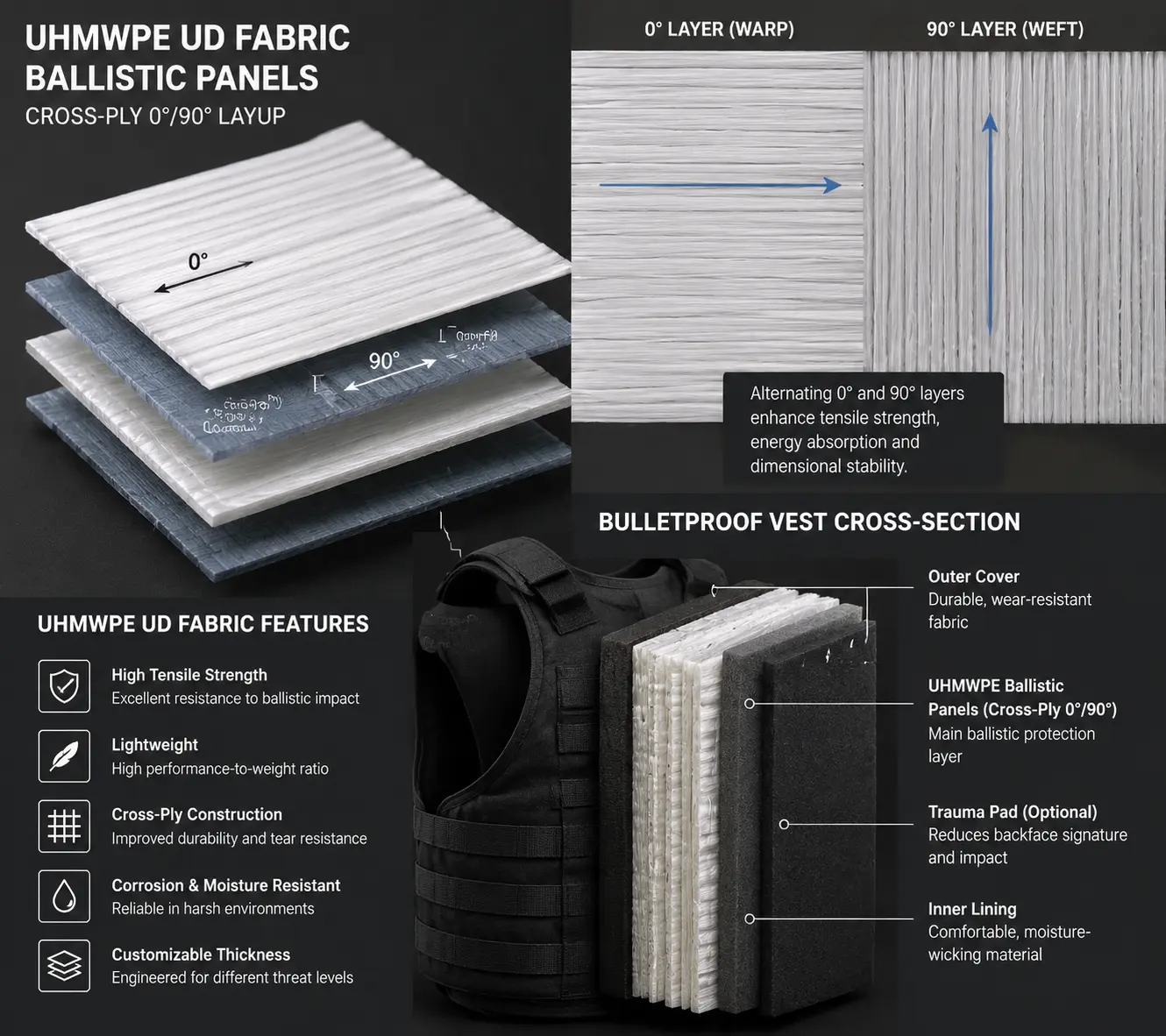
UHMWPE (Ultra-High Molecular Weight Polyethylene) has become the dominant fiber in modern body armor over the past decade. By 2023, nearly every major body armor brand had a UHMWPE UD product line, displacing woven aramid (Kevlar) as the default material for soft armor. The reason is simple: UHMWPE delivers NIJ Level IIIA protection at 25-40% lower weight than aramid, while being fully hydrophobic and chemically inert.
This guide covers everything a procurement manager, defense contractor, or body armor manufacturer needs to know: NIJ protection levels (0101.06 and the new 0101.07), UD fabric manufacturing process, Dyneema ballistic grade selection (SB/HB series), UHMWPE vs Kevlar comparison, fiber grade selection (SK75/SK78/SK99), and how to verify ballistic-grade UHMWPE when sourcing from Chinese manufacturers.
NIJ Body Armor Standards: 0101.06 vs 0101.07
The National Institute of Justice (NIJ) sets the performance standards that body armor must meet before U.S. law enforcement agencies will procure it. The current transition from Standard 0101.06 (2008) to Standard 0101.07 (December 2025) changes the naming convention but not the underlying physics.
| NIJ Level (0101.06) | New Name (0101.07) | Test Threat | Velocity (fps) | Hits | Armor Type |
|---|---|---|---|---|---|
| Level IIA | Phasing out | 9mm FMJ RN, .40 S&W FMJ | 1,165 (9mm) | Multiple | Soft (concealable) |
| Level II | HG1 | 9mm FMJ RN, .357 Magnum JSP | 1,305 (9mm) | Multiple | Soft (concealable) |
| Level IIIA | HG2 | .357 SIG FMJ FN, .44 Magnum SJHP | 1,470 (.357 SIG) | Multiple | Soft (duty standard) |
| Level III | RF1 | 7.62mm NATO M80 FMJ | 2,780 | 6 | Hard plate |
| — | RF2 (new) | RF1 + 5.56mm M855 green tip | ~3,000 | Multiple | Hard plate |
| Level IV | RF3 | .30-06 M2 Armor-Piercing | 2,880 | 1 | Hard plate (ceramic) |
Key insight for procurement: The new RF2 rating fills the gap that "Level III+" marketing claims previously occupied. If you need protection against M855 green tip (common in AR-15 platforms), specify RF2 or request special-threat testing documentation. Level III alone does not guarantee M855 defeat.
Why UHMWPE Works for Ballistic Protection
UHMWPE's ballistic superiority comes from its molecular architecture. Gel-spinning aligns polymer chains to over 95% crystallinity, producing fibers with tenacity of 35-42.5 cN/dtex — approximately 15× the specific strength of steel and 40% stronger than aramid on a weight-for-weight basis.
When a projectile strikes UHMWPE UD fabric, the energy dissipation mechanism differs fundamentally from woven aramid:
- No crimp points: In woven fabric (Kevlar), fibers pass over-and-under each other, creating microscopic bends that absorb energy unproductively. UD fabric has zero crimp — every fiber is perfectly straight, maximizing energy transfer along the fiber axis.
- Strain rate stiffening: UHMWPE exhibits increased stiffness under high strain rates (ballistic impact), meaning the fiber gets stronger the faster it is loaded — an ideal property for ballistic applications.
- Hydrophobic surface: 0% moisture absorption means ballistic performance is identical in dry desert and tropical monsoon conditions. Aramid absorbs 3-7% moisture by weight, which degrades ballistic performance when wet.
- Low density (0.97 g/cm³): UHMWPE floats on water. For marine and amphibious operations, this means the vest does not become a liability in water crossings.
UD Fabric Manufacturing: 5-Step Process
The manufacturing process for UHMWPE UD (Unidirectional) ballistic fabric directly determines its protective performance. Understanding this process is critical for factory audits and quality verification.
Step 1: Fiber Production (Gel-Spinning)
UHMWPE resin with molecular weight of 3-7 million g/mol is dissolved in a solvent (decalin or paraffin oil) at 130-150°C, then extruded through spinnerets into a coagulation bath. The gel filaments are drawn at ratios of 20-100×, aligning the polymer chains to achieve the final tenacity. This is the same process that produces SK75, SK78, and SK99 fiber grades.
Step 2: Unidirectional Alignment (0°)
UHMWPE yarn (typically 400D-1600D) is spread into a thin, flat tape and wound onto a rotating drum with all fibers aligned at exactly 0°. Tension monitoring is critical — misalignment greater than 2° reduces directional ballistic efficiency by up to 15%. This creates a single-ply UD sheet with strength concentrated entirely along the fiber axis.
Step 3: Pre-Impregnation (Resin Coating)
The UD sheet is coated with a water-based thermoplastic resin (binder content typically 5-15%). The resin serves three functions: bonds filaments within the yarn, creates a handleable sheet, and distributes impact energy across a wider area during a ballistic event. The resin formulation is proprietary to each manufacturer and significantly affects flexibility and ballistic efficiency.
Step 4: Cross-Ply Lamination (0°/90° = 2UD)
A single 0° layer has no strength in the cross direction. To create an isotropic ballistic material, a second UD sheet is rotated 90° and laminated to the first, forming a "2UD" cross-ply. This 0°/90° configuration is the fundamental building block of all UD-based armor. Typical areal density per 2UD layer: 130-160 g/m².
Step 5: Multi-Ply Stacking and Hot Pressing
For soft armor (NIJ IIA-IIIA), 20-40 layers of 2UD are stacked and edge-sewn into a flexible panel. For hard armor (NIJ III-IV), 60-100+ layers are hot-pressed at 120-130°C and 60-200 bar for 30-60 minutes, creating a rigid monolithic plate. The pressure, temperature, and time cycle must be precisely controlled — air pockets or incomplete bonding create ballistic weak points.
| UD Structure | Ply Count | Areal Density (g/m²) | Flexibility | Typical Application |
|---|---|---|---|---|
| 2UD (Elite) | 2 layers | 35-75 | Maximum | VIP concealable vests, ballistic briefcases |
| 2UD (Standard) | 2 layers | 130-160 | High | NIJ IIIA police vests, tactical armor |
| 4UD | 4 layers | 200-240 | Moderate | Hard armor plates, shields |
| 6UD+ | 6+ layers | 320-520 | Rigid | Helmets, vehicle armor, rifle plates |
Dyneema Ballistic Grades: SB and HB Series
Dyneema (produced by Avient, formerly DSM) is the gold standard for UHMWPE ballistic fiber. The product portfolio includes over 40 grades, but ballistic applications use two families: SB (Soft Ballistic) for flexible vests and HB (Hard Ballistic) for rigid plates and helmets.
| Grade | Type | Key Properties | Primary Application |
|---|---|---|---|
| SB301 | Soft | Highest performance, lightest, most flexible | Premium soft armor vests |
| SB115 | Soft | High performance, lightweight, flexible | Concealable vests |
| SB117 | Soft | Optimized fragment + handgun performance | Military vests (frag + handgun) |
| SB252 | Soft | For POL (Purchase Order Logistics) requirements | Specialized procurement specs |
| HB210 | Hard | High performance, rigid resin | Vest inserts, shields, vehicle armor |
| HB212 | Hard | High performance, softer resin (more flexible) | Vest inserts |
| HB311 | Hard | High performance, stiffest resin | Ballistic helmets, shields, inserts |
| HB480 | Hard | Highest rifle protection (UD film) | Premium ballistic helmets |
| HB26 | Hard | Standard performance, rigid resin | Vest inserts, shields, platforms |
| MT220 | Soft | Anti-stab + handgun, thin | Dual-threat (stab + ballistic) vests |
Grade selection rule: SB grades use flexible resin systems that allow the panel to drape and conform to body contours. HB grades use rigid resin systems that hold shape under impact. The resin system — not just the fiber — determines whether a panel qualifies for soft or hard armor applications.
UHMWPE vs Kevlar (Aramid): Full Comparison
The shift from aramid to UHMWPE in body armor happened between 2018-2023. Understanding why manufacturers switched requires a property-by-property comparison.
| Property | UHMWPE (Dyneema/Spectra) | Aramid (Kevlar/Twaron) | Advantage |
|---|---|---|---|
| Density | 0.97 g/cm³ (floats) | 1.44 g/cm³ | UHMWPE 33% lighter |
| Tenacity | 35-42.5 cN/dtex | 22-25 cN/dtex | UHMWPE 40%+ stronger |
| Tensile modulus | 109-159 GPa | 70-112 GPa | UHMWPE stiffer |
| Moisture absorption | ~0% (hydrophobic) | 3-7% | UHMWPE — no performance loss when wet |
| Heat tolerance | Softens 135-145°C | Degrades >400°C | Aramid — far superior |
| UV resistance | Good (requires stabilizer) | Poor (up to 25% strength loss) | UHMWPE |
| IIIA areal density | 3.6-5.6 kg/m² | 6-8 kg/m² | UHMWPE 25-40% lighter |
| Backface deformation (BFD) | Higher (needs more thickness) | Lower (thinner stacks) | Aramid — better BFD control |
| Multi-hit performance | Good | Excellent | Aramid |
| Flexibility (woven) | Moderate (UD is stiffer) | Excellent | Aramid — better drape |
| Stab/edge resistance | Fair (surface slippage) | Good | Aramid |
| Shelf life | 5-10 years | 5-10 years | Tie |
| Raw material cost | Higher | Moderate | Aramid — cheaper fiber |
| System cost (vest level) | Lower (less material needed) | Higher (more layers needed) | UHMWPE — often cheaper system |
Bottom line: UHMWPE wins decisively on weight, moisture resistance, and UV stability. Aramid wins on heat tolerance, multi-hit performance, and BFD control. For most law enforcement and military applications where weight and humidity are primary concerns, UHMWPE is the better choice. For high-temperature environments (vehicle engine compartments, foundry security) or applications requiring maximum multi-hit tolerance, aramid remains relevant.
Fiber Grade Selection: SK75 vs SK78 vs SK99
The UHMWPE fiber grade used in UD fabric affects ballistic performance, cost, and long-term reliability. The three primary grades have distinct roles in ballistic applications:
| Property | SK75 | SK78 | SK99 |
|---|---|---|---|
| Tenacity | 35.1 cN/dtex | 35.1 cN/dtex | 42.5 cN/dtex |
| Modulus | 1,090 cN/dtex | 1,090 cN/dtex | 1,590 cN/dtex |
| Creep rate (30°C, 300 MPa) | 0.02%/day | 0.006%/day (70% less) | 0.006%/day |
| Ballistic role | Standard duty vests, cost-effective | Premium vests, long-term load bearing | Ultra-lightweight tactical, special forces |
| Cost premium | Baseline | +15-20% | +30-40% |
Procurement guidance: For NIJ IIIA soft armor vests that officers wear 10-12 hours daily, SK78 is the recommended grade — its 70% lower creep rate means the panel maintains ballistic integrity longer under sustained body weight and movement. SK75 is acceptable for budget-sensitive programs with 5-year replacement cycles. SK99 is justified only when weight savings of 10-15% per panel provide operational advantage (special operations, aviation security).
Application Selection Matrix
Different body armor applications demand different UHMWPE configurations. This matrix maps 8 common applications to their optimal material specifications:
| Application | NIJ Level | UD Grade | Fiber Grade | Areal Density | Key Requirement |
|---|---|---|---|---|---|
| Concealable LE vest | IIIA (HG2) | SB301 or SB115 | SK78 | 3.6-4.5 kg/m² | Thin profile, flexibility |
| Duty vest (patrol) | IIA-II (HG1) | SB115 | SK75 | 2.5-3.5 kg/m² | Cost-effective, 8+ hr comfort |
| Military vest (frag + handgun) | IIIA + frag | SB117 | SK78 | 4.5-5.6 kg/m² | Fragment protection (V50) |
| Ballistic helmet | III (RF1) frag | HB311 or HB480 | SK78 | 8-12 kg/m² | Rigidity, multi-hit, weight |
| Hard rifle plate (standalone) | III (RF1) | HB210 or HB26 | SK75/SK78 | 18-25 kg/m² | Rifle defeat, 6-hit capability |
| Vehicle door armor | III-IV | HB210 | SK75 | 15-24 kg/m² | Spall containment, large format |
| Ballistic shield | IIIA-III | HB210 or HB212 | SK75 | 5-15 kg/m² | Multi-hit, viewport integration |
| Ballistic briefcase/backpack | IIIA (HG2) | SB301 | SK99 | 3.6-4.0 kg/m² | Ultra-thin, concealed |
8 Red Flags When Sourcing Ballistic-Grade UHMWPE
The B2B market — particularly Chinese suppliers on Alibaba and trade shows — is flooded with "Dyneema-equivalent" UHMWPE that may not meet ballistic specifications. Here are 8 red flags that should trigger additional due diligence:
- "Dyneema-equivalent" or "Dyneema-type" labels: Generic HMPE produced by standard extrusion achieves only 80-85% of gel-spun Dyneema's tenacity and has significantly higher batch-to-batch variation (up to 22% breaking strength variation vs <10% for Dyneema). Request Dyneema fiber certificates with batch numbers traceable to Avient/DSM.
- No NIJ CPL listing number: The NIJ Compliant Products List (CPL) is public. If the supplier claims NIJ certification but cannot provide a CPL model number, the claim is unverified. Check the NIJ CPL database directly.
- No Backface Deformation (BFD) data: BFD measures how far the vest indents into the body on impact — excessive BFD causes internal injury even when the bullet is stopped. NIJ 0101.06 limits BFD to 44mm. Request BFD test reports from an accredited lab (HP White, NTS Chesapeake, or equivalent).
- Single-batch test reports: A single ballistic test pass proves nothing about consistency. Require test reports from at least 3 production batches spanning 6+ months. Ballistic performance variation between batches should be <5% in V50 values.
- No environmental conditioning data: NIJ 0101.06 requires conditioned armor testing (24 hours at 65°C, 80% RH, followed by tumbling). If the supplier only provides unconditioned test data, real-world performance in hot/hum climates is unverified.
- Resin content not disclosed: Resin (binder) content typically ranges 5-15% by weight. Too little resin causes delamination; too much reduces ballistic efficiency. If the supplier cannot specify resin content and type, their QC process is insufficient.
- No V50 ballistic limit data: V50 is the velocity at which 50% of projectiles penetrate. This is the standard metric for comparing ballistic materials. A supplier that only provides "pass/fail" NIJ results without V50 data is hiding performance margin information.
- Folded packaging: UHMWPE UD panels stored folded for extended periods develop permanent creases where the polymer film binder creeps. Panels arriving folded in packaging should be allowed to relax at room temperature for 24-48 hours before use. Reputable manufacturers ship flat or rolled.
5-Step Quick Decision Tree
- What threat level? Handgun only → soft armor (SB grades). Rifle → hard plates (HB grades). Armor-piercing → ceramic + UHMWPE backing (Level IV/RF3).
- What environment? Hot/humid (tropical, maritime) → UHMWPE (0% moisture). High temperature (>80°C sustained) → aramid or aramid/UHMWPE hybrid. UV exposure → UHMWPE with UV-protective carrier.
- What wear duration? 8+ hours daily → SK78 (low creep, maintains performance under sustained load). Occasional use → SK75 (cost-effective). Special operations → SK99 (ultra-lightweight).
- What budget tier? Budget → SK75 + SB115. Standard → SK78 + SB301. Premium → SK99 + SB301 or HB480.
- What certification is required? NIJ 0101.06 (current CPL) → check model number. NIJ 0101.07 (new) → HG1/HG2/RF1/RF2/RF3. NATO STANAG 2920 → request V50 data. GA141 (China) → separate standard.
Cost Considerations: Fiber vs System
While UHMWPE raw fiber costs 20-40% more than aramid per kilogram, the system-level cost often favors UHMWPE. A NIJ IIIA vest using UHMWPE UD requires fewer layers (20-30 vs 30-40 for aramid), less cutting waste, and lighter carrier fabric. The 25-40% weight reduction also lowers shipping costs and improves end-user compliance — a vest that gets worn is more cost-effective than a cheaper vest left in a locker.
For MOQ considerations, UHMWPE UD fabric typically requires minimum orders of 500-1,000 m² for custom configurations, while standard SB/HB grades may be available in smaller quantities from stock.
Frequently Asked Questions
Can UHMWPE armor be repaired after a hit?
No. Any UHMWPE panel that has stopped a bullet must be replaced, even if no visible damage extends beyond the impact point. The internal fiber layers delaminate in a cone pattern extending 50-100mm from the impact center. Continued use of a struck panel provides no reliable protection.
Does UHMWPE armor expire?
Yes. UHMWPE ballistic panels carry a manufacturer expiration date, typically 5-10 years from manufacture. The primary degradation mechanism is not the fiber itself (which is chemically stable) but the resin binder, which can embrittle or creep over time. Always check the date-stamped label and replace expired panels.
How should UHMWPE armor be stored?
Store flat (never folded) at temperatures below 65°C and away from direct UV exposure. Avoid storage in vehicle trunks in summer (interior temperatures can exceed 70°C). If panels arrive folded, allow 24-48 hours at room temperature to relax before use.
Need ballistic-grade UHMWPE UD fabric or finished armor panels? Contact TMG Webbing — we work with Dyneema SK75/SK78/SK99 fiber and produce UD fabric to NIJ, GA141, and STANAG 2920 specifications. We provide full test reports (V50, BFD, conditioned), batch traceability, and NIJ CPL documentation.
Continue reading: SK75 vs SK78 vs SK99 UHMWPE Fiber Guide · Dyneema vs Aramid: Strength, Weight & Price · Kevlar vs Dyneema: Heat, Buoyancy & Strength · UHMWPE Webbing vs Steel Cable · How to Identify Quality UHMWPE Webbing · How to Read a Webbing Test Report · Factory Inspection Checklist · Military IRR Webbing Guide · Mil-Spec Color Standards