
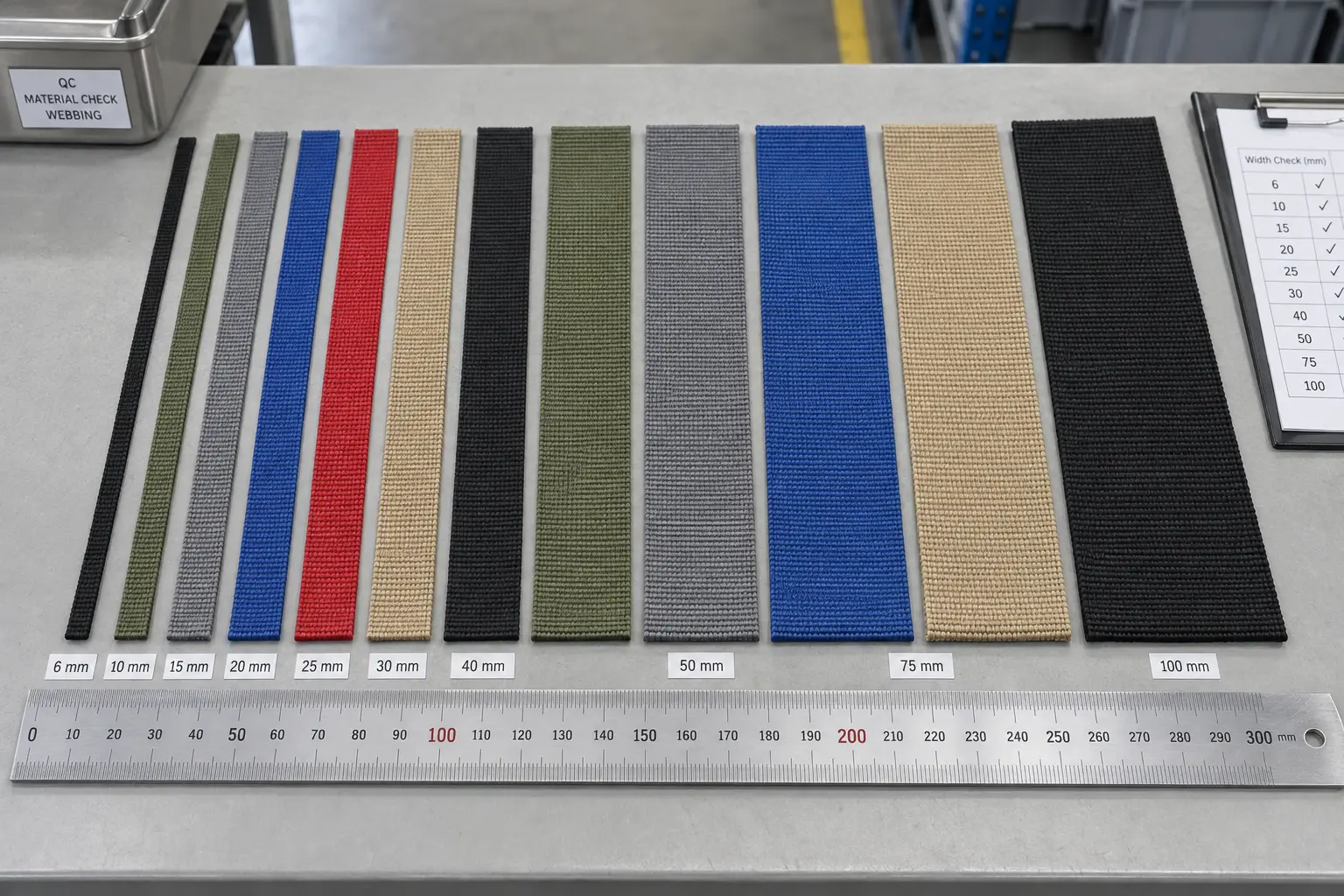
Ask two suppliers for "1-inch webbing" and you may receive 25 mm from one and 25.4 mm from the other. Both are right, both are called 1 inch, and both may or may not fit the buckle you already sourced. Width is the single most quoted dimension in a webbing specification — and the one most often specified carelessly, costing brands weeks of rework when straps arrive that will not thread through their hardware.
This guide covers everything a product developer or procurement manager needs to specify width correctly: the metric-to-inch chart that mills actually work in, how much breaking strength really scales with width, how to match webbing to buckles and tri-glides, realistic production tolerances, recommended widths by end use, and what happens when you need a size nobody stocks. If you are still deciding the material itself, start with the nylon vs polyester tensile comparison before locking the width.
The Webbing Width Chart: Millimetres and Inches
The industry runs on two systems at once. Asian and European mills quote millimetres; North American brands often design in inches. The table below lists the widths that actually exist as production standards, so you can specify a size that any competent factory can weave without a custom setup.
| Nominal Width (mm) | Nominal Width (in) | Common Industry Name | Typical Use |
|---|---|---|---|
| 6 mm | 1/4" | Light binding / drawcord tape | Garment drawcords, light bag pulls, price tickets |
| 10 mm | 3/8" | Narrow strap tape | Hat bands, small pet harness trim, light webbing loops |
| 13 mm | 1/2" | Standard light strap | Cat collars, light camera straps, child-size adjusters |
| 16 mm | 5/8" | Light-mid strap | Small dog collars, wrist straps, roll-top bag closures |
| 19-20 mm | 3/4" | Most popular narrow strap | Medium dog collars, leashes, daypack sternum straps |
| 25-25.4 mm | 1" | The industry default | MOLLE/PALS, belts, backpack straps, tactical gear, tie-downs |
| 32 mm | 1-1/4" | Mid strap | Large dog collars, gun slings, duty belts |
| 38 mm | 1-1/2" | Heavy strap | Backpack shoulder straps, woven belts, cargo straps |
| 47 mm | approx. 1-7/8" | Automotive seat belt width | Seat belt replacement webbing, industrial restraint |
| 50 mm | 2" | Standard cargo width | Ratchet tie-downs, ratchet straps, heavy-duty lashing |
| 75-76 mm | 3" | Wide cargo / sling | Flat slings, lift straps, wide belt backs |
| 100 mm + | 4" + | Industrial sling width | Lifting slings, cargo nets, fall-protection harness webbing |
Width vs Strength: How Much Strength Do You Gain?
Within one construction — same yarn, same weave, same finishing — breaking strength scales roughly linearly with width, because a wider webbing simply contains more load-bearing warp yarns. Doubling the width roughly doubles the strength. But this rule breaks the moment any other variable changes, which is why two webbings of the same width can differ by 300% in strength.
The reference ranges below assume a standard plain-weave nylon 6.6 construction. Use them for sanity checks only — your actual figure must come from a measured test report, not from this table.
| Width | Polyester, Typical Range | Nylon 6.6, Typical Range | Approx. Cost Trend |
|---|---|---|---|
| 13 mm | 1.5-2.5 kN | 2.0-3.5 kN | Low |
| 20 mm | 2.5-4.5 kN | 3.5-6.0 kN | Low-Mid |
| 25 mm | 3.0-5.5 kN | 4.5-8.0 kN | Mid |
| 38 mm | 5.0-8.5 kN | 7.0-12.0 kN | Mid |
| 50 mm | 7.0-11.0 kN | 9.0-16.0 kN | Mid-High |
| 75 mm | 10.0-16.0 kN | 13.0-23.0 kN | High |
Note what the cost column does not say: cost per metre rises almost in step with width, because you are buying more yarn. Doubling width nearly doubles yarn consumption. This is why the smart comparison is not price per metre but price per unit of strength — a narrow, high-denier webbing can deliver the same kN at lower weight, lower bulk, and sometimes lower cost than a wide commodity webbing. Use the webbing strength calculator to model before you commit.
Recommended Width by Application
When a buyer asks "what width should I use?", the honest answer depends on the hardware ecosystem the product lives in. The following map reflects what actually ships in volume:
| Application | Recommended Width | Why This Width | Related Guide |
|---|---|---|---|
| Small pet collars & cat harnesses | 10-16 mm | Weight of the buckle must stay proportional to animal size | Dog collar webbing guide |
| Medium & large dog collars | 20-25 mm | Standard hardware sizes exist everywhere; comfortable edge pressure | Bulk dog collar webbing |
| Dog leashes | 20-25 mm | Must survive sudden loading; wider distributes pulling force | Pet webbing guide |
| Daypack & hydration straps | 20-25 mm | Fits standard ladderlocks and sternum buckles | Bag strap webbing |
| Backpack shoulder straps | 38 mm | Spreads load across the shoulder; padding sleeves are cut to this size | Bag strap guide |
| Woven & braided belts | 32-38 mm | Fits belt loops and standard buckle frames | Belt material types |
| MOLLE / PALS systems | 25.4 mm nominal | Must thread through sewn rows; check the current spec drawing | MIL-W-4088 webbing |
| Gun slings | 25-32 mm | Balances shoulder comfort against swivel hardware size | Mil-spec standards |
| Cargo & ratchet tie-downs | 25-50 mm (2" for heavy loads) | Ratchet hardware is built around 1" and 2" sizes | Flat vs tubular webbing |
| Rooftop tents & outdoor covers | 25-38 mm | UV-resistant polyester typical; must match cam buckles | Rooftop tent webbing |
| Climbing slings & runners | 16-25 mm tubular | Must meet EN 565 and UIAA requirements — never substitute | Climbing webbing guide |
| Automotive seat belt webbing | 47 mm nominal | Regulatory fits and retractor compatibility define this size | Read a test report |
Matching Webbing Width to Hardware
Buckles, D-rings, tri-glides, and cam buckles are made by the webbing width they accept. A "25 mm" side-release buckle expects a 25 mm strap, but the slot has a real internal height and width — and a thick, heavy-weave webbing at the correct nominal width still may not feed through. This single issue causes more assembly-line problems than any strength question.
| Hardware Type | Sizing Rule | Failure Mode If Wrong |
|---|---|---|
| Side-release buckle (POM) | Nominal match; 0.5-1 mm side clearance | Strap jams in the slot or pulls out under load |
| Tri-glide / slide adjuster | Nominal match; webbing must slide freely by hand | Strap will not adjust, or slips instead of holding |
| Cam buckle | Nominal match plus check webbing thickness | Cam teeth crush the webbing or fail to bite |
| D-ring / rectangular ring | Ring internal width ≥ webbing width + 1 mm | Webbing bunches, creating a weak folded edge |
| Ratchet buckle | Width-specific by design (usually 25 or 50 mm) | Eccentric cannot grip; strap shreds under tension |
The fix is cheap and takes ten minutes: send physical samples of your chosen webbing to your hardware supplier, or vice-versa, and assemble a wet prototype before you cut production fabric. See the webbing hardware guide for slot tolerance details and the POM load-bearing buckle guide for strength limitations of plastic hardware.
Production Tolerance: What Actually Counts as In-Spec
Woven fabric moves. Width measured hot off the loom differs from width measured after dyeing and finishing, and it differs again depending on whether the tape is measured flat under tension or relaxed. The ranges below are what most commercial programmes accept when the drawing does not state otherwise.
| Width Range | Standard Commercial Tolerance | Tight Tolerance (surcharge) |
|---|---|---|
| Up to 25 mm | ±0.5 mm | ±0.25 mm |
| 26-50 mm | ±1.0 mm | ±0.5 mm |
| 51-100 mm | ±1.5 mm | ±0.75 mm |
| Above 100 mm | ±2.0 mm | ±1.0 mm |
Military and automotive specifications state their own narrower limits — always work from the applicable drawing rather than assuming commercial tolerance. Requesting tighter tolerance than you functionally need is one of the costliest habits in webbing purchasing: it slows the loom, raises rejection rates, and adds nothing the end user notices. Verify measurements the same way your factory does, as described in the test report guide.
When "Width" Means Something Different
Some constructions break the basic definition, and specifying them without knowing this leads to parts that do not fit:
- Tubular webbing is quoted by nominal (rounded) width, not flat width. A nominal 25 mm tubular webbing measures wider when laid flat — roughly 1.6 times its nominal size — because you are seeing a flattened tube, not a flat tape. If your design slots it through hardware, measure the flattened dimension yourself. See the flat vs tubular comparison.
- Elastic webbing changes width and length under tension, and narrows as it stretches. Specify at the relaxed state and test at working extension. Details in the elastic webbing guide.
- Heavyweight and high-denier webbing is often thicker rather than wider; thickness affects loom class and price far more predictably than width does.
- UHMWPE and aramid webbing can hit the strength of much wider commodity tape at a narrower width — a genuine route to lighter, lower-bulk products, though at higher cost per metre. See the UHMWPE fibre grade guide.
- Cut edges versus woven edges differ slightly at the selvedge; a heat-cut or ultrasonically cut tape can fringe or swell marginally, changing how it feeds through tight hardware.
Custom Widths: What It Costs and How Long It Takes
Most widths between roughly 10 mm and 100 mm are not "custom" in the expensive sense — the loom needs a different reed, which is a setup change rather than new tooling. Real constraints appear at the extremes and in scheduling:
- Below about 8-10 mm, you move onto needle looms intended for binding tapes and drawcords; fewer factories run these in high volume.
- Above roughly 100 mm, heavy shuttle looms are required, which restricts the supplier pool and lengthens lead time.
- Non-stock widths carry higher MOQ, typically 3,000-5,000 m, because the factory cannot splice your order into an existing reed setup running this week.
- Jacquard or printed versions of an unusual width need their own artwork setup on top of the width change — see the full process in the custom OEM ordering guide.
Check realistic minimum quantities in the MOQ guide and unit-price expectations in the pricing guide before finalising a width nobody else stocks. Often a 1-2 mm shift to a standard size saves both money and a week of lead time.
7 Width-Selection Mistakes That Cost Money
- Designing in inches and buying in millimetres with no conversion tolerance stated — then discovering the "1-inch" tape is 25 mm, not 25.4 mm, and jams the adjuster.
- Specifying width instead of strength. Width is a dimension; strength is a test result. Always specify both, minimum breaking strength first.
- Ignoring thickness. Two webbings can be identical in width, and only one will pass through the buckle.
- Choosing the widest cheap option instead of comparing price per kN — heavier, bulkier, and often not cheaper.
- No hardware fit test before production. Always build a physical prototype from the exact production webbing.
- Requesting tolerances tighter than function requires, which drives cost up with no user-visible benefit.
- Forgetting that dyeing and finishing change width — approve based on a finished sample, not a grey goods offcut.
Not Sure Which Width Your Product Needs?
TMG Webbing weaves 6 mm to 100 mm+ in nylon, polyester, PP, UHMWPE, aramid, and recycled rPET, with in-house dyeing and batch-level test reports. Send your hardware drawing, target breaking strength, and estimated annual quantity — our engineering team will recommend a stock or custom width, quote honestly, and ship physical samples within 48 hours.
Request Width Recommendation Talk to an EngineerFrequently Asked Questions
What is the most common webbing width?
25 mm (1 inch) is by far the most produced width worldwide — it fits standard hardware, suits most straps, and runs on nearly every narrow fabric loom. Other high-volume widths are 20 mm (3/4 inch) for light straps and pet products, 38 mm (1.5 inch) for bag straps and belts, 50 mm (2 inch) for cargo tie-downs, and 47 mm nominal for automotive seat belt webbing.
How do I convert webbing width from inches to millimeters?
Multiply inches by 25.4. Common conversions: 1/2 inch = 12.7 mm, 3/4 inch = 19 mm, 1 inch = 25.4 mm, 1.5 inch = 38 mm, 2 inch = 50 mm, 3 inch = 76 mm. In practice the industry rounds these: 3/4 inch is usually quoted as 19 or 20 mm, and 1 inch as 25 or 25.4 mm. Always specify both units on your drawing.
Does wider webbing mean stronger webbing?
Yes, but only within the same construction — doubling the width of an identical weave and yarn roughly doubles breaking strength. Width alone never predicts strength: a 25 mm heavy-weave UHMWPE webbing can outperform a standard 38 mm polyester webbing. Always compare the measured breaking strength on the test report, not the width on the drawing.
What width tolerance should I accept for custom webbing?
Typical commercial tolerances are ±0.5 mm up to 25 mm, ±1.0 mm for 26-50 mm, and ±1.5 mm above 50 mm unless your drawing states otherwise. Tighter tolerances are achievable but raise cost. Military specifications define their own limits — check the applicable drawing rather than assuming the commercial default.
How do I know which buckle width to buy for my webbing?
Match the nominal size first, then always test physically. The webbing must pass through the hardware slot with about 0.5 to 1 mm of side clearance — tight enough not to twist, loose enough to slide under load. Thick or heavy-weave webbing often fails even at the correct nominal width, especially with POM side-release and cam buckles.
Can a factory make a non-standard webbing width?
Yes. Any width between roughly 10 mm and 100 mm can usually be woven on existing looms by changing the reed, which is low-cost setup rather than new tooling. Below about 8 mm you need needle looms for binding tapes, above 100 mm heavy shuttle looms. Expect higher MOQ for non-stock widths, typically 3,000-5,000 m.
What width is MOLLE and PALS webbing?
MOLLE and PALS systems use nominally 1 inch (25.4 mm) webbing with defined row spacing, because pouch attachment straps must thread through those rows. Consistency matters more than absolute strength: if the webbing is too thick or too stiff, the strap will not thread. Always verify against the current specification drawing and your chosen hardware.