
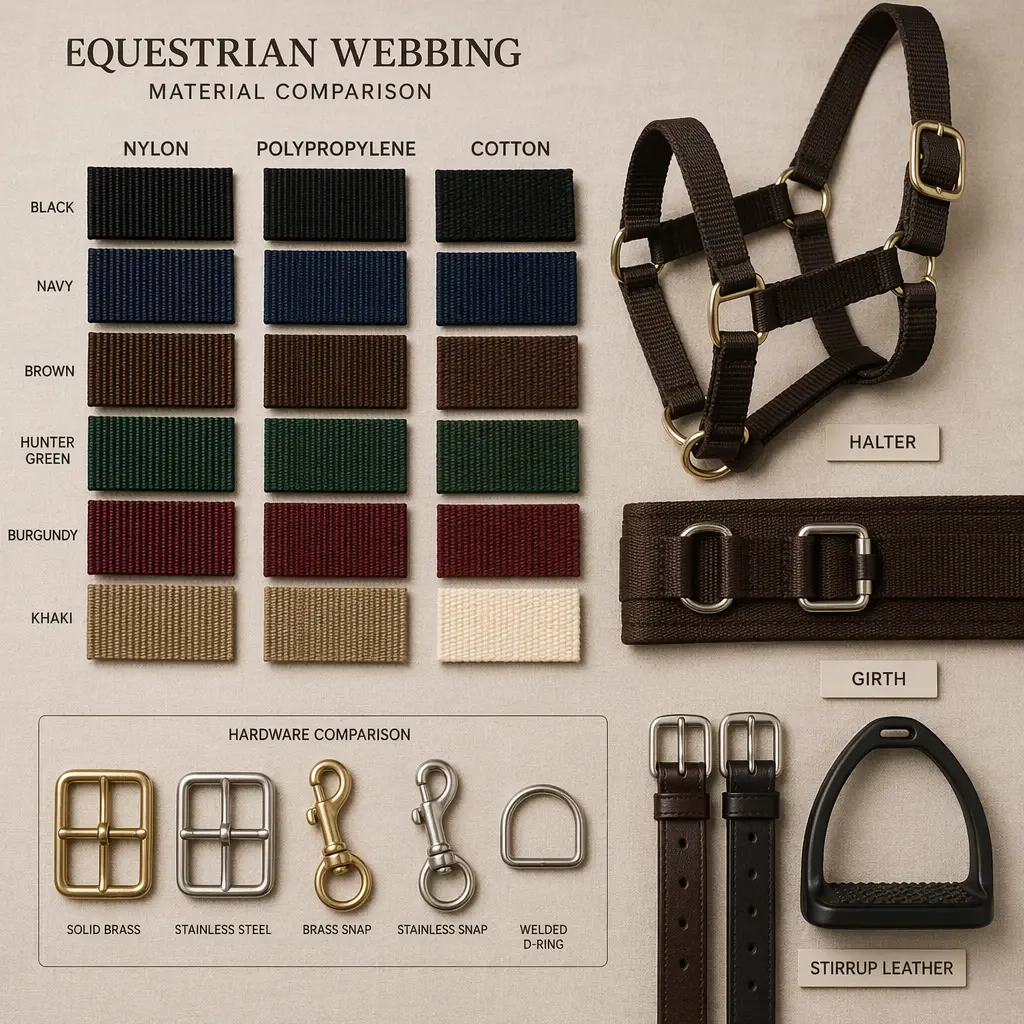
Equestrian equipment faces a unique combination of stresses that no other webbing application encounters: constant exposure to acidic horse sweat (pH 4.5–6.0), dynamic shock loads from a 500 kg animal in motion, repeated stretching and releasing under girth tension, and long-term UV exposure during outdoor riding and pasture turnout. The webbing material you choose for each piece of horse tack — halter, girth, billet, stirrup leather, or rein — determines not just durability and cost, but the horse's comfort and the rider's safety.
This guide compares the three webbing materials most commonly used in equestrian equipment — nylon, polypropylene, and cotton — with specific data on breaking strength by width, sweat absorption, stretch behavior, mildew susceptibility, and cost. It also covers polyester and PVC-coated (BioThane®) alternatives, application-by-application recommendations, and the red flags that separate a knowledgeable equestrian webbing supplier from a generic manufacturer.
Material Comparison: 7 Metrics That Matter for Horse Tack
Horse tack webbing must perform across seven key metrics that are specific to the equestrian environment. Here is the head-to-head data:
| Property | Nylon | Polypropylene | Cotton | Polyester | PVC-Coated (BioThane®) |
|---|---|---|---|---|---|
| Sweat / moisture absorption | 4–8% by weight | < 0.5% (hydrophobic) | 20–25% by weight | < 1% | 0% (sealed coating) |
| Strength loss when wet (sweat-saturated) | 10–15% | < 3% | 20–30% | < 5% | 0% |
| Elongation at break | 20–30% (high stretch) | 15–20% | 5–8% (low stretch, dry) | 12–15% (low stretch) | Follows core material |
| Typical 25mm breaking strength | 1,200–2,500 kg | 400–800 kg | 300–500 kg | 1,500–3,000 kg | 500–1,200 kg (core-dependent) |
| Mildew resistance | Poor (absorbs sweat → mildew) | Excellent | Very poor (organic fiber) | Excellent | Excellent |
| Hand feel / grip when wet | Slippery when wet | Slippery | Excellent grip | Moderate | Grippy (matte finish) |
| Relative cost (25mm, per 100m) | High | Low | Mid | Mid | Premium |
Nylon — Strong but Sweat-Sensitive
Nylon is the default webbing material for horse halters, leads, and many Western cinch straps. Its dry breaking strength is the highest among the three (1,200–2,500 kg for 25mm), and its abrasion resistance is excellent — a nylon halter that rubs against a fence post or stall wall will survive far longer than a polypropylene one.
The problem is horse sweat. Nylon's amide groups form hydrogen bonds with water molecules, which physically displace the polymer chains. A nylon girth or cinch that is sweat-saturated absorbs 4–8% of its weight in moisture and loses 10–15% of its dry breaking strength. It also stretches further under load — a nylon cinch tightened before a ride may loosen 20–30 minutes later as the webbing absorbs sweat and relaxes. This is why experienced riders re-tighten nylon cinches after the first 10 minutes of work.
Nylon is also susceptible to mildew. Horse sweat contains salts, proteins, and lipids that create an ideal substrate for fungal growth. A nylon halter stored damp in a tack room (30°C, high humidity) can develop visible mildew within 48–72 hours. The mildew does not directly attack nylon polymer, but the trapped moisture accelerates degradation at the fiber surface and creates odor and skin irritation issues for the horse.
Polypropylene — Budget Option with Limitations
Polypropylene (PP) is the cheapest webbing option for equestrian use — roughly half the cost of nylon per meter. It is completely hydrophobic, absorbing less than 0.5% moisture, so sweat has virtually no effect on its breaking strength or dimensional stability. PP is also inherently mildew-resistant, making it a practical choice for halters and leads used in humid climates.
The trade-offs are significant. A 25mm PP webbing typically breaks at 400–800 kg — roughly one-third to one-half of equivalent nylon. PP has lower abrasion resistance, a lower melting point (~165°C, relevant near hot trailer floors), and a slippery surface that makes it harder to grip when wet. For light-duty applications (trail halters, breakaway halter straps, training leads), PP's strength is adequate. For anything involving dynamic loads (cinches, girths, longeing lines), PP is not strong enough for safe use.
Cotton — Traditional Comfort, Modern Vulnerability
Cotton webbing has a centuries-long tradition in equestrian equipment, particularly for reins, driving lines, and English girth liners. Its primary advantage is hand feel: cotton is soft, breathable, and provides excellent grip even when wet with sweat — a critical safety property for reins and driving lines where a slippery grip can cause loss of control.
The vulnerability is moisture. Cotton absorbs 20–25% of its weight in water, and horse sweat — being acidic — actively degrades cotton fibers through hydrolysis. A cotton rein used daily in summer riding can lose 20–30% of its dry strength within a single season of sweat exposure. Cotton is also the most mildew-susceptible of all webbing materials; organic cellulose fibers are a direct food source for fungal colonies.
In modern equestrian manufacturing, pure cotton webbing is increasingly replaced by cotton-polyester blends (typically 65% cotton / 35% polyester) that preserve the hand feel and grip of cotton while adding moisture resistance and 50–80% higher breaking strength. A 25mm cotton-polyester blend webbing typically achieves 500–800 kg breaking strength — still below nylon, but far above pure cotton's 300–500 kg.
Polyester and PVC-Coated Webbing: The Equestrian Alternatives
While nylon, polypropylene, and cotton are the three most traditional equestrian webbing materials, two alternatives are gaining significant market share in equestrian equipment manufacturing:
Polyester — Low Stretch, Low Absorption, High UV
Polyester absorbs less than 1% moisture and retains more than 90% of its breaking strength after prolonged sweat and UV exposure — the same properties that make it the gold standard for marine webbing. Its low elongation (12–15% at break) means a polyester girth or cinch maintains tension without the periodic re-tightening that nylon requires.
Polyester's limitation in equestrian use is hand feel. It is smoother and slightly more slippery than nylon, which is acceptable for girths and cinches (where grip is provided by hardware, not the webbing surface) but less desirable for reins and driving lines where the rider's hands must maintain constant contact. The higher cost (roughly 50% above nylon) also limits polyester to premium equestrian products.
PVC-Coated Webbing (BioThane®) — The Low-Maintenance Revolution
BioThane® — PVC-coated polyester webbing — has become the fastest-growing material in equestrian equipment. The PVC coating completely seals the polyester core from sweat, dirt, and moisture, making it effectively waterproof, mildew-proof, and maintenance-free. A BioThane® halter or girth can be rinsed clean with water and hung to dry — no conditioning, no mildew treatment, no stretch recovery.
The matte-finish PVC coating provides excellent grip even when wet, addressing polyester's main equestrian weakness. BioThane® is available in a wide range of colors, textures (matte, glossy, embossed), and widths (16mm–50mm), making it popular for halters, leads, girths, breastplates, and even stirrup leathers.
The trade-off: BioThane® is the most expensive option, at 2–3× the cost of bare nylon webbing per meter. And while the PVC coating is durable, it can crack or peel at fold points after 3–5 years of heavy use — a concern for girths and cinches that are repeatedly buckled and unbuckled at the same location.
Application-by-Application Webbing Selection Guide
Different horse tack items prioritize different webbing properties. Here is the recommended specification for each major application:
| Application | Recommended Material | Width | Min. Breaking Strength | Key Property |
|---|---|---|---|---|
| Horse halter (daily) | Nylon or BioThane® | 20–25 mm | 800 kg (8 kN) | Strength + abrasion resistance |
| Breakaway halter | Polypropylene (crown), nylon (cheeks) | 20–25 mm | 400 kg (4 kN) crown | Weaker crown for safety break |
| Lead rope / shank | Nylon | 20–25 mm | 800 kg (8 kN) | Strength for pull-back loads |
| English girth | Polyester or nylon with elastic ends | 25–38 mm | 1,500 kg (15 kN) | Low stretch + sweat resistance |
| Western cinch | Nylon or polyester, flat weave | 38–50 mm | 2,500 kg (25 kN) | Width for comfort + strength |
| Saddle billets (nylon-reinforced) | Nylon core in leather shell | 25–30 mm | 500 kg (5 kN) per billet | Stretch <1%, strength >1 ton/pair |
| Stirrup leathers | Nylon-reinforced leather or BioThane® | 38–50 mm | 250 kg (2.5 kN) each | No stretch for consistent length |
| Reins / driving lines | Cotton-poly blend or BioThane® | 16–25 mm | 500–800 kg | Grip when wet + comfort |
| Breastplate / martingale | Nylon or BioThane® | 20–25 mm | 800 kg (8 kN) | Adjustability + durability |
| Horse blanket strap | Polypropylene | 20–25 mm | 400–800 kg | Low cost + mildew resistance |
| Trailer tie / cross-tie | Nylon or polyester with panic snap | 25 mm | 1,500 kg (15 kN) | High strength for safety |
Saddle Billets: Where Stretch Is a Safety Issue
Saddle billets (also called girth straps) are the most safety-critical webbing application in equestrian equipment. They connect the girth to the saddle tree and bear the entire upward force generated by the rider's weight, the horse's motion, and any sudden shock loads (jumping, bucking, sudden stops). If a billet fails under load, the saddle separates from the horse — with potentially catastrophic consequences for both rider and horse.
The Stretch Problem with Traditional Leather Billets
Traditional all-leather billets stretch 5–7% over their lifespan. This stretch is uneven — the billet that is tightened first (typically the front one) stretches more than the others, creating asymmetric girth tension that can twist the saddle tree and create pressure points on the horse's back. Research confirms that uneven billet stretch is a leading cause of asymmetric saddle pressure distribution and associated muscle soreness.
Nylon-Reinforced Billets: The Modern Standard
Nylon-reinforced billets solve the stretch problem by embedding a nylon webbing core inside a leather shell. The nylon core limits total stretch to less than 1% over the billet's entire life, while the leather exterior maintains the traditional appearance and feel. A single nylon-reinforced billet has a tensile strength exceeding 500 kg (5 kN) — meaning a pair can withstand more than a ton of force. This is why modern saddle manufacturers increasingly specify nylon-reinforced billets as standard, particularly for high-performance and safety-critical saddles.
B2B sourcing note: When ordering nylon webbing for billet reinforcement, specify 25–30mm flat nylon with a certified breaking strength of at least 1,200 kg (12 kN) and elongation at break of 20–25%. The nylon core must be pre-stretched (5–10 cycles at 50% rated load) before assembly to eliminate initial creep. Request tensile test reports that include both dry and sweat-conditioned (24-hour pH 5.0 immersion) breaking strength values.
Girths and Cinches: The Sweat Zone
The girth or cinch sits directly against the horse's belly — the area with the highest sweat output during work. A 500 kg horse exercising at moderate intensity produces 8–12 liters of sweat per hour, and the girth absorbs this sweat continuously. Material selection for girth webbing is therefore dominated by two properties: moisture resistance and dimensional stability under wet conditions.
English Girths
English girths typically use 25–38mm webbing with elastic inserts at both ends. The elastic provides some stretch for comfort, but the main webbing body must not stretch further when wet — otherwise the girth loosens during the ride. Polyester is the best choice for the main body because it absorbs less than 1% moisture and maintains breaking strength. Nylon is acceptable but requires re-tightening after the first 10 minutes of work.
Western Cinches
Western cinches use wider webbing (38–50mm) for greater surface area and comfort. The wider width also distributes pressure more evenly, reducing the risk of girth galls (pressure sores) on the horse's underside. Nylon is the most common material for Western cinches, but polyester cinches are gaining popularity in premium products because they maintain tension without re-tightening.
Girth Elastic Webbing
English girth elastic — the stretchy strips inserted at each end of the girth — is a specialized narrow elastic webbing typically 20–25mm wide with 50–100% stretch. This elastic must retain its stretch properties after repeated sweat exposure and washing. Rubber-core elastic degrades in sweat and UV within 6–12 months; textile elastic (woven from elastic yarn) lasts 2–3 years under the same conditions.
Halters and Leads: Strength vs. Safety
Horse halters and lead ropes present a unique design tension: they must be strong enough to control a frightened 500 kg animal pulling back against a tie post, but they must also be breakable under extreme force to prevent the horse from injuring itself if it panics and fights the tie. This dual requirement is solved by the breakaway halter design.
Standard Halters (Nylon)
A standard nylon halter uses 20–25mm nylon webbing throughout, with breaking strength of 800–1,200 kg. This is strong enough for everyday handling, leading, and tying, but it will not break under panic loads — a horse that fights a nylon halter tied to a solid post can suffer neck injuries or strangle before the halter fails.
Breakaway Halters
Breakaway halters solve this by using a weaker crown piece (the strap over the poll) combined with stronger cheek pieces. The crown is typically made from polypropylene (breaking strength ~400 kg) or a thin leather strap, while the cheeks remain nylon. Under panic load, the crown breaks first, releasing the horse before injury occurs. The cheeks remain intact so the halter can be recovered and the crown replaced.
Lead Ropes and Shank Straps
Lead ropes must withstand the full pull-back force of a resistant horse. A horse pulling back against a tie post can generate 500–800 kg of force. Nylon webbing leads (20–25mm, 800+ kg breaking strength) are standard for this application. Polypropylene leads are used for training and light-duty work but are not safe for tying. Chain shanks (nylon webbing with a short chain section near the halter) provide additional control for difficult horses — the chain section adds a correction cue, while the nylon webbing provides the breaking strength needed for safe tying.
Reins and Driving Lines: Where Grip Saves Lives
Reins and driving lines are the only equestrian webbing application where the rider's hands are in continuous, direct contact with the webbing surface. Grip — especially wet grip — is the single most important property. A slippery rein during a fast gallop, a sudden spook, or a driving turn can result in loss of control and a serious accident.
Cotton Reins (Traditional)
Cotton webbing reins provide the best wet grip of any material. When soaked with sweat, cotton fibers swell slightly and create a textured, non-slip surface that many riders prefer. The downside: cotton absorbs 20–25% moisture, loses 20–30% strength when wet, and mildews rapidly. Laced cotton reins (cotton webbing with leather lacing along the edges) combine cotton's grip with leather's durability at the stress points.
Cotton-Polyester Blend Reins
65/35 cotton-polyester blend webbing preserves most of cotton's wet grip while adding 50–80% more breaking strength and significantly better moisture and mildew resistance. This is the most common modern material for English reins and driving lines. The polyester component reduces total moisture absorption to roughly 10–12%, and the blend achieves 500–800 kg breaking strength for 20mm width.
BioThane® Reins
BioThane® reins are increasingly popular for endurance riding, trail riding, and Western disciplines. The matte-finish PVC coating provides excellent grip even when wet, and the sealed surface means no sweat absorption, no mildew, and easy cleaning. BioThane® reins are also available in half-round (rounded cross-section) profiles that are more comfortable in the hand than flat webbing. The cost is 2–3× cotton-poly blend, but the maintenance-free longevity appeals to riders who ride daily in wet or dusty conditions.
Horse Sweat: The Chemistry That Destroys Webbing
Understanding why horse sweat is so destructive to webbing helps explain the material trade-offs throughout this guide:
| Sweat Property | Value | Effect on Webbing |
|---|---|---|
| pH | 4.5–6.0 (acidic) | Hydrolysis of cotton cellulose and nylon amide bonds |
| NaCl content | 0.5–1.0% | Salt crystals abrade fibers after drying; corrosive to hardware |
| Protein content | Albumin, globulin | Substrate for mildew growth on organic fibers |
| Lipid content | Sebum oils | Oils coat fibers, reducing grip; attract dirt |
| Volume (working horse) | 8–12 L/hour | Saturates cotton and nylon within 15–30 minutes of work |
This is why hydrophobic materials (polypropylene, polyester, PVC-coated) have an inherent advantage in girths and cinches — they simply do not absorb the sweat that degrades nylon and cotton. And it is why cotton-polyester blends outperform pure cotton in reins — the polyester component reduces total moisture absorption and slows the hydrolysis attack.
6 Red Flags When Sourcing Equestrian Webbing
- "Equestrian-grade" without sweat test data. "Equestrian grade" is a marketing term, not a standard. If the supplier cannot produce breaking strength data after pH 5.0 immersion conditioning (simulating horse sweat), the claim is meaningless. Ask specifically for wet/sweat-conditioned test results, not just dry breaking strength.
- Offering nylon girth webbing without a stretch warning. A responsible equestrian webbing supplier knows that nylon stretches when wet. If they recommend nylon for girths without explaining the re-tightening requirement and the 10–15% wet strength loss, they don't understand equestrian applications.
- Cotton webbing without mildew treatment. Pure cotton webbing stored in a humid tack room will mildew within days. If the supplier sells cotton webbing for equestrian use without mildew-resistant treatment or a recommendation for cotton-polyester blend, they are creating a product that will fail in real-world conditions.
- No width-specific breaking strength data. Equestrian webbing spans from 16mm (reins) to 50mm (cinches). A supplier who only provides one breaking strength number (e.g., "1,500 kg") without specifying the width it was tested at is either incompetent or misleading. Breaking strength scales roughly linearly with width — ask for data at every width you plan to order.
- BioThane®-type coating without peel resistance data. PVC coatings on webbing can crack and peel at fold points. If the supplier claims PVC-coated equestrian webbing but cannot provide flex-cycle test data (how many buckling cycles before the coating cracks), assume their coating will fail at girth buckle points within 2–3 years.
- No hardware compatibility testing. Equestrian webbing must work with specific hardware — buckles, D-rings, snap hooks, and billet holes. The supplier should have tested their webbing sewn to the hardware you plan to use, with test reports for the full assembly. Webbing that is strong in isolation can fail at a poorly specified buckle or stitch point. See our guide on factory inspection for more on hardware quality verification.
Quick Decision Matrix: Equestrian Material Selection
| If your priority is... | Choose... | But be aware that... |
|---|---|---|
| Maximum breaking strength | Nylon | Stretches when wet; re-tighten girths after 10 min |
| Lowest stretch / most stable tension | Polyester | Slightly slippery hand feel; higher cost than nylon |
| Best wet grip for reins | Cotton-polyester blend | Still absorbs 10–12% moisture; mildew risk if stored damp |
| Zero maintenance / waterproof | BioThane® (PVC-coated) | 2–3× cost; coating can crack at fold points over 3–5 years |
| Lowest cost | Polypropylene | Lowest breaking strength; not for safety-critical applications |
| Billet reinforcement (stretch <1%) | Pre-stretched nylon core | Must specify pre-stretch conditioning and test report |
Ready to source equestrian-grade webbing for your next production run? Contact TMG Webbing — we manufacture nylon, polyester, and cotton-polyester blend webbing from 16mm to 50mm widths with certified breaking strengths, sweat-conditioned test data, and custom color matching for equestrian brands. Nylon pre-stretch conditioning available for billet reinforcement orders. Small MOQ and OEM private labeling for saddle and tack manufacturers.