
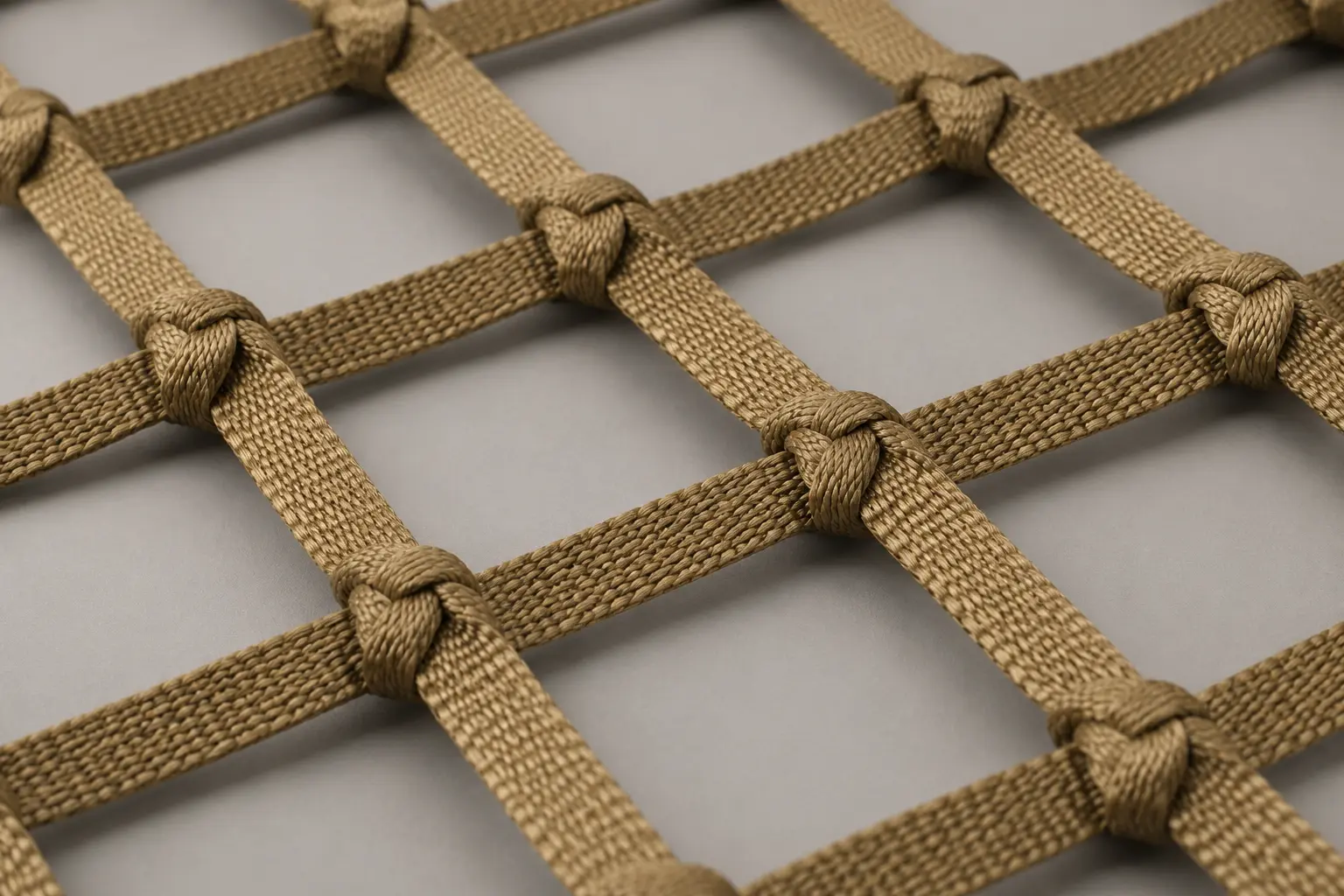
Capture and interception netting for counter-UAS systems places demands on narrow fabric that ordinary strap applications never see. A net panel has to deploy cleanly, entangle a moving airframe, absorb a shock load without snapping, and survive contact with spinning rotors and sharp composite edges — all while weighing as little as possible, because every gram sits inside a launch or deployment mass budget.
That combination is why para-aramid, rather than UHMWPE or polyester, dominates the load-bearing webbing in these systems. This guide is written for procurement and engineering teams specifying the fabric itself: the thermal and cut-resistance case for aramid, how elongation and knot efficiency govern the design, construction and width choices, coating and signature options, the test data to demand, and a seven-field specification checklist. For the properties of the fiber itself, start with the aramid webbing guide.
What the Webbing Actually Has to Survive
Four failure modes drive every material decision in this application, and only one of them is tensile strength:
- Cutting and abrasive contact. Airframe arms, propeller edges, and motor housings are sharp. A tape that abrades through at the first contact point defeats the net regardless of its rated strength.
- Frictional and electrical heat. A stalled motor or a damaged lithium cell generates intense local heat. A fiber that melts at the contact point loses the entire load path instantly.
- Shock loading. Capture is a dynamic event. Peak load can far exceed the static weight of the target, and a low-elongation material transmits that spike straight into the joints.
- Weathering in storage and carry. Nets live folded in canisters, mounted outdoors, or carried on vehicles — UV, moisture, and repeated packing cycles all take a toll.
Material Comparison: Why Aramid Over UHMWPE
UHMWPE wins on paper for strength per gram, which is why it is often the first material considered. It loses on the two properties that decide a capture event:
| Property | Para-Aramid | UHMWPE | Polyester | Nylon 6.6 |
|---|---|---|---|---|
| Typical tenacity | ~ 20-23 cN/dtex | ~ 30-35 cN/dtex | ~ 4-7 cN/dtex | ~ 6-9 cN/dtex |
| Heat behaviour | Decomposes ~ 500 C; does not melt | Softens / melts ~ 145-155 C | Melts ~ 255-260 C | Melts ~ 260 C |
| Cut / abrasion resistance | Very high | High (but low friction — knots slip) | Moderate | Good |
| Elongation at break | ~ 2-4% | ~ 3-4% | ~ 12-18% | ~ 18-25% |
| Knot strength retention | ~ 50-70% | Low — prone to slip | Moderate | Moderate |
| UV resistance (unprotected) | Poor — needs protection | Good | Good | Moderate |
| Density | 1.44 g/cm3 | 0.97 g/cm3 | 1.38 g/cm3 | 1.14 g/cm3 |
| Cost position | High | Premium | Low | Low-Mid |
The decisive row is heat. UHMWPE offers more strength per gram, but a fiber that softens near 150 C can lose a load path at exactly the moment a stalled motor or a punctured cell is dumping heat into the contact area. Aramid gives up some specific strength and carries a UV penalty in exchange for thermal survival and cut resistance. The full trade-off is covered in the Kevlar vs Dyneema comparison; where flame behaviour also matters, see the flame-retardant webbing guide.
Elongation and Energy Absorption: The Design Trap
Aramid's low elongation is a double-edged property. It gives dimensional stability — the net does not distort or bag out under preload — but it means the fabric itself absorbs very little energy. A capture event produces a load spike, and a strap that stretches only 3% transmits nearly all of that spike into the knots and hardware.
Systems therefore manage energy elsewhere, and the webbing specification should support that decision:
- Net geometry and load paths — longer spans and staged engagement spread the impulse over time.
- Sacrificial or elastic elements — some designs introduce a controlled-stretch component in series with the aramid load path.
- Joint design — because knots are the weak link, joint efficiency usually governs the whole assembly.
Never assume the datasheet breaking strength is the design value. Test the assembled joint, and specify knot or splice strength retention explicitly.
Construction Choices
| Choice | Options | Practical Effect |
|---|---|---|
| Flat vs tubular | Flat tape; tubular (see the flat vs tubular guide) | Tubular knots more predictably and resists edge curl; flat packs tighter into canisters |
| Weave | Plain, twill, basket | Tighter weaves snag less on airframe edges; looser weaves are softer and pack smaller |
| Width | 10-32 mm typical; 15 and 25 mm common | Narrower reduces weight and drag; wider spreads load and resists cutting — see the width selection guide |
| Coating | PU, silicone, or uncoated | Coatings add abrasion and UV protection and stabilise knots, at the cost of some weight and stiffness |
| Colour & signature | Natural gold, black, coyote, ranger green | Dark shades reduce visual signature; NIR reflectance must be specified and tested — see the IRR guide |
Aramid's colour range is narrower than polyester's, and a visual match does not guarantee a near-infrared match. If signature control is part of the requirement, define the reflectance band and test it rather than ordering by colour name.
Specification Checklist: 7 Fields
- Construction: fiber type (meta- vs para-aramid, or blend), flat or tubular, weave, and width with tolerance — tolerance expectations follow the same rules as the width guide.
- Minimum breaking strength in kN for the exact construction purchased, measured by a named method (strip tensile, e.g. ISO 13934-1 or ASTM D5035).
- Knot or joint strength retention as a percentage, with the knot type named — this is usually the governing value.
- Elongation at break and the working-load elongation, so the system model uses real numbers.
- Thermal requirement: exposure temperature and duration the tape must survive with a stated minimum residual strength.
- Environmental durability: UV ageing hours with a residual-strength target, plus moisture, salt fog, and packing-cycle expectations.
- Documentation: batch-level test reports, fiber traceability, and lot numbering — verify them using how to read a webbing test report.
Test Data to Demand Before Production
- Straight tensile and knot tensile on the same production lot, not on a lab sample.
- Abrasion and cut cycling to an agreed method and cycle count, with residual strength reported.
- Heat exposure test at your specified temperature and duration, with residual strength — this is the number that separates aramid from cheaper alternatives.
- UV ageing with residual strength, especially if the net is stored or carried exposed.
- Packing-cycle simulation, because repeated folding and deployment fatigues fabric in ways a single tensile test never reveals.
6 Sourcing Mistakes in This Application
- Specifying straight tensile only, then discovering the net fails at joints that retain 55% of that value.
- Choosing UHMWPE on strength-per-gram without checking the thermal load case at the contact point.
- Ignoring UV — unprotected aramid loses strength outdoors; specify protection and ageing data.
- Assuming a visual colour match delivers NIR signature control; reflectance must be measured.
- Freezing width and weave before prototyping; deployment behaviour changes noticeably between 15 mm and 25 mm.
- Skipping batch traceability, which makes any field failure impossible to investigate — see the mil-spec standards guide for documentation discipline.
Developing an Aramid Capture or Interception Net?
TMG Webbing weaves para-aramid and aramid-blend narrow fabric in 10-50 mm widths, flat and tubular, with coated and low-signature options. We supply development samples with straight and knot tensile data, heat-exposure and abrasion results, and batch-level traceability — and we work under NDA on defence programmes. Send your load case, thermal requirement, environmental targets, and annual volume for a construction proposal within 48 hours.
Request Aramid Net Webbing Quote Talk to an EngineerFrequently Asked Questions
Why is aramid used instead of UHMWPE for interception net webbing?
Because heat and cutting are the failure modes, not tensile strength. UHMWPE has higher specific strength but softens and melts around 145-155 C, and its low friction makes knots and joints slip. Para-aramid does not melt — it decomposes near 500 C — and offers far better cut and abrasion resistance against sharp composite and metal airframe edges.
What breaking strength should interception net webbing have?
It comes from your own load case, not a catalogue. Specify a minimum breaking strength in kN for the exact construction, plus a minimum knot or joint strength retention, because nets fail at connections far more often than mid-span. Typical narrow constructions in this application run from about 2 kN for light cord sizes to well over 20 kN for heavy-duty tapes.
How much elongation should capture net webbing have?
Para-aramid breaks at roughly 2-4% elongation: excellent dimensional stability, poor shock absorption on its own. Most systems manage impact energy through net geometry, longer load paths, sacrificial energy-absorbing elements, or controlled slip at the deployment hardware. Decide that trade-off during sampling, not after tooling.
Does aramid webbing lose strength in a knot?
Yes — aramid typically retains about 50-70% of its straight tensile strength in a standard knot, varying with knot type, stiffness, and weave. Since a net is essentially an array of knots and joints, joint efficiency is usually the governing design value. Always specify and test knot strength rather than relying on the straight-break figure.
How does UV exposure affect aramid webbing?
Aramid degrades under prolonged UV, showing surface fibrillation and progressive strength loss. For equipment stored or carried outdoors, specify a UV-stabilised construction, protective coating or sleeving, or a dark pigment, and require UV ageing data. Polyester and UHMWPE generally weather better than unprotected aramid.
What widths are used for interception net webbing?
Most net and cord elements fall between about 10 mm and 32 mm, with 15 mm and 25 mm the common production sizes. Narrower tape reduces weight and deployment drag; wider tape spreads load and resists cutting at contact points. Prototype two or three widths before freezing the specification.
Can aramid interception webbing be produced in low-visibility colours?
Yes, though the palette is narrower than for polyester. Aramid is commonly supplied in natural gold, black, or low-signature shades such as coyote and ranger green via dope-dyed or coated routes. Where near-infrared signature matters, specify and test reflectance rather than assuming a visual colour match achieves it.